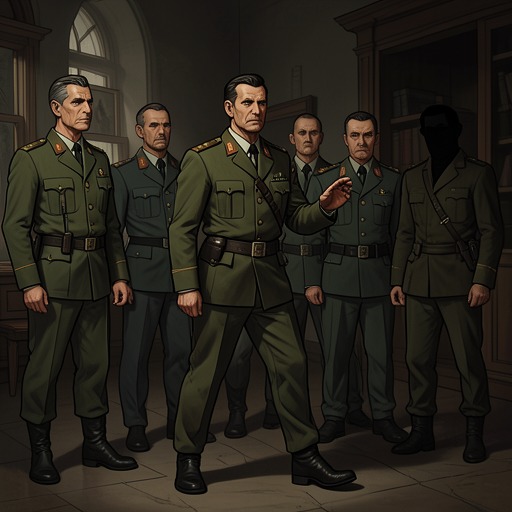
Joshua Marquis’s military uniform
The Pale Blue EyeJoshua Marquis’s military uniform is at once a family relic, an apparent clue in Augustus Landor’s investigation, and a costume through which Edgar Allan Poe assumes another identity. Its meaning changes as it passes from an indistinct shape in a dark closet to a recognized keepsake and, finally, a garment worn in public: an object whose material details invite suspicion even as its use makes appearances deceptive.
Appearance and Discovery
Landor finds the uniform while searching Artemus Marquis’s closet. In the cramped darkness, touch comes before sight: his hands trace a hanger, collar, shoulder, and wool garment before he drags it to the floor and raises his lantern. The delayed recognition makes the clothing briefly strange and ominous. What seemed an empty, airless space contains an officer’s uniform.
Its details make the object seem convincingly military. It consists of blue pantaloons with gold piping and a blue coatee decorated with gold flourishes. The blue has faded, and the shoulder straps are old-fashioned, but the garment otherwise appears almost new. Landor judges it to be genuine or a very good facsimile. That uncertainty matters: its appearance can suggest military authority without, by itself, establishing who owned or wore it.
One shoulder bears a faint rectangle where thread has been shorn away. Landor initially reads the mark as the place where a bar had once been sewn. As he examines the coatee, he also feels a small raised patch above the waist, faintly sticky and rough. He has no time to identify the substance: a footfall announces someone entering the room, and Landor extinguishes his lantern, remaining hidden in the steaming darkness. The cut threads and unexplained patch give the uniform the quality of material evidence, but neither detail is fully explained at the moment of discovery.
A Family Keepsake
When Landor later handles the garment in Artemus’s presence, Artemus recognizes it as belonging to his brother, Joshua Marquis. Joshua died of influenza shortly before the Battle of Maguaga, and the uniform is the only thing the family has left to remember him by. Artemus kneels to stroke the fabric and rubs his fingers together beneath his nose, treating the clothing not merely as military property but as a tactile remnant of his dead brother.
Artemus’s recognition establishes the uniform’s personal history while complicating Landor’s first reading of its shoulder. Landor points to the apparent place where a bar has gone missing; Artemus replies that there never was a bar, since Joshua rose no higher than second lieutenant. The exchange unsettles the visual clue: a mark Landor interprets as evidence of an altered rank is not confirmed as such by the person who knows the family keepsake. The object’s details are legible, but their meaning remains open to correction.
The Officer in the Investigation
Before learning the uniform’s family history, Landor connects it to the mysterious officer who ordered Private Cochrane to abandon Leroy Fry’s body. The association arises immediately when Landor discovers the garment in Artemus’s closet. The uniform therefore links a concealed object in a cadet’s quarters with the investigation’s unanswered question about the officer’s identity, though the garment alone does not prove who gave the order or wore it.
That distinction between what the uniform suggests and what it establishes is central to its role as a clue. Its cut and decoration can make someone appear to be an officer; its apparent alteration seems to promise a specific explanation; yet Artemus’s account revises Landor’s inference about the shoulder. The garment offers evidence, but its evidence requires interpretation, and an interpretation can change when another witness supplies the object’s history.
Poe’s Disguise
The uniform’s later appearance gives it a new function. As a boat reaches the dock, Landor sees a figure who can be identified only as an Army officer: the face is turned away, and the rank is unclear. A lantern finally illuminates him. Landor recognizes Edgar Allan Poe beneath the false clothes, airs, and facial adornments, wearing Joshua Marquis’s military uniform.
The narrative then revises the timing of Landor’s recognition. Poe removes his cloak and wraps it around Lea Marquis; only then does Landor understand whose uniform he is seeing. The garment has changed in one visible detail since Landor last saw it: it now bears a single yellow bar on the shoulder. Earlier, the shoulder’s faint rectangle had appeared to mark a removed bar, while Artemus had insisted Joshua never wore one. Now the added bar helps complete Poe’s officerly presentation. The uniform is not simply recovered and worn unchanged; its appearance has been adjusted for the identity Poe is performing.
Lea introduces Poe to Landor as Lieutenant le Rennet, Henri le Rennet, a supposed friend of the family. Landor scarcely attends to the name; his attention stays on the uniform and the ease with which it fits Poe. This fit makes the disguise persuasive to the eye even as Landor knows the wearer. The keepsake that had seemed to point backward toward Joshua and the mystery of Fry’s body now conceals Poe inside a borrowed military identity.
Meaning and Narrative Function
The uniform’s significance lies in its changing relation to recognition. In the closet, it is first encountered through touch, then exposed by lantern light; its officer’s cut triggers a connection to the unknown figure in the investigation. In Artemus’s hands, the same garment becomes an intimate family relic, and his account corrects Landor’s assumption about the shoulder. On Poe, it becomes a disguise whose details are deliberately made to support a false identity.
Across these appearances, the uniform does not offer a stable answer simply because it looks official. Its faded blue, old-fashioned straps, apparent trace of a missing bar, and later yellow bar record different readings and uses. The garment’s family history does not erase its investigative importance, and its use as costume does not erase its connection to Joshua. Instead, those meanings coexist: it is the Marquis family’s sole material remembrance of a brother, an object that directs suspicion toward a hidden officer, and the means by which Poe can arrive at the dock under another name.