Lea Marquis’s attempted suicide and Landor’s rescue
The Pale Blue EyeLea Marquis’s attempted suicide and Augustus Landor’s rescue turn a confrontation over justice into a literal struggle to keep two people alive. When Lea throws herself from an overlook, Landor catches her arm, but the fall leaves her hanging beneath a granite shelf above rocks hundreds of feet below. He holds on, finds exposed roots in the cliff face, and slowly hauls them both to the plateau. Lea survives, and the rescue changes Landor’s understanding of her without dispelling his awareness of how little he knows.
The confrontation
The crisis begins when Landor says he intends to see justice done. Lea asks whose justice he means. The question stops him: before he can answer, he sees a change in her face, her eyes simmering and her cheeks turning white. He tries to keep his voice light, deflecting her question by suggesting she take it up with Edgar Allan Poe, then says he has work to do and little time. Lea’s cry that he cannot do so breaks off the exchange, but not its pressure. She is beyond hearing him; she totters away as if driven by a private sense of failure.
Landor follows gingerly. His account makes clear that he recognizes, or thinks he recognizes, what her body is about to do, yet cannot make himself move quickly enough to prevent it. Lea’s limbs stiffen and fail, but she still manages to reach the overlook. She stands trembling at its edge, then flings herself over. The action is presented through a collision between intention and physical incapacity: Landor hesitates while Lea, despite her failing control, carries herself to the brink.
The fall and the precarious hold
Landor catches Lea’s arm as the rest of her disappears. The catch does not avert the fall. Her momentum carries both of them over the edge in a rush of rocks and wind, while he continues holding on. The ground suddenly reappears beneath them: they have dropped about eight feet onto a granite outcropping. Landor initially takes the ledge for safety, but that relief proves mistaken. Lea has swung clear of it and is suspended in midair; he is her sole lifeline, perched at the rim and holding her while hundreds of feet of open air separate them from the rocks below.
As Lea slips, Landor is dragged toward the edge with her. At last he locks a hand around her wrist, stopping their descent long enough to search the darkness by touch for anything that can bear their weight. His fingers close around a hard, dry, calloused root jutting from the rock face. The root bends and cracks under the strain. Landor repeats, “You can't. You can't.” When that root finally breaks, his hand is already reaching by intuition for another. This one holds; he gets onto the ledge, where Lea lies alive and still trembling.
The climb to safety
The immediate danger is not over. Lea is unconscious, and the pair remain about eight feet below level ground. A zigzagging line of exposed roots offers a route upward, but Landor must find a way to climb while carrying her without throwing her against the rocks. After trial and error, he turns his back to the cliff and locks his legs around Lea’s waist, making their bodies one unit that he can drag up the face.
The climb is slow and physically punishing. Landor braces against the roots to rest; the rock cuts his flesh, and Lea’s weight makes his legs wobble. It takes roughly fifteen minutes to climb only half the distance. He measures progress in inches, each small gain enabling the next, until they reach the plateau and collapse together. His rescue depends not on a single dramatic leap but on maintaining his hold and repeating that laborious upward movement despite pain and exhaustion.
Survival and recognition
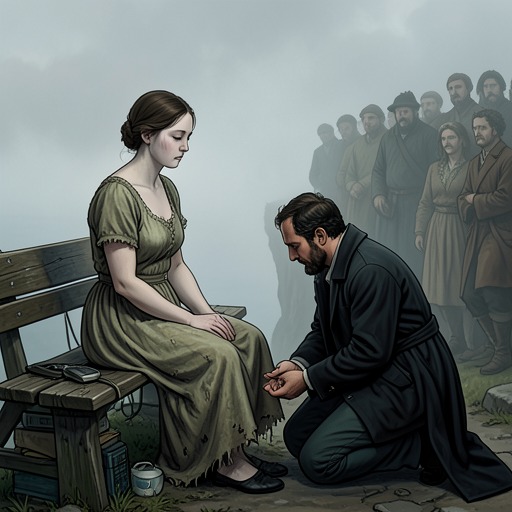
On the plateau, Landor pauses for breath, lifts Lea, and carries her to a stone bench. He stands over her, panting and aching, bleeding from the climb. Then he gathers her into his arms. As her twitching subsides and her arms unlock, her body slowly returns to her. The immediate crisis gives way, in Landor, to tenderness.
The rescue also produces a limited recognition rather than a claim of full understanding. Landor feels he has come to understand something of the sadness that clings to Lea even in her gayest moments. At the same time, he acknowledges how little he knows of her and how little he ever will know. When her pupils return to place and her eyelids begin to blink, she remains trembling against him; waking from unconsciousness is itself depicted as a difficult passage, not an instant return to safety. The event therefore ends with Lea alive but vulnerable, and with Landor’s act of rescue deepening his sympathy while leaving the mystery of her inner life unresolved.