Lea Marquis’s convulsive illness
The Pale Blue EyeLea Marquis’s convulsive illness is the condition Augustus Landor tentatively recognizes in the account Edgar Allan Poe gives of her collapse. The episode is described as a seizure followed by a gradual return of responsiveness; Landor’s recognition comes later, through memories of another family’s repeated appeals for a clergyman to cure their son. The illness is therefore presented not as a confirmed medical diagnosis but as a pattern interpreted through observation, memory, and the religious explanations available to those who witnessed it.
The Collapse and Its Aftermath
Poe finds Lea Marquis inert on the ground after searching for her, and remains beside her while the fit recedes. During the episode she cannot speak; afterward, he watches for signs that she is recovering and concludes that she is alive. Her condition is conveyed through involuntary movement, altered responsiveness, and the slow return of ordinary bodily signs. The account does not establish what caused the seizure or provide a medical diagnosis at the scene.
Poe’s description also separates the fit itself from the injuries he finds on her. Landor later treats the seizure’s bodily disturbances as organic, while regarding other marks on Lea as evidence of a separate human act. This distinction matters to the illness’s place in the narrative: her collapse is not presented as an explanation for everything that happened to her, and the possible disorder does not erase the violence surrounding the episode.
Landor’s Retrospective Recognition
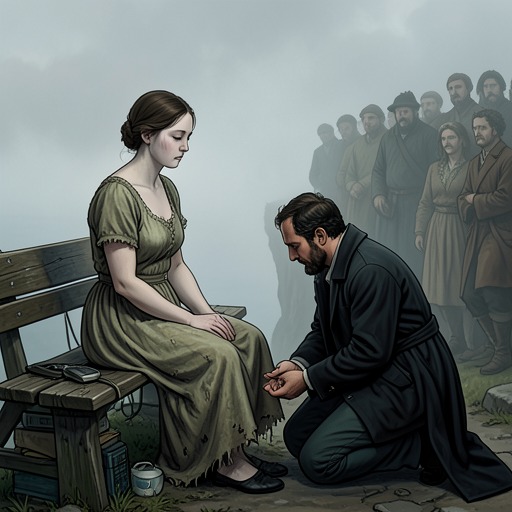
On November 17, Landor reflects that Poe would not necessarily have recognized the symptoms. He then recalls a boy from a farmhouse in the next glen whose family repeatedly brought him to Landor’s father during seizures. They sought a miracle from the Reverend Landor, invoking a biblical account of a boy afflicted by a similar condition. This recollection supplies the interpretive context that Poe’s immediate account lacked.
Landor remembers his father placing a hand on the child and commanding the spirits to leave. The apparent relief never lasted: the seizures returned the next day or the following week, and eventually the family stopped coming. The repeated failure of the intervention gives the memory a clear pattern—an episode, a hoped-for cure, a temporary appearance of change, and recurrence. Landor’s later inference about Lea arises from comparing Poe’s account with this remembered pattern, not from having examined her himself.
Naming and Uncertainty
The remembered boy’s father called the condition possession, but Landor recalls questioning what, exactly, possessed him. What he saw was absence, a person seeming temporarily withdrawn from himself. The recollection presents a religious interpretation alongside Landor’s own uncertainty, without claiming that the supernatural explanation was true. His father’s clerical role made him a sought-after healer in the community, even though the family’s repeated visits showed that his efforts did not prevent the seizures from returning.
Landor applies the term falling sickness to Lea only conditionally. He has Poe’s report to rely on, and he has not yet met her when he considers the possibility. His conclusion is thus an inference from another person’s account, strengthened by an analogous memory but not confirmed through direct observation or medical examination. The narrative preserves that limit: it makes the comparison intelligible without turning it into certainty.
Consequences for Lea’s Future
The possibility of a chronic disorder changes the meaning Landor assigns to Lea’s prospects. He imagines that, if his inference is right, her illness could leave her facing a future of sorrow and diminished hope, and he feels sympathy for her despite not yet having met her. This is Landor’s forecast, not a stated outcome or a prognosis supported by further evidence. The passage shows how quickly an uncertain diagnosis can become a judgment about a person’s whole life.
That judgment is colored by Poe’s poetic formulation about the death of a beautiful woman, which returns to Landor as he travels toward a funeral. Landor does not accept the formulation as his own view, but its recurrence links Lea’s possible illness to the book’s language of beauty, suffering, and anticipated loss. The illness remains a concrete bodily event in Poe’s account and an uncertain interpretation in Landor’s; the remembered failures of spiritual healing and the sorrowful future Landor imagines give that uncertainty its weight.