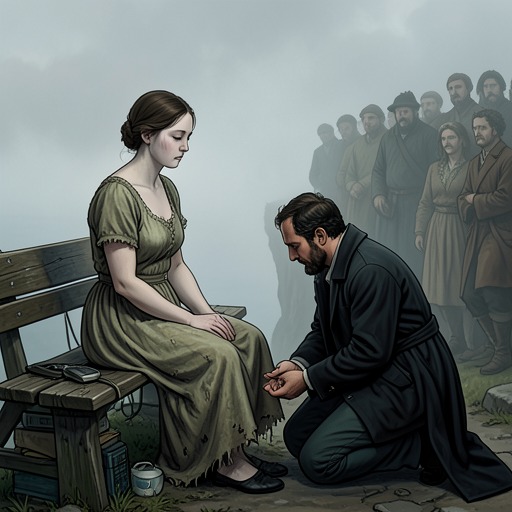
Lea Marquis’s epilepsy (“falling sickness”)
The Pale Blue EyeLea Marquis’s epilepsy (“falling sickness”) is a recurring bodily crisis and a source of secrecy for the Marquis family. Her spells worsen as she grows older, resist the treatments her father tries, and bring the family to fear for her life. They also become entangled with Lea’s belief that she is in contact with someone who can guide her toward a cure. The novel’s account holds together the physical severity of the seizures, the family’s social fear, and the unresolved question of how to understand that apparent communication.
Course and Physical Experience
Lea’s illness is described as beginning in childhood and becoming markedly worse when she turns twelve. Dr. Marquis remembers spells that could seize her without warning, interrupting her awareness and shaking her violently; at times the family despaired that she would survive. The account conveys the illness through its effects on Lea’s body and on those who witness it, rather than offering a clinical explanation of its cause.
During a later seizure at a cliff edge, Augustus Landor recognizes that Lea has passed into a full convulsion. Her body becomes rigid and bucks in rapid spasms, making it nearly impossible for him to hold her securely. One hand curls into a fist, her pupils turn upward, and foam gathers along her teeth. Landor knows that calling to her cannot bring her back during the episode. As he holds her above the rocks, he feels her slipping away by degrees. The scene makes the seizure an immediate physical danger as well as a crisis of helpless witnessing: Landor can maintain his grip, but cannot reach Lea’s awareness or stop the spell.
The recurrence of these episodes is central to how the family understands Lea’s future. Her father’s account does not describe a steadily worsening illness alone: after a period of particularly severe spells, Lea experiences an improvement, and the seizures subsequently occur less often and with less intensity. That change encourages hope, even though it does not establish what caused the improvement or whether it will last.
Treatment, Secrecy, and Family Life
Dr. Marquis tries the medical regimens he can devise, but none succeeds in stopping the seizures. He also turns to faith healers, whose efforts fail as well. The repeated disappointments make the illness a continuing family emergency, not a problem resolved by a single course of treatment. In the father’s account, fear gradually reorganizes the household: the family leaves New York City for the relative isolation of West Point, withdraws from friendships, and largely keeps to itself.
The illness affects each family member differently. Dr. Marquis abandons his ambitions; his wife becomes bitter and eccentric; and the children, left increasingly to their own company, form bonds he describes as unnaturally close. He presents the disease as something that has taken hold of the whole household, although Lea is the person whose body undergoes the spells. The family’s isolation thus follows both the practical strain of repeated crises and their apprehension about what others might think.
That apprehension keeps them from telling outsiders. When Landor asks why Dr. Marquis did not confide in the authorities, the doctor explains that the family feared being shunned. His confession links concealment to stigma: secrecy is not evidence that the seizures are slight, but a response to the family’s dread of public judgment. Even the father, who has sought both medical and religious help, has not found a way to speak openly about what is happening to his daughter.
The Promised Cure and Uncertain Contact
Landor proposes that during her spells Lea imagines herself in contact with someone who tells her things and gives her instructions. He directs Dr. Marquis’s attention to a painting and asks whether the figure is the one Lea encounters. The father’s response connects the perceived presence to Henri le Clerc, but the account does not settle whether Lea’s experiences are solely products of illness or whether the novel’s supernatural possibilities should remain in view. The distinction matters: Landor offers a medical-psychological interpretation, while the family’s history gives the supposed contact a powerful place in their understanding of the illness.
Dr. Marquis recalls that on an afternoon in July, Lea came to herself and began to speak. His account pauses at the threshold of her words, but later he explains that the being promised a cure if she did what he asked. Lea followed the instructions, and, according to her father, her spells became less frequent and less severe. The improvement is presented as real within his testimony, but its explanation remains uncertain: it follows the promised intervention, yet the novel provides no independent medical account establishing how or why the change occurred.
The hope of relief develops into a more absolute promise. Dr. Marquis says Lea wanted to be free of what she understood as both a curse and a gift, and to be whole and live as other women did. He also reports that she wanted to love. The language of cure therefore reaches beyond fewer seizures: it carries the promise of release from an identity and a future organized around illness. Yet her father says the being told her that a human heart was necessary for this final freedom. He insists that Lea herself wanted no part of the heart, while acknowledging that he and the children agreed not to discuss what they were doing with him. Her desire for a cure is consequently bound to an increasingly dangerous bargain, even as the precise nature of the bargain’s power remains open to interpretation.
Narrative Significance and Afterlife
Lea’s condition occupies two registers at once. In the seizure scenes, it is an embodied experience with observable, frightening consequences; in the family’s account, it is also the setting in which instructions and hopes of cure acquire authority. Neither register cancels the other. The father’s testimony shows why a promise of relief could become compelling after ordinary medicine and faith healing had failed, while Landor’s observations establish the limits of what a witness can do during an attack.
The novel also places Lea’s illness within a wider pattern of strained interpretation. Landor must decide what to make of her episodes while investigating a family that has concealed its central fear. Dr. Marquis’s account arrives through confession, after Landor has challenged him directly, and is shaped by the father’s love, shame, and willingness to believe that Lea improved. His testimony supplies important details, but it does not turn the illness into a fully explained medical case.
In Landor’s final reflection on time, the dead and the living seem to occupy the same imaginative space: Lea appears studying at the feet of Henri le Clerc. This image does not establish that her seizures continue after death. Instead, it returns her to the figure associated with the instructions she received and places her among the novel’s persistent presences. Her illness remains part of the story’s unresolved boundary between bodily suffering, belief, and the continuing claims of the dead.