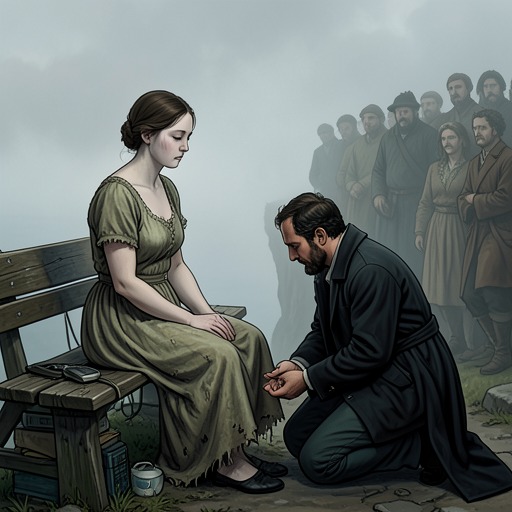
Lea Marquis’s seizure at the West Point cemetery
The Pale Blue EyeLea Marquis’s seizure at West Point Cemetery interrupts Edgar Allan Poe’s vigil for her with a sudden disappearance and a frightening collapse. In Poe’s account to Augustus Landor, anticipation gives way to fear, then to the discovery that Lea is alive but incapacitated. The episode makes her vulnerability immediate while keeping the cause of her terror unresolved: Poe can describe what he witnesses, but he cannot identify what she perceived or explain all that has happened to her.
Setting and the vigil
Poe places the encounter in a cemetery about half a mile from the United States Military Academy, on a high bank above the Hudson River. Trees and shrubbery partly conceal the small enclosure, while its shaded walk and views toward the Academy and surrounding highlands lend it a quiet, secluded character. For Poe, that setting is both a place of the dead and the scene of an intensely present concern: his thoughts are fixed on a woman who is still alive.
Lea’s expected arrival occupies Poe’s attention before she appears. He describes her imminent visit as having exhausted his powers of concentration, and he waits past the appointed hour rather than abandon the vigil. His watch marks thirty-two minutes after four when he hears silk moving and sees her pale yellow bonnet. The measured delay gives way to a private meeting in a setting where ordinary duties and the surrounding landscape recede behind his attention to Lea.
Terror and disappearance
After Lea arrives, her mood shifts. She eventually acknowledges that she has been behaving strangely, but Poe cannot determine what lies behind her distress. When he notices her shivering, he offers his cloak; she does not answer, and her fear intensifies. Poe’s narration emphasizes the limits of his knowledge: he reads terror in her expression and becomes afraid himself, but the threatening presence he imagines cannot be found.
Poe searches around the monument, inspecting the nearby stones and trees and circling the area. Finding no one, he turns back to discover that Lea has disappeared from the place where she had been standing. His concern for her overtakes thoughts of evening parade and military duty. He searches the shaded walk and nearby ground, calling out and even looking over the cemetery bluff, afraid that she may have fallen. The moment reverses the scene’s earlier arrangement: Poe had waited for Lea to arrive, but now he cannot find her and fears that he may be too late to help her.
Discovery and recovery
Poe finds Lea less than fifty yards from where he last saw her, lying on hard, rocky ground beyond a rhododendron bush. She is pale and unresponsive, with her eyes turned upward and her body trembling. These observations lead Poe to fear for her life, but he does not treat them as an explanation of what caused the episode. He remains beside her, waiting for the fit to pass and watching for signs that she is breathing and regaining awareness.
The change is gradual. After a period in which neither of them speaks, Poe notices her breathing and small movements that assure him she is alive. The relief does not erase the seriousness of what he has witnessed. Her appearance is disordered, and there are signs that she has also been physically harmed. Poe registers this distinction without establishing who or what was responsible; the account conveys both the seizure and a possible human threat, but does not resolve their relationship.
When Lea can speak, she apologizes for troubling Poe and asks him to walk her home, adding that her mother worries when she is away too long. The request brings the scene back to ordinary obligations and family life, but it does not make the encounter ordinary. Poe has seen her pass from agitation into apparent unconsciousness and then return to awareness, while the cause of her fear and the harm to her remain uncertain.
Narrative significance
The event is presented through Poe’s first-person recollection, shaped by his intense attachment to Lea. His account makes the cemetery’s stillness heighten the contrast between the expected meeting and the sudden emergency, while his escalating search shows how quickly concern becomes fear. Because the scene is confined to what Poe observes and feels, it offers no independent confirmation of the presence he suspects. His terror is real as an experience, but its object remains unknown.
The episode also belongs to a broader narrative in which bereavement and memory continue to shape the living. Elsewhere, Augustus Landor describes how the absence of Amelia and the loss of his daughter persist in the intimate space of his bed; later, he reflects on time as bringing the living and dead into continuing relation. Against that frame, the cemetery scene places Poe’s intense attention on Lea, not on the dead around them. The event’s decisive movement is from anxious waiting to a search for a living person in danger, and then to a fragile relief when she survives. It establishes Lea’s vulnerability and Poe’s devotion without supplying a complete account of either her illness or the source of her terror.