Leroy Fry's heart
The Pale Blue EyeLeroy Fry's heart is the missing organ at the center of the inquiry into Fry's death: its removal turns a reported hanging into a suspected desecration and gives Augustus Landor a concrete question to pursue. The heart is not present during the examination described here. Instead, it is known through its absence, through a proposed method of preservation, and through the bodily traces that make the apparent suicide uncertain.
Identity and Significance
Fry is first reported to have hanged himself. The account changes when Sylvanus Thayer states that Fry's heart was carved from his body, an act Ethan Allen Hitchcock struggles to describe as a uniquely terrible desecration. This discovery makes the heart more than a missing anatomical part: it is evidence that someone interfered with the corpse, and it raises the possibility that the death and the treatment of the body belong to a larger crime.
For Landor, that absence becomes the investigation's immediate question. Looking at Fry's body, he feels compelled to discover who took the heart, whatever danger the inquiry may bring. His response makes the object important not because its location or later use is established, but because its removal gives the investigation a specific, material problem to solve. The heart is absent from the body, yet it organizes attention around the body.
Removal and the Question of Preservation
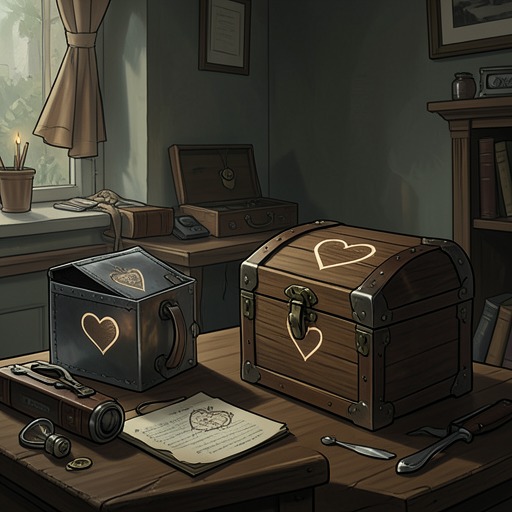
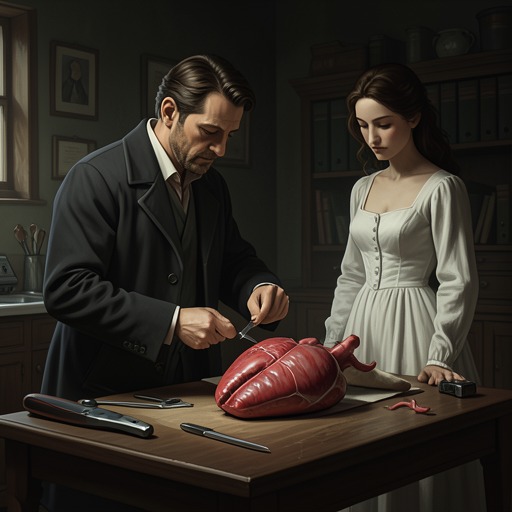
The body is said to have been found by the Icehouse after the heart was taken. Landor asks Dr. Daniel Marquis, West Point's surgeon, how a person would remove a heart from a body, then asks how someone might preserve one. Marquis suggests finding a container, explaining that it would not need to be very large. This is a practical possibility offered in response to Landor's question, not confirmation that the heart was preserved in such a container or that its eventual fate is known.
The sequence links the extraction to a second uncertainty: whether the missing organ was simply removed or prepared for some further purpose. The scene supplies no answer, and Landor's questions do not establish the taker's identity or motive. Their significance lies in turning an unsettling absence into lines of inquiry—how the heart was removed, how it might have been kept, and who could have carried out the act.
The Body as Evidence
Landor's examination of Fry's body gives the missing heart a forensic context. With his hand in the alcohol bath, he draws the submerged body toward the surface, supporting it with his other hand to keep it from sinking again. He points out that the rope mark on Fry's neck is not a clean, fixed cinch: the rope ran up and down the neck as if searching for a hold. He also directs attention to Fry's fingers. These observations make the body appear to have resisted the hanging, complicating the initial report of suicide without, by themselves, identifying who caused the death.
The examination reveals a contusion on the head, a lump rising roughly a quarter inch above the skull. Dr. Marquis explains that a bruise comes from blood escaping its vessels and is not likely to have been inflicted after death; without circulation, he reasons, a bruise could not form. This distinction matters because it gives the injury a relation to the body's living state: the mark points toward a blow received before death, rather than damage inflicted on an already dead body. The heart's removal does not itself explain the contusion, but the organ's absence sharpens the bodily puzzle, since the circulation that makes bruising possible has ceased by the time the body is examined.
Comparison and Narrative Role
Later, Landor asks a witness to compare Randolph Ballinger's body with Fry's. Ballinger had been found hanging higher, with his feet clear of the ground; his wounds were already on him when discovered, and the witness concludes that he was killed, cut open, and then strung up. The injuries could not plausibly have been inflicted after the hanging, since a body at that height would have been difficult to keep still. The witness therefore rejects the pretense of suicide in Ballinger's case.
That comparison clarifies the investigative function of Fry's heart without proving that the two deaths followed the same sequence. In both inquiries, the arrangement of the body and the timing of injuries matter more than the outward appearance of a hanging. Fry's shifting rope mark, fingers, and head contusion are details to be tested; Ballinger's wounds provide a contrasting case in which the order of killing, cutting, and hanging is stated more firmly. The heart remains the most dramatic sign that Fry's corpse was violated, but the evidence presented here leaves the central questions open: who removed it, why, and what became of it.