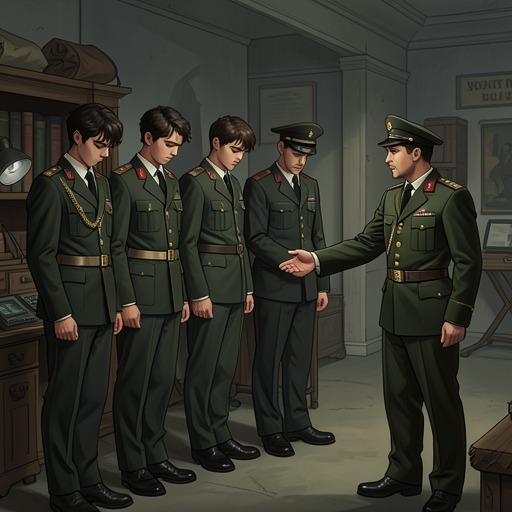
Leroy Fry’s diary
The Pale Blue EyeLeroy Fry’s diary is at once a private record, a physical puzzle, and a contested piece of evidence in the investigation of Fry’s death. Its crosshatched writing resists casual reading, but Augustus Landor recognizes how to decipher it. The diary eventually gives Landor information connecting Fry with Randolph Ballinger and Julius Stoddard; at the same time, Landor’s selective transcription shows that access to a document does not guarantee an impartial account of what it contains.
A Private Record Passed to Landor
The diary reaches Landor through Fry’s mother. At their meeting, she presses a small, clothbound volume with gilt edges into his hand and identifies it as her son’s diary. She explains that one of Fry’s friends went to his quarters after learning what had happened, found the book, and brought it to her, believing that it belonged in the hands of Fry’s mother rather than being examined by others. She had considered what to do with it, but says that, as Landor is investigating and the Army is depending on him, he should have it instead. Her inability to make sense of its writing is part of the transfer: the diary becomes available to the investigation because its owner’s mother cannot read its particular system and entrusts it to someone she believes can.
That handoff gives the book a layered custody. Fry made the entries; an unnamed friend recovered the volume from Fry’s quarters and returned it to his mother; and she passed it to Landor. Each step changes who can interpret and use the record. The mother’s decision also carries an ethical expectation: the diary had first been treated as a private possession, and its passage to Landor is justified by the demands of the investigation rather than by any claim that it was intended for public reading.
The Crosshatched Writing
Fry has taken the precaution of crosshatching his entries, drawing vertical columns across horizontal ones to frustrate prying eyes. The result is a jumble of letters that can challenge even its author to transcribe. The diary is therefore not simply a container of written facts. Its arrangement controls access to those facts: a reader needs a trained eye to sort the marks into legible patterns. Landor recognizes the method, and his attention moves from the page’s apparent disorder to the work of deciphering it.
The contrast between the diary’s outward confusion and its recoverable contents matters to the investigation. To Fry’s mother, the writing is difficult to make out; to Landor, it quickly becomes legible enough to begin sorting. The same object thus presents different degrees of access depending on the reader. Its concealment is deliberate, but not absolute. Once Landor has worked out the system, the private writing can be copied, studied, and selectively circulated beyond the person who made it.
What the Pages Reveal—and Do Not Reveal
Landor works through the pages at length, including late at night after returning to the notebook by candlelight. His attention to its patterns continues for more than an hour and a half before Patsy finds him at work. His brief description of what the book contains reduces it to words, but the diary’s contents are more particular: it records Fry’s everyday complaints, habits, and preoccupations. Landor later characterizes the pages as largely repetitions of distress, trivial observations, and private concerns, rather than an obvious account of the crime.
That ordinary material initially frustrates expectations of a decisive confession or a ready-made explanation. Captain Hitchcock repeatedly presses Landor for names, suspicious cadets, or a new line of inquiry. When Hitchcock asks whether a week with the diary has yielded a useful clue, Landor answers with examples of personal information from its pages and Fry’s dislikes, including his objections to reveille roll call and analytical geometry. The response emphasizes the disparity between the commandant’s hope for a key to the case and the unremarkable texture of most of the record.
Yet the diary is not useless simply because much of it is mundane. Its evidentiary value lies in details that become meaningful when read against the investigation. Landor later tells Hitchcock that a forthcoming transcription contains the fact that, two summers earlier, Julius Stoddard and Randolph Ballinger had both been close friends of Fry. That connection changes the investigative picture: Stoddard’s link to Ballinger is established through his earlier association with Fry, even though Landor says that Stoddard’s connection to Artemus Marquis remains unclear. The diary supplies a relationship, not a complete explanation.
Transcription, Selection, and Disclosure
Landor responds to Hitchcock’s demands by bringing him transcribed pages each morning. Hitchcock reads each installment as though it might contain the key to everything, while Landor knows that the pages largely present the same mixture of complaint and personal detail. The daily copies make the diary part of the investigation’s official flow of information, but the later disclosure of omissions changes how those copies should be understood.
In his final conversation with Edgar Allan Poe, Landor confirms that he learned of Ballinger’s involvement from Fry’s diary. Poe then asks whether the pages Landor had been supplying to Hitchcock were genuine. Landor says that they were, but that a few items were missing. Among the omitted material were the names of Ballinger and Stoddard. The distinction is crucial: Landor did not need to fabricate the diary’s contents in order to shape what the commandant knew. By withholding particular names from otherwise authentic transcriptions, he controlled which connections became visible and when.
The diary consequently supports two different readings of Landor’s investigative practice. It is a source from which he extracts real information, including Fry’s former friendships with Ballinger and Stoddard. It is also a record whose circulation he manages, giving Hitchcock pages while keeping significant names out of the copies. The book’s opacity begins with Fry’s crosshatching, but later opacity comes from the investigator’s selection. The difference between what the diary contains and what its readers receive becomes part of the case itself.
A Record Among Other Texts
Landor’s response to the diary belongs to a wider pattern of documents and competing interpretations. He thinks of it alongside poems and prose by Edgar Allan Poe, Professor Pawpaw’s and Sergeant Locke’s notebooks, a scrap found in Fry’s fist, and newspapers. In that reflection, written records do not automatically converge on a single reliable meaning; they can obscure or cancel one another. The diary’s significance therefore exceeds the clues in any one entry. It exemplifies both the promise of written evidence and the uncertainty involved in interpreting, transcribing, and distributing it.
The book’s final importance is inseparable from the difference between the private object and its public afterlife. Fry’s guarded writing reaches his mother, then Landor, then Hitchcock in selected copies, and finally becomes a point of scrutiny in Poe’s confrontation with Landor. It preserves traces of Fry’s daily life and an investigative link among three cadets, but it cannot speak independently of the people who read and relay it. Its evidence is real; its meaning depends on access, attention, and the choices made in transmission.