Mathilde (Mattie) Landor’s assault and suicide
The Pale Blue EyeMathilde (Mattie) Landor’s assault and suicide form the defining rupture in Augustus Landor’s family history: an evening that leaves Mathilde injured and silent is followed, after a period of watchful withdrawal, by her death in the river. The account connects the two events through what remains unsaid. Mathilde does not explain what happened at the ball, and Augustus later gives his neighbors a false account of her death. A chain she kept from one of the men, however, survives as a material trace of that night.
Background and the Ball
After a long career in the city, Augustus had become a hermit, and Mathilde, his daughter, began to long quietly for company. A wealthy cousin of Mathilde’s late mother, whose home was in nearby Haverstraw, took an interest in her and introduced her to carriage rides and dinner parties, despite Augustus’s objections. The cousin had no daughter of her own and regarded Mathilde as a promising young woman she could guide and present socially.
The first ball brought Mathilde into a world she had not previously sought out. She cheerfully submitted to dress fittings, lessons in deportment, and instruction from French dancing masters. When Augustus reacted grimly to her new clothes, she made light of his concern and reassured him that he remained the only man for her. He watched her leave in a landau for her cousin’s house, imagining both her enjoyment of the evening and his own later chance to question her about it. Those expectations gave way to alarm as the hours passed without her return.
The Assault and Her Return
After midnight, Augustus took a lantern and searched the nearby roads. He was preparing to ride to Haverstraw when Mathilde appeared, limping home in her slippers. Her formal clothes were torn and disordered, and she had visible injuries. The account establishes that she had been assaulted but does not supply her own description of what the men did. Mathilde refused to let her father wash her or to tell him what had happened; for several days, she stopped speaking altogether.
Seeking an explanation, Augustus went to the cousin he had already sworn off. She told him that three young men had appeared at the ball without anyone recalling inviting or knowing them. They were personable and well-mannered, although their clothes seemed ill-fitting. The guests noticed their pronounced interest in the women present. Mathilde, unused to such attention, initially received it gratefully; when she recognized its direction, she withdrew into silence. The men continued to follow her through the rooms and followed her when she stepped outside for air. Neither they nor Mathilde returned to the gathering. Rather than show herself to her hostess in her torn and injured state, Mathilde took the long road home.
Silence and the Picnic
Mathilde’s bodily wounds healed, but the account describes no return to her former ease. Her silence deepened into a watchful quiet, as if she were waiting for wheels on the road. The narrative does not explain what she expected or whether the men would come back. Her refusal to speak leaves Augustus with the cousin’s account and the visible evidence of her return, but not with Mathilde’s testimony.
Later, Mathilde proposed a picnic, which Augustus welcomed as a chance to draw her out of her reveries. They ate on a bluff overlooking the river. After putting the plates and silverware back in the basket, Mathilde pulled her father to his feet and embraced him. Augustus was too surprised to embrace her in return. She walked to the edge, looked in several directions, and told him that everything would be all right and would work out. She then leapt from the bluff, her eyes still fixed on him rather than on where she was going.
Death and Concealment
The river swept Mathilde’s body away. Afterward, Augustus told the neighbors that she had run off with another man. The story was a deliberate lie that hid her suicide, though the account also gives the language of running away a painful second meaning: Mathilde had thrown herself into the river while looking at her father, and Augustus later understood her as having gone with the knowledge that he would be waiting. That interpretation belongs to his account; Mathilde left no explanation of her final act.
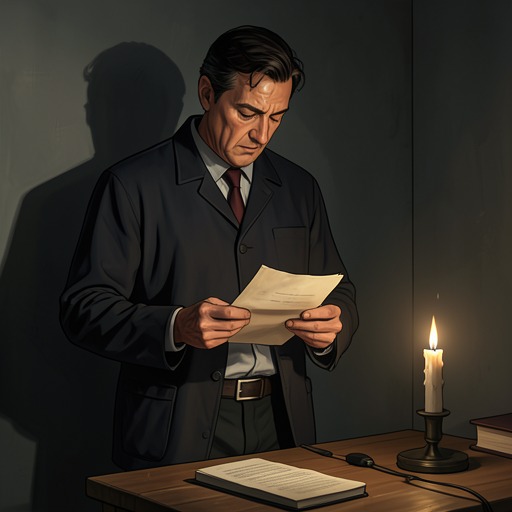
Her death freed Augustus to pursue an idea that had been forming in his mind. A morning after the loss, he opened a volume of Byron’s poetry because Mathilde had once loved it and found a chain inside. She had taken it from one of the men who assaulted her and kept it from her father’s view. The chain links the ball to the later search for an explanation: Mathilde’s silence had withheld her account, but she had preserved an object associated with the men. The episode therefore leaves both a concealed death and an unresolved trace, while showing how grief and secrecy shape what Augustus does next.
Narrative Significance
The episode is presented as an embedded account by Augustus Landor, who recounts his daughter’s past to Edgar Allan Poe. Its movement from the crowded ball to Mathilde’s silence, then to the isolated bluff, makes the failure of testimony central to the event. The cousin can report the strangers’ conduct, Augustus can describe Mathilde’s return and death, and the chain can establish a connection to one of the men; none of these replaces Mathilde’s own account.
The final scene also reverses the father’s earlier position. At the ball, Augustus had imagined questioning Mathilde and dismissing the evening as foolishness; after her return, he could not make her speak. At the picnic, her embrace and assurance that things would work out precede an act he cannot prevent. The account does not resolve the meaning of those words. Their contrast with the river’s carrying away of her body leaves Augustus with a lasting uncertainty, a public falsehood, and the chain that may help him act.