Mrs. Marquis–Lea Marquis relationship
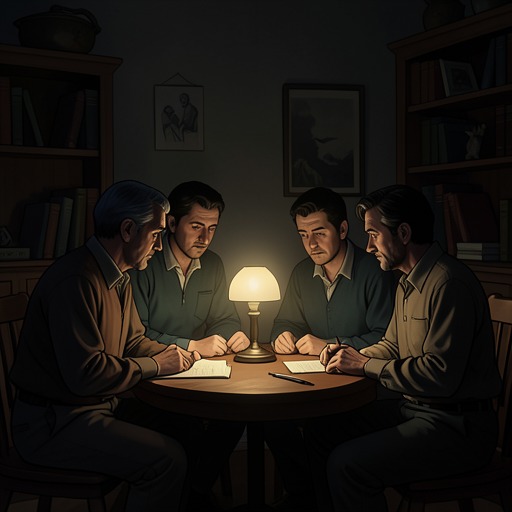
The Pale Blue EyeMrs. Marquis’s bond with Lea Marquis is formed under the pressure of Lea’s recurring illness and the family’s increasingly desperate search for relief. As the illness draws the family away from ordinary social life, mother and daughter become part of a closed household whose hopes for Lea’s future and whose secret practices are bound together. After Lea’s death, Mrs. Marquis’s grief breaks through that guarded family world: she first reacts with anger at what has been lost, then tends to her daughter with tenderness. Her relationship with Lea thus carries both the family’s effort to preserve her and the sorrow of discovering that those efforts could not save her.
A family shaped by illness
Dr. Marquis recounts that Lea’s illness began in childhood and grew more severe as she approached adolescence. His attempts to treat it, including medical regimens and the help of faith healers, brought no lasting relief. The illness gradually became the central fact of family life, altering the prospects and behavior of every member of the household.
The family left the comforts of New York for the isolation of West Point, gave up much of its contact with others, and kept largely to itself. Dr. Marquis abandoned his ambitions, while Mrs. Marquis became bitter and eccentric. Their children, left largely to one another, formed unusually close bonds. These circumstances do not define Mrs. Marquis only as a caretaker, but they show how Lea’s condition narrowed the family’s world and made each relationship part of a shared response to an illness that no one had managed to control.
Shared involvement in the search for a cure
The family’s isolation also created the conditions for its secret instruction and practices. Augustus Landor infers that Lea had been taught by Henri le Clerc, whom the family regarded not as an evil figure but as a healer; Lea then passed that instruction to Artemus Marquis, and Mrs. Marquis became a student as well. Landor’s conclusion is a deduction from what he has observed, rather than a written record of her lessons, but Dr. Marquis’s response confirms that he has identified her involvement.
The instruction centered on sacrifice. Landor understands the family’s practices as having begun with animal sacrifice and then advanced beyond it. In his account of the family’s reasoning, the rites were connected to Lea’s hope of pleasing her ancestral guide and curing her illness. The evidence places Mrs. Marquis within this shared undertaking, but does not establish that she devised it or specify the extent of her individual actions. Her participation instead shows how the family’s desire to help Lea became entangled with a dangerous system of belief.
The choice between her children
When Landor demands to know which of her children he is to save, Mrs. Marquis’s first response is to look from Lea to Artemus and back again. The moment registers the impossible pressure of the question: she appears to weigh the two children, then recoils from the act of weighing them at all. Her hesitation reveals a divided family crisis, not a settled preference for one child over the other.
Landor frames the choice in terms of a possible case against Lea that might leave Artemus with a lesser punishment and allow him to remain at the Academy. Mrs. Marquis does not plainly endorse this alternative. Instead, she struggles to speak while Landor lays out the accusation that Lea’s need for human hearts came from her wish to please her beloved ancestor and cure her condition. The scene draws the mother into the consequences of the family’s secrecy: she must confront the possibility that the attempt to protect one child has placed both children in danger.
Grief after Lea’s death
After Lea dies, Mrs. Marquis initially appears more composed than the others gathered there. She speaks of the future Lea was expected to have: a wife and a mother. The word mother then turns her composure into an open expression of grief. Her response makes the lost future intensely personal, linking her daughter’s death to the life Mrs. Marquis herself had known and to the role she had expected Lea to inherit.
Her grief does not follow a single, orderly course. She first reacts in anger toward what has happened, and Artemus has to hold her back. She then turns toward Lea’s body, moves her daughter’s hair from her face, wipes her throat, kisses her hand, and sinks into tears. The movement from anger to care does not resolve her sorrow; it shows care persisting within it. Artemus’s effort to restrain and comfort his mother also makes the family bond visible in the immediate aftermath of Lea’s death.
The meaning of the bond
Mrs. Marquis’s relationship with Lea is presented through a contrast between protective hope and the consequences of the family’s attempted cure. The illness reorganizes the household around the wish that Lea might recover, while the practices adopted in that hope draw the family into further danger. The text gives Mrs. Marquis a part in that shared history without reducing her to either a detached accomplice or an uncomplicated rescuer.
Her final response to Lea brings the relationship back to its most direct form: a mother mourning her daughter. The expectation that Lea would become a wife and mother, the moment of indecision when both children are at risk, and the return to small gestures of care after Lea’s death reveal different pressures on the same bond. The family’s secret undertaking cannot secure the future it seeks; Mrs. Marquis’s grief instead makes plain what remains when that hope fails.