Necessary business
The Pale Blue EyeNecessary business is both a conventional excuse and a small, charged clue in the account of Leroy Fry’s late-night departure from West Point. Its ordinary meaning explains why the words would pass without challenge; Julius Stoddard’s memory of Fry’s emphasis makes that familiar formula newly significant. Later, Edgar Allan Poe places the phrase within a reconstructed invitation and reads it as a sign that Fry expected to meet a woman, though the words themselves do not establish who sent the invitation.
A customary excuse
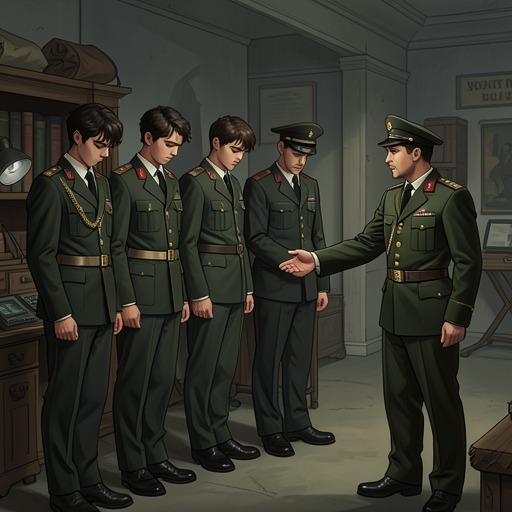
The phrase belongs to a specific routine of cadet life. Cadets who needed to relieve themselves at night but did not want to use a chamber pot went to the outdoor privies. If an officer encountered one on the way, the cadet could say, "Necessary business, sir," and be allowed to pass, with the expectation that he would return soon. In that setting, the phrase names a mundane need while also functioning as a recognized answer to an officer’s question: it gives enough explanation for passage without inviting further inquiry.
That routine makes the words useful precisely because they are unremarkable. They do not, by themselves, identify a destination, a companion, or a larger purpose. The excuse could conceal an ordinary trip to the privies, and its accepted use depends on that ordinary interpretation. The expression therefore carries two possibilities at once: an authorized-sounding explanation and, when circumstances invite suspicion, a cover under which a cadet can leave without disclosing where he is really going.
Stoddard’s recollection
When asked whether he had seen anything else on Fry’s person, Stoddard initially says that the darkness prevented him from seeing much. In particular, he had not seen a rope. Then he stops and recalls something different: as Fry was leaving, Stoddard called after him, "Where are you off to at such an hour?" Fry answered, "Necessary business." Stoddard explains that the words were a joke in the cadets’ familiar sense, but what stayed with him was the weight Fry placed on the first word.
The distinction is important. Stoddard does not report that Fry named a specific errand, nor does he claim to have understood the answer at the time. He remembers an emphasis, not a disclosure. The darkness limits the physical evidence he can offer, while the phrase supplies a verbal detail whose significance remains uncertain. His recollection thus shifts attention from what might have been carried to how Fry spoke: a common formula becomes memorable because its delivery seemed unusual.
From routine to clue
The investigation returns to the expression when the conversation turns to a secluded cove near North Landing, known to cadets who had smuggled beer or whiskey. Poe’s companion proposes that Fry received an invitation to meet there at eleven at night and was obliged to accept. In this reconstruction, Fry accepts with a light heart, perhaps even glad to go, and says, "Necessary business," while winking in the dark. The phrase now appears not simply as the answer to Stoddard’s question, but as language associated with a planned meeting.
That change in context does not erase the phrase’s ordinary use. Rather, the interpretation depends on holding the routine explanation beside the suspected one. At West Point, the words could account for a nighttime absence without exposing its purpose; in the cove scenario, the same familiar excuse accompanies an appointment. The expression becomes suggestive because it is plausible on the surface and incomplete underneath. Stoddard’s remembered emphasis helps the investigators revisit a moment that had first seemed to offer no more than a standard answer.
Poe’s inference and the phrase’s limits
Asked what the invitation suggests, Poe responds that it suggests a woman. His conclusion gives the phrase a new direction within the inquiry: Fry’s willingness to go, the secluded meeting place, the late hour, and the remembered wink are read together as signs of a personal appointment. The expression is not itself a name or confession, and Poe’s inference remains an interpretation of the circumstances rather than something directly stated by Fry.
The phrase’s narrative force lies in this gap between what it conventionally says and what the investigators come to suspect it means. As an accepted excuse, it explains how Fry could leave; as a recollected utterance, its emphatic first word draws Stoddard’s attention; as part of Poe’s reconstruction, it helps make a clandestine meeting imaginable. Its repetition preserves the unresolved quality of the clue: the words remain commonplace, but their setting and delivery prevent them from being dismissed as merely routine.