North Barracks
The Pale Blue EyeNorth Barracks is both a cadet residence and a stage for two sharply contrasting episodes: the illicit sociability through which Edgar Allan Poe enters Artemus Marquis’s circle, and the later search of Marquis’s quarters with Augustus Landor. Its cramped darkness, concealed stores, and sudden sounds make the building feel less like a neutral backdrop than a space where fellowship and suspicion share the same rooms.
Setting and Material Conditions
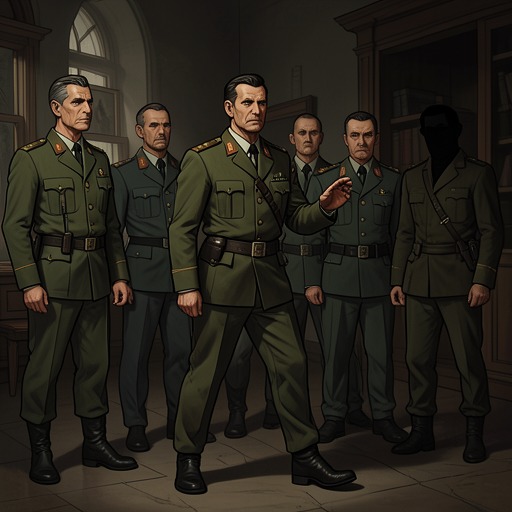
The upperclassmen’s rooms in North Barracks measure twenty-five by nineteen feet, a modest concession to their seniority. Marquis’s quarters are warmer than Poe’s but hardly comfortable: the pallets are patched, the coverlets heavily used, the air sneezy, and soot streaks and bulges mark the walls. Facing west, the room receives only whatever light clears the mountains; even at midmorning, its corners are dark enough that Landor and Captain Hitchcock use matches to inspect them. The room’s material disorder is specific rather than theatrical: scattered snuff lies on the windowsill, while a compacted telescope is tucked between a water bucket and a chamber pot.
The After-Hours Gathering
Shortly after tattoo, Edgar Allan Poe slips away from the quarters he shares with two cadets and reaches a room in North Barracks several minutes before the appointed hour. Blankets cover the windows. Food gathered from several sources—bread and butter from the mess hall, potatoes from the officers’ mess, a chicken taken from a barnyard, and red apples from an orchard—marks the meeting as planned but illicit. Poe is a plebe among upperclassmen and attracts their curiosity, while Randolph Ballinger singles him out with repeated jibes. Poe connects Ballinger’s hostility to his position as Marquis’s roommate and self-appointed guardian of Marquis’s circle; mindful of his responsibilities to Landor and the Academy, he decides not to answer the insults.
The gathering’s conviviality is uneasy. After discussion that includes Leroy Fry, Marquis and Ballinger lapse into laughter Poe describes as hysterical rather than merry; no one dares reopen the subject of Fry, and the company retreats to safer banalities. Shortly before one o’clock, only four remain. Marquis insists on escorting Poe out, warning that Lieutenant Case’s rounds in caoutchouc overshoes have recently led to cadets being caught and gatherings broken up. Poe refuses the escort, but Marquis ends the evening by clasping his hand and inviting him to tea at his father’s house the following Sunday. The room thus serves as Poe’s entry into Marquis’s social circle while also revealing Ballinger’s resistance to that inclusion.
Search, Darkness, and Suspense
When Landor and Captain Hitchcock later search Marquis’s quarters, the room’s dimness turns inspection into a physical effort. Hitchcock begins with the woodbox, where the search yields wood, an old lottery ticket from Cuming’s Truly Lucky Offices, a scrap of book-muslin handkerchief, and a half-empty packet of Brazil sugar. The room otherwise offers no obvious remains of the earlier revels: no cards, chickens, or pipes, and no lingering tobacco aroma beyond the grains of snuff on the sill. The contrast between the remembered feast and the bare evidence of it makes the space difficult to read as straightforward proof.
The search changes abruptly when a click sounds like a latch being slid into place, followed by a fainter sound behind it. Landor concludes that he and Hitchcock may have been expected. At that moment, sunlight begins to strike the blue rocky slopes to the west and then floods the chamber with hard yellow light; Landor’s understanding of the situation arrives with the light rather than through the objects uncovered in the woodbox. North Barracks therefore recurs as a place where concealment is both practical and atmospheric: blankets shut out witnesses during a forbidden gathering, while the gloom of a later search delays recognition until the room itself seems to disclose that the investigators are not alone in controlling events.