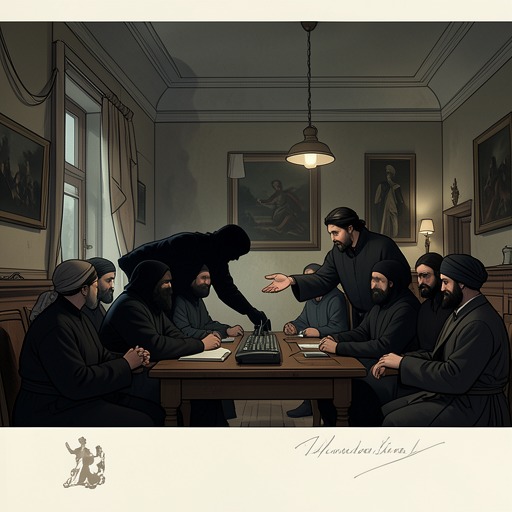
Poe identifies Artemus Marquis as a suspect
The Pale Blue EyePoe identifies Artemus Marquis as a suspect through a calculated approach to West Point’s Prayer Squad: by pretending to seek religious guidance, he leads its members to name the cadet they associate with dark practices. The disclosure turns a general search for a secret Satanist enclave into an inquiry focused on a particular person, while leaving the central allegation unverified. The event’s importance lies as much in how the name emerges as in the name itself: Poe exploits the squad’s zeal, curiosity, and own reluctance to break its code of discretion.
Background and Investigative Rationale
On the ride back to West Point, Augustus Landor and Poe remain silent until Poe speaks as he is dismounting about a quarter mile short of the guard post. Poe proposes that, if they want to locate a secret enclave of Satanists, they should turn to people most likely to notice such a group: its religious opposite. Landor identifies Christians, and Poe specifies the Prayer Squad rather than Reverend Zantzinger. The suggestion redirects their investigation from looking directly for suspected occult activity to asking a devout group what it fears or has heard.
The choice has a concrete connection to the case. Leroy Fry had briefly belonged to the Prayer Squad, a voluntary association of cadets dissatisfied with the Episcopal character of the West Point chapel and seeking a more direct path to God. Poe had previously held the group in contempt; now he argues that its members might be put to investigative use. The change is practical rather than a conversion of belief: the squad’s religious convictions, which had made it an object of Poe’s scorn, make it a useful source of information about the alleged enclave.
Poe’s Approach to the Squad
Poe acts on Friday afternoon, after evening parade and before mess. He approaches Llewellyn Lee, a third classman and one of the squad’s leaders, asking to join the group at its next convocation rather than wait until Sunday chapel. Lee gathers several squad-mates for an impromptu discussion by the gun trestles. The setting and timing let Poe seek access through the group’s own members before a formal meeting, while his request presents him as someone in need of their counsel.
To secure their interest, Poe performs a version of himself quite unlike the religious skeptic he admits he is. He says he has recently encountered a fellow cadet who made dark, un-Christian overtures, challenged the grounds of his faith, and urged him toward mysterious practices of ancient origin. The story is a ruse, not an account of an actual conversion or encounter. Poe reports that he adopts a docile, deferential manner, inviting the cadets to respond as spiritual advisers while withholding the supposed offender’s identity.
The Name Emerges
The squad members demand to know which cadet Poe means. He refuses, claiming that because the confidences were made privately, he is honor-bound to protect the name. When they press him again, he invokes the codes of an officer and a gentleman and says they could not force him to disclose it even under threat of divine punishment. The refusal is part of the bait: it makes the identity an object of curiosity while allowing Poe to appear steadfastly discreet.
The pressure eventually produces the answer Poe wants. One squad member, goaded beyond endurance, asks whether the cadet is Marquis. The others immediately silence the person who has spoken, pummeled him into silence; the group therefore yields a name but does not willingly elaborate. Poe later presents this as the result of his ruse and the squad members’ credulity. His account makes clear that they do not provide a confession or evidence of a particular act. Their spontaneous identification is the lead.
What the Identification Establishes
When Landor asks whether the name means Dr. Marquis, Poe corrects him: he means Artemus Marquis, Dr. Marquis’s only son and a first classman. Poe adds that Artemus is reputed to dabble in black magic. That reputation explains why the cadets connect the name with Poe’s invented story, but it remains a report about Artemus, not proof that he practices magic or belongs to a Satanist enclave. The distinction matters: the investigation has narrowed, not solved, its question.
The episode also marks a shift in the inquiry’s method. Rather than confronting a suspected cadet directly, Poe draws information out of a group by staging a problem that touches its members’ deepest concerns and then refusing to satisfy their curiosity. Landor recognizes the tactic’s effectiveness, but the result is deliberately limited: the squad yields Artemus’s name, while its abrupt silencing of the speaker underscores how little more the investigators have secured. Suspicion now has a face, but verification remains ahead.