Poem beginning “'Mid the groves of Circassian splendor”
The Pale Blue EyeThe Poem beginning “'Mid the groves of Circassian splendor” is an unfinished poem by Edgar Allan Poe that becomes a possible clue in Augustus Landor’s investigation of Leroy Fry’s death. Poe links its mysterious woman and concealed violence to the case, and attributes its first lines to his dead mother; Landor hears the account but does not accept that the poem proves a supernatural connection. The poem’s force lies in that unresolved passage between an image on paper, a report of an uncanny experience, and the investigator’s demand for evidence.
Text and presentation
The poem appears in two textual forms in the book. Its opening version begins, “'Mid the groves of Circassian splendor,” and offers two alternatives for the brook: one “darkly dappled with sky,” the other “moonshattered” and “raked with sky.” The later version Poe shows Landor preserves that variation as “In a brook darkly dappled with sky,” followed by “In a moon-shattered brook raked with sky.” Rather than settling on a single description, the poem’s wording keeps both images in view: the brook reflects the sky, but the reflection is darkened, broken, or disturbed. The doubled lines make uncertainty part of the text’s form, not merely a question raised by its interpretation.
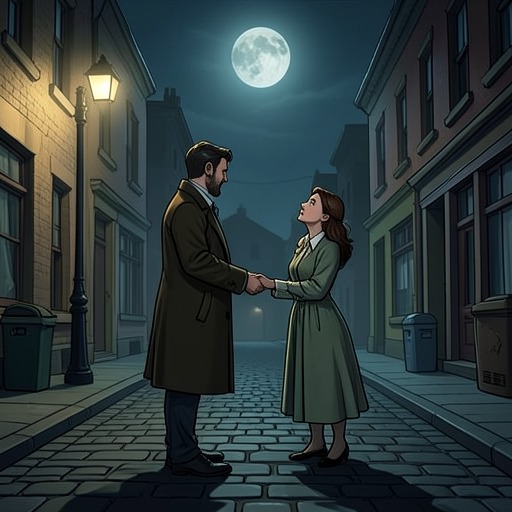
The remaining images move from a classical landscape toward menace. “Athene's lissome maidens” perform “Obeisances lisping and shy”; then the speaker finds Leonore “lorn and tender,” caught “In the clutch of a cloud-rending cry.” The stanza’s courtly, delicately voiced opening is abruptly pressed by distress. Its sound and diction turn from ceremonious obeisance to a cry that seems to rend the sky, leaving the woman both a figure of tenderness and the center of an unnamed violence.
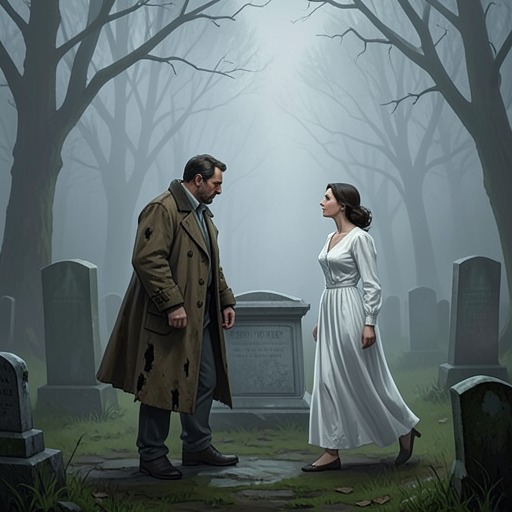
The final couplet intensifies that instability through repetition: “To the maid with the pale blue eye / To the ghoul with the pale blue eye.” The same eye belongs first to a maid and then to a ghoul; the repeated phrase holds the two identities together without explaining whether the speaker sees one figure changing, two figures merging, or a beloved transformed by terror. In the opening material, the image of “the pale blue eye” already supplies the poem with its arresting refrain. Its return as the poem’s endpoint makes the eye less a solved clue than a focus for recognition and dread.
Composition and the Fry investigation
Poe brings the poem to Landor during their investigation, taking a folded paper from his coat and unfolding it to show a regular cursive hand. His voice trembles as he says he may have seen the woman they seek. He dates the composition to the morning after Fry’s death, when, before knowing what had happened, he awoke and began writing lines about a mysterious woman and an obscure but profound distress. The timing is central to his case: he proposes that the poem’s appearance before he knew the circumstances of Fry’s death links its woman and violence to the event.
Poe’s reasoning rests on a cluster of correspondences rather than on a described sighting that Landor can independently verify. He points to the poem’s concealed violence, its suggestion of unspeakable duress, its unknown woman, and the timing of its composition. He insists that the coincidence cannot be accidental. Landor, however, notes the basic alternative: Poe might have awoken on any morning and written the lines. The poem thus enters the inquiry as a piece of testimony whose significance depends on whether its timing is treated as evidence or coincidence.
Poe does not present the poem as finished. He describes it as unfinished “For the time being,” a qualification that leaves its textual incompletion open rather than final. Its broken alternatives and unresolved figure echo that provisional status: the poem records a compelling image, but supplies neither a complete account of the woman nor a settled explanation of her relation to Fry. Landor’s question about the connection consequently remains distinct from Poe’s conviction that one exists.
The claim of dictation and Landor’s response
When Landor presses him, Poe says the poem was dictated. Asked by whom, he answers, “My mother.” That claim changes the poem’s status in the conversation. It is no longer only a poem written after Fry’s death and interpreted through its apparent correspondences; Poe offers it as a message received from someone who could not have known the case through ordinary means. Landor responds with laughter and sarcastically proposes bringing Poe’s mother in to shed light on Fry’s death.
Poe’s reaction exposes the gap between the two men’s standards of explanation. Landor’s mockery treats the dead mother as unavailable and the claimed dictation as no useful lead. Poe looks at him with profound surprise, as though Landor had forgotten something self-evident, and replies that she has been dead nearly seventeen years. The fact of her death is not a resolution of the poem’s origin: it sharpens the contradiction between Poe’s insistence that she dictated it and Landor’s refusal to treat that assertion as investigative evidence.
Framing and significance
The poem is associated with the book’s opening material, where the heading “Last Testament of Gus Landor” and the date April 19th, 1831, precede Landor’s statement that he expects to die within hours. That placement gives the poem’s images of grief, distress, and an apparently returning presence an ominous resonance, while not establishing that Landor wrote it: in the investigation scene, Poe identifies himself as its writer and attributes the lines to his mother. The distinction between the opening framing and Poe’s later account matters; the poem is connected to Landor’s testamentary frame, but its authorship claim within the narrative belongs to Poe.
The poem also sits near the book’s epigraph, Washington Irving’s sentence, “The sorrow for the dead is the only sorrow from which we refuse to be divorced.” Read alongside Poe’s account of his mother, that framing makes bereavement relevant without proving a supernatural cause. The poem gives grief a striking visual form—the pale blue eye—and makes the dead mother both absent and, in Poe’s telling, a source of words. Yet the investigation scene preserves Landor’s skepticism and leaves the asserted dictation unverified. Its significance is therefore double: it is a possible clue Poe offers about Fry’s death and a compact expression of the book’s uncertainty about whether the dead speak, or whether the living find their own losses returning in images and poems.