Poetry as Prophecy or Supernatural Message
The Pale Blue EyePoetry as Prophecy or Supernatural Message names the possibility that a poem may convey knowledge from beyond its author: a dead person may persist as a presence, or an unseen spirit may use the poet as a conduit. The idea gives Edgar Allan Poe a way to interpret his anxiety about Lea Marquis as a warning embedded in verse. Augustus Landor offers a more ordinary explanation—that the poem expresses Poe’s own fear—but Poe refuses to accept authorship. The exchange leaves the poem suspended between supernatural message and personal expression, making the act of interpretation part of the mystery.
The Dead as a Continuing Presence
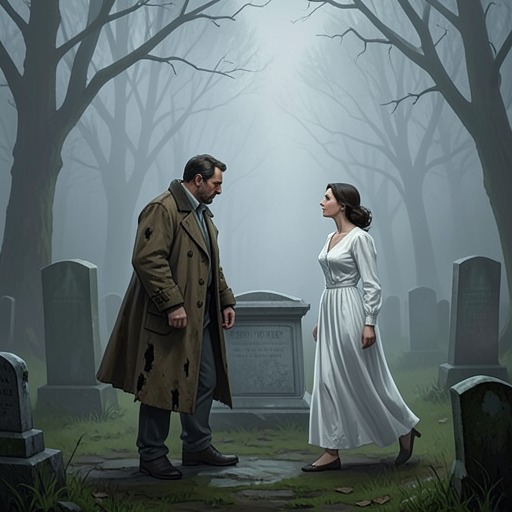
The concept first emerges through Poe’s account of his mother, Eliza Poe. In speaking with Lea Marquis, he describes her national renown and artistry, her devotion to her family, and her death in the fire at the E Theatre, where she had achieved many of her theatrical triumphs. He also recounts being orphaned, John Allan’s decision to raise him as an heir, his years in England, his travels in Europe, and his service in the artillery. Lea’s attentive response encourages him to speak not only of biographical facts but of thoughts, dreams, and fancies.
Poe says that although his mother left him no living memory, she persists in his sleep and waking as a kind of spirit-memory. The idea of communication from beyond thus begins as an intimate problem of bereavement: absence does not prevent a dead loved one from feeling present. When Lea asks whether Eliza speaks to him, Poe becomes reticent. He wants to disclose a mysterious poetic fragment but cannot bring himself to do so. Lea does not press him; instead, she reflects that those who came before remain with the living, without claiming to know why. The scene makes uncertainty essential to the concept: presence is felt, but its source and meaning remain unconfirmed.
The Poem as a Possible Message
Poe later produces a single sheet of verse with conspicuous reverence, unfolding it as though it were a sacred object. The poem stages a fearful exchange between a speaker and Leonore, who describes the demons that ravaged her soul. Its vocabulary of dread and its dramatic presentation allow it to be read as more than an exercise in poetic craft: the page appears to hold a message whose significance has not yet been deciphered. Landor responds politely, and Poe says that he will tell his mother that Landor liked it. The brief remark brings the poem’s literary exchange back to the earlier theme of a deceased mother who remains present in the imagination.
Later, Poe’s concern about the poem becomes explicitly prophetic. After witnessing an intensely prolonged embrace between Lea and her brother, Artemus Marquis, he returns to his quarters and writes anxiously to Landor. He disavows the prevailing panic around him, yet admits to a nervous apprehension unlike his usual nature. His thoughts repeatedly turn to Lea, and he rereads the poem, finding danger in its lines. He hopes that the spirit using him as a conduit will soon let him solve the poem’s enigmas. This mixture of fear, attachment, and interpretive urgency turns verse into a possible warning about a particular person rather than a general supernatural puzzle.
The poem’s later stanza intensifies that reading through images of descending wings, endless darkness, and the survival of a single blue eye. Poe connects Leonore’s name with Lea’s and their shared blue eyes with the poem’s image; he also reads the suffering and darkness as signs of an imminent end. For him, these correspondences amount to an announcement that Lea is in danger. The poem’s apparent force comes from the convergence of identifiable details, not from a prophecy whose meaning is plainly stated. Poe believes the details form a pattern, and that belief makes interpretation feel urgent.
Dispute over Authorship and Meaning
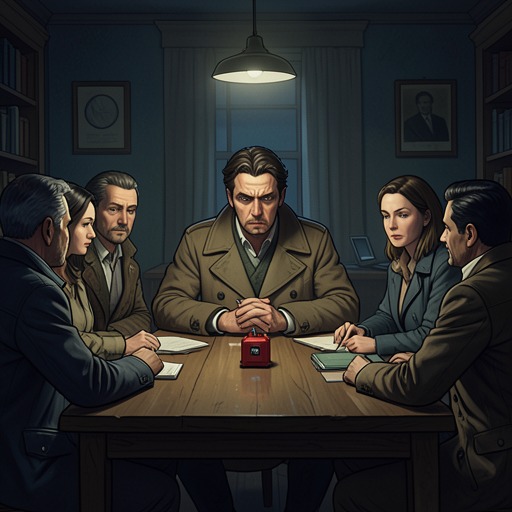
Landor challenges both the supernatural reading and Poe’s account of the poem’s origin. He argues that Poe has been thinking about Lea continually and has reason, given their brief history, to fear for her safety. On this account, the fear has entered Poe’s preferred form of expression: the poem seems prophetic because it gives shape to an anxiety Poe already carries. Landor tells him that he wrote it, rather than his mother or a supernatural scribe.
Poe rejects that explanation. Although he says he does not believe in muses, he insists that he is not the poem’s author. The contradiction preserves the central uncertainty: he denies supernatural inspiration in one form while maintaining that the poem did not originate with him. Landor decides to examine the whole poem, asking Poe to recall its first two stanzas. In the evidence presented here, that proposed examination has not yet resolved the dispute.
Narrative Significance
The concept links bereavement to the desire to read signs. For Poe, his mother’s continuing presence and the poem’s apparent warning belong to the same unresolved question: whether words and images can carry knowledge from the dead or another unseen source. His reticence about the mysterious fragment, followed by his fixation on the poem’s danger to Lea, gives that question emotional as well as interpretive weight.
Landor’s alternative reading does not dismiss the poem’s details; it relocates their source from the supernatural to Poe’s own divided awareness. The pale eye, the darkness, and the imagined threat remain meaningful, but may register fear rather than foretell an event. Because Poe holds to an origin he cannot explain while Landor proposes a psychological one, the poem operates at once as possible prophecy and as an expression whose author will not recognize himself in it. The tension makes poetic interpretation consequential: whichever reading prevails changes whether the poem is a message to decode or a fear made visible in verse.