Prayer Squad
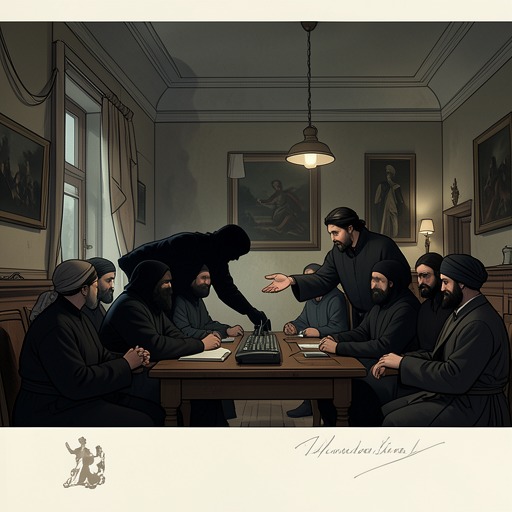
The Pale Blue EyeThe Prayer Squad is a voluntary association of cadets at the United States Military Academy who considered the Academy chapel too Episcopalian and sought a more direct road to God. Its brief connection to Leroy Fry made it relevant to the inquiry into his death, while its members’ zeal gave Edgar Allan Poe a way to maneuver the investigation toward Artemus Marquis. The group stands at the intersection of sincere religious dissent, suspicion of occult practice, and the Academy’s effort to preserve order after a cadet’s death.
Identity and Religious Purpose
The Prayer Squad is presented as a cadet association, not as an official body of the United States Military Academy. Its members had chosen to gather voluntarily because they found the chapel’s Episcopalian character unsatisfactory and wanted a more direct relationship with God. Their purpose was therefore religious, but it also set them apart from the Academy’s regular worship and made them recognizable as a group with convictions of their own.
That distinction matters to the investigation. When Augustus Landor and Edgar Allan Poe consider whether the removal of Leroy Fry’s heart might have had a religious motive, the Prayer Squad offers a concrete connection: Fry had joined it briefly after falling in with what Edgar Allan Poe calls a bad group. The narrative does not establish that the association committed a crime or practiced magic. Instead, its presence gives the investigators a religious context to test, while the difference between the squad’s worship and the suspected rite remains essential.
Connection to Leroy Fry and the Inquiry
Fry’s brief membership links the Prayer Squad to the events surrounding his death, but it does not establish what he believed or what role the group played in his final actions. In the account of his history, he turns from a disreputable company toward the Prayer Squad. That change makes the association relevant to questions about religion and conduct, without making membership proof of criminality.
The group becomes a line of inquiry when Landor and Edgar Allan Poe reason that a ceremony might leave traces even if its objects had been removed. Their search for impressions left by objects follows the possibility that the killing involved a religious act. The Prayer Squad’s connection to Fry gives that possibility a local point of reference, but the reasoning remains investigative rather than conclusive: the squad is a lead, not an established culprit.
The Academy’s public routine provides a telling contrast. During evening parade, cadets move in companies and the space Fry occupied is filled by another; the ranks absorb his absence so smoothly that only a more attentive observer might notice a lost step or stumble. Rumor about Fry circulates among the cadets even as the formation carries on. Against that visible discipline, the Prayer Squad represents a voluntary religious fellowship within the same institution, one whose distinct beliefs become newly significant after the death.
Edgar Allan Poe’s Approach to the Squad
Edgar Allan Poe had previously regarded the Prayer Squad with contempt. His view changes when he sees that its members might serve the investigation. He proposes approaching them, while Augustus Landor accepts the plan. The turn is practical rather than devotional: Edgar Allan Poe intends to use the group’s concern with spiritual danger to find out what its members know.
On Friday afternoon, after evening parade and before mess, Edgar Allan Poe approaches Llewellyn Lee, a third-classman and one of the squad’s leaders. He asks to join the group at its next convocation, explaining that waiting until Sunday chapel would be too long. Lee calls several members together for an impromptu discussion beside the gun trestles. Edgar Allan Poe later admits that he performed a deferential, docile manner unlike his usual character because he expected the squad would reject his actual religious principles.
To secure an invitation, Edgar Allan Poe presents himself as needing spiritual counsel after an encounter with another cadet. He says that this cadet has made dark, un-Christian overtures, challenged the grounds of his faith, and urged him toward mysterious ancient practices. The account is a deliberate fabrication designed to make the squad curious and concerned. Its members respond as he anticipates: they want to know the cadet’s identity, and they press him even after he claims that private confidences prevent him from naming the person.
Identification of Artemus Marquis and Narrative Significance
Edgar Allan Poe turns his refusal into a test of the group’s interest. He insists that he cannot reveal the name, while the members repeatedly ask who the cadet is. One of them eventually proposes Artemus Marquis. The group’s suggestion identifies a specific suspicion that Edgar Allan Poe had sought to elicit: Artemus Marquis, Dr. Marquis’s only son, is a first-classman and is reputed to dabble in black magic.
The scene demonstrates both the usefulness and the limits of the Prayer Squad as an investigative source. Its members’ religious concern makes them receptive to Edgar Allan Poe’s invented account, and their questions bring Artemus Marquis into focus. Yet what they provide is an accusation by suggestion, not direct evidence that he killed Fry. The squad’s credulity helps advance the inquiry, but the method depends on manipulation and leaves the truth to be established elsewhere.
The association also sharpens the narrative’s contrast between religious identity and alleged occult practice. The Prayer Squad’s stated aim is to find a straighter path to God; Edgar Allan Poe invokes that concern by describing the opposite, a cadet’s supposed invitation into arcane practices. The later discovery of a private ceremony in the icehouse belongs to the Marquis family, not to the Prayer Squad. Keeping those groups distinct prevents the squad’s brief connection to Fry and its members’ suspicion of Artemus Marquis from being mistaken for participation in the rite.