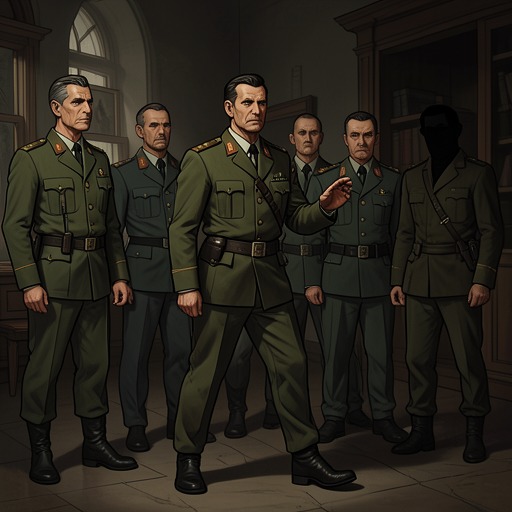
Recruitment of Edgar Allan Poe as Landor's informant
The Pale Blue EyeThe recruitment of Edgar Allan Poe as Landor's informant turns a civilian investigator's exclusion from the cadet corps into a covert working arrangement with one of its own. Augustus Landor must persuade Colonel Thayer and Captain Hitchcock to permit an unofficial assistant, then persuade Poe to accept a role that Landor describes as observation rather than informing. The resulting handshake begins their investigative partnership, but its very informality leaves the arrangement suspended between military discipline, secrecy, and personal trust.
Causes and Background
Landor asks Colonel Thayer and Captain Hitchcock to let him engage one of their cadets as an assistant. He knows that the request crosses a boundary they have carefully maintained between military and civilian authority. Their response is immediate: the teacups go down, their heads snap up, and they begin setting out their objections. Landor sees that he is not asking for a routine favor but attempting to undo the separation that has governed his access to the academy.
He argues that his restrictions make ordinary investigation among the cadets ineffective. He cannot move freely among them or speak to them without permission, and even an investigator with greater access might not get far: young men, he says, are skilled at keeping secrets. In his account, the academy's system itself encourages that silence. Information, he argues, is most likely to emerge through someone who belongs to the cadet corps. His case thus makes the obstacle to his inquiry the reason to appoint a cadet as his agent.
Landor also offers practical assurances. The assistant will continue attending recitals and drills, fulfill all military duties, and maintain class standing; the intelligence work, he says, could count as valuable experience for a future career. Thayer and Hitchcock do not become enthusiastic, but they eventually discuss possible candidates. When Landor proposes Poe, their silence initially makes him think they do not know the name. He realizes that he has misread their pause: they recognize it.
The Offer to Poe
Landor presents the position to Poe as an offer of employment, not an official appointment. He makes clear that it depends on satisfactory performance as a cadet and will end if Poe fails or falters in those duties. By invoking Colonel Thayer and Captain Hitchcock, he lets Poe know that his superiors are aware of the proposal. Landor reflects that even a plebe with large ambitions may feel beneath the notice of his superiors; discovering that they have noticed him can make him strive to deserve that attention.
To explain the work, Landor draws on his time as a constable in New York City. His most useful news, he says, came not from newspapers but from people whom respectable society would shun: criminals and other marginal figures whose information was indispensable to police work. Poe understands the implication and names the position an informer's. Landor recasts it as an observer's role, saying that he wants Poe to be what Poe already is. That distinction does not remove the underlying secrecy; it gives the work a less compromising description and presents it as an extension of Poe's existing habits of attention.
The surviving exchange does not specify what particular subjects Poe is to observe. Landor instead insists on precision and brings the conversation to a decision: Poe must answer yes or no. The offer therefore combines a broad assignment with strict conditions. Poe is to gather information from within the cadet corps, while remaining subject to the same visible duties and standards as before.
Acceptance and Arrangement
Poe rises for the first time in the conversation and goes to the window. Landor declines to claim knowledge of the feelings competing in him, but recognizes that the delay makes the eventual answer more intense. Poe finally agrees. With a lopsided smile, he says he would be perversely honored to be Landor's spy. Landor answers by calling himself Poe's spymaster, and the two shake hands by mutual consent.
The handshake is both an agreement and a small breach of the formality they have just observed. They pull their hands away as if they have already crossed a code. Landor then proposes that they meet on Sunday after chapel at Cozzens' Hotel, asking whether Poe can reach it without being seen. The detail gives the new arrangement its immediate method: their contact must remain private, even as Poe continues his public life and obligations as a cadet.
Consequences and Retrospective Significance
The recruitment makes Poe an insider in an investigation whose central difficulty is the secrecy of the cadet community. Landor's case to his superiors depends on the claim that an outsider cannot readily penetrate that community; his offer to Poe turns this limitation into a partnership. The conditions attached to the job also preserve the academy's authority: the assignment is unofficial, and Poe's position as Landor's assistant cannot excuse any lapse in cadet duties.
The later recovery of two scraps of text complicates the trust implied by the recruitment. Landor tells Poe that one is the note found in Leroy Fry's hand, which Landor had carelessly left with him; the other is a note Landor had left for Poe. He identifies the latter as a message written to ease his conscience, though he knew it could not be eased. This later disclosure does not alter the terms of the original conversation, but it casts a shadow backward over them: the investigator who recruited Poe as an observer had also left him evidence connected to Fry's death and a message burdened by Landor's own guilt. The handshake begins a working alliance, not a guarantee that Landor will be candid about everything Poe is asked to interpret.