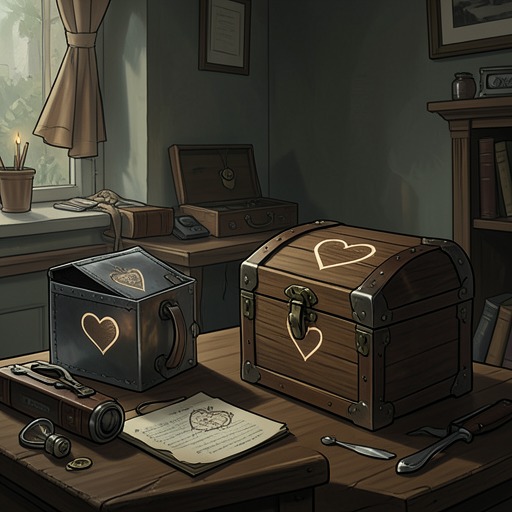
Removal of Leroy Fry's heart
The Pale Blue EyeThe removal of Leroy Fry’s heart is the crime that turns a cadet’s death into a mystery of deliberate bodily desecration. Between half past two and three o’clock in the morning, while Fry’s body was supposed to be under guard, it vanished; it was later found by the Icehouse, returned, and discovered to have been opened so that its heart could be taken.
The disappearance and its discovery
The first breach was not the removal of the heart but the disappearance of the body. Captain Hitchcock explained that the sergeant assigned to watch it had left his post, mistakenly believing he was needed elsewhere. By the time he returned and the error was discovered, Fry’s body was gone. The narrow time window—between 2:30 and 3:00 a.m.—made the lapse more than a failure of routine: someone had exploited the absence of the guard to carry out an act that could not be dismissed as a prank.
The body was located by the Icehouse and eventually returned. Sylvanus Thayer stated the injury plainly: Fry’s heart had been carved from his body. The stark announcement gave precise form to what Captain Hitchcock struggled to describe as a uniquely terrible desecration. The body’s return did not undo the violation; it made the missing organ, rather than the missing corpse, the investigation’s defining fact.
Forensic clues and the scene of removal
When Augustus Landor examined the body, he plunged his hand into the alcohol bath and hauled Leroy Fry up by the head, bracing the corpse with his other hand so it would not sink again. The neck showed no clean, even cinch: the rope had run up and down, searching for a hold. Landor read the irregular marks as evidence that Fry had struggled against hanging, while the corpse’s rigid posture and the marks on its fingers sharpened the question of how he had died before his heart was taken.
A lump on the back of Fry’s skull offered another clue. Dr. Marquis identified a contusion raised roughly a quarter inch above the skull and explained that a bruise formed when blood escaped its vessels. Since circulation had ceased, he judged that such a bruise was not likely to have been inflicted after death. The observation did not by itself identify the assailant or establish precisely when the blow occurred, but it made the body a record of injury as well as a site of desecration.
The search for the place where the heart had been removed began with a change in vantage point. Near the Icehouse, Landor marked out an area roughly twenty yards square, just north and slightly northeast of its door. The officers’ quarters lay northwest, the cadet barracks west, the Academies south, and the guard post at Fort Clinton east. From that position, the location appeared deliberately chosen: it offered concealment from the surrounding posts and buildings. Landor had already searched around the Icehouse on his hands and knees, but had missed the site until reconsidering the ground from a different angle.
Landor and Edgar Allan Poe treated the scene as possible evidence of a rite. Fry had once joined a group the narrator describes as bad company before turning to the Prayer Squad; the removed heart and the condition of the body had also prompted religious associations. Landor reasoned that anyone who had arranged stones or candles ceremonially would probably carry them away afterward, but might leave their impressions in the ground. With a pencil and notebook, he moved in a wave pattern among the small white stones scattered through the pale grass, measuring distances and plotting them as a lattice of dots. The search thus shifted from looking for objects that were no longer there to reading the marks their arrangement might have left behind.
The missing organ as clue and symbol
The opened chest made absence more vivid than any surviving wound. Landor could see the shivered ends of the bones, the folded tissue, the shriveled lungs, the diaphragm, and the liver; what fixed his attention was the organ that was no longer there. In his account, Fry seemed reduced to a question posed by the body itself. The heart’s removal therefore works on two levels: it is a concrete act investigators must explain, and an absence that turns the corpse into an unresolved demand for an answer.
That absence also steered the investigation toward ritual without proving a religious motive. Landor recalled that Fry had once associated with a disreputable group and later joined the Prayer Squad; the condition of the body had likewise suggested religious fanaticism to Thayer. Treating religion as a possible starting point, Landor asked whether stones or candles might once have marked a ceremony. He reasoned that the objects could have been removed to conceal evidence while their impressions remained in the ground, and searched for those traces with Poe. The theory arose from the scene’s missing heart and the possibility of deliberate arrangement, but the marks sought in the soil were evidence to test, not proof that a rite had occurred.
The novel later returns to the image of a heart in a different investigative setting. After a shell fails to explode and its smoke clears, Hitchcock unwraps a bundle and finds a heart, described as oozing rust and raw as life. The passage establishes a striking recurrence of the heart as a physical object within the investigation, but the discovery alone does not identify that heart as Fry’s. Elsewhere, when Landor and Poe consider the removal of Fry’s heart, the case is explicitly framed as a second crime at the Icehouse, separating the place where the body was found from the place where the organ was taken.
The contrast with Randolph Ballinger’s body further clarifies how physical evidence can distinguish one death from another without resolving every uncertainty. Ballinger’s wounds were already present when he was found hanging, making the appearance of suicide untenable; the storm and many soldiers’ tracks, however, left it unclear whether he had come to the tree willingly or alive. That later examination does not establish who removed Fry’s heart. It extends the novel’s forensic pattern: bodily details can overturn an official appearance, while weather, concealment, and the limits of observation leave essential parts of the crime unresolved.
The crime as a narrated revelation
The discovery is presented not as a single revelation but as a sequence of silences and corrections. Captain Hitchcock first warns that Fry’s death is not the end of the matter; after a guarded pause, he reports the body’s disappearance. Landor’s question about who removed it meets another hesitation, and only then does Hitchcock name the Icehouse as the place where it was found. The delayed disclosure makes the missing body feel like a second breach of order before the nature of the desecration is stated plainly.
The announcement of the missing heart also changes the scene’s emotional register. Hitchcock struggles to describe what happened, while Sylvanus Thayer delivers the fact with the composure of an officer reading out class standings. Landor records his own response through involuntary physical gestures: he sets down his glass carefully, closes his eyes, and notices his hands rubbing together. The contrast between Thayer’s controlled bluntness and Landor’s bodily shock makes the information feel at once official and almost impossible to absorb.
That movement from report to reaction suits the investigation’s larger method. The event is first an absence that demands explanation; only through close attention to the body and the ground around the Icehouse can the absence become a set of questions that investigators might test. Landor’s account therefore gives the crime two forms of force: the physical violation itself and the disturbance it produces in those trying to describe it. The heart is missing from the body, but the effort to name what happened becomes the case’s continuing pressure.