Satanism
The Pale Blue EyeSatanism becomes an investigative hypothesis in the inquiry into Leroy Fry’s murder, not an established explanation. Augustus Landor and Edgar Allan Poe consider whether the removal of Fry’s heart and marks at the crime scene point to a religious rite; a backward inscription then raises the possibility that the figure being invoked is opposed to Christ. The theory gives the investigators a direction to pursue, while their exchanges repeatedly distinguish suggestive signs from proof.
From the crime to a religious hypothesis
Landor begins with the manner of Fry’s death: the taking of his heart has already led Poe to think about the Bible, and Landor says he too has wondered whether the crime carries a religious aspect. He reasons from Fry’s earlier association with a disreputable group to his later turn toward the Prayer Squad, and recalls that Sylvanus Thayer interpreted Fry’s body as evidence of religious fanaticism. These details make religion a possible starting point for the inquiry; they do not, by themselves, establish that Fry or his killer belonged to any particular sect.
The distinction matters because Landor treats religious motive as a question to test against physical traces. In the icehouse, he proposes that a ceremony might have involved deliberately arranged objects, such as stones or candles. A person responsible for the crime, he reasons, could remove the objects afterward, but leave behind impressions in the ground. The proposed search is therefore for indirect evidence: not the ritual objects themselves, but the marks their placement might have made. Landor also factors in the approaching search party and the need to deal with Fry’s heart, circumstances that, in his account, could have limited the time available to erase such traces.
The backward inscription
A backward religious inscription sharpens the investigators’ interpretation without resolving it. Landor calls the inscription common in earlier times but says he has not seen it written in reverse. Poe suggests that the reversal may indicate an invocation of someone directly opposed to Christ. The step from an unusual inscription to an anti-Christian presence is an interpretation offered in conversation, not a confirmed identification of the person or belief behind it.
The exchange links the physical sign to a larger symbolic opposition. An inscription associated with Christ, turned backward, can be read as a clue to deliberate inversion; Poe’s suggestion gives that inversion a possible religious meaning. But the scene leaves room between what can be observed and what can be inferred. The mark is discussed as unusual, and Poe proposes what it might signify. Neither the inscription alone nor the investigators’ reading of it demonstrates that a Satanist ceremony took place.
Seeking an opposite community
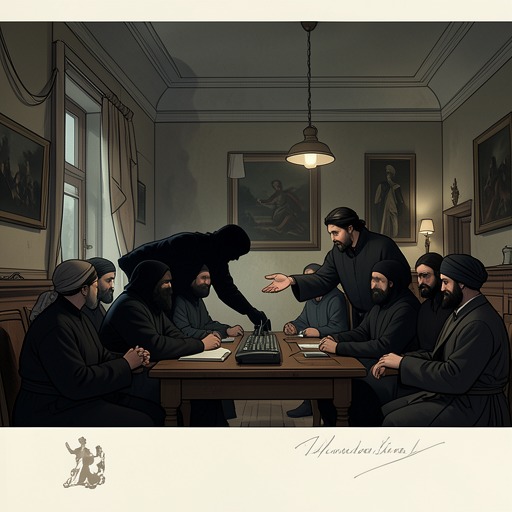
On the ride back to West Point, Poe proposes approaching the people most likely to notice a secret Satanist enclave: its religious opposite, the Christians. Landor cautiously agrees that Christians could be the corresponding group to consult. This is a tactical use of the hypothesis. If such a hidden community existed, people attentive to its perceived opposite might know of it or recognize signs that others would overlook.
The proposal also shows how the theory shapes the next stage of the investigation. Instead of treating Satanism as a conclusion, Poe and Landor use it to identify a possible source of information. Their reasoning depends on the assumption that a secret religious group would have an opposite number sensitive to its presence. The exchange establishes that this is how they intend to direct their inquiries, not that Christians confirm the existence of a Satanist enclave.
Landor’s case before Hitchcock
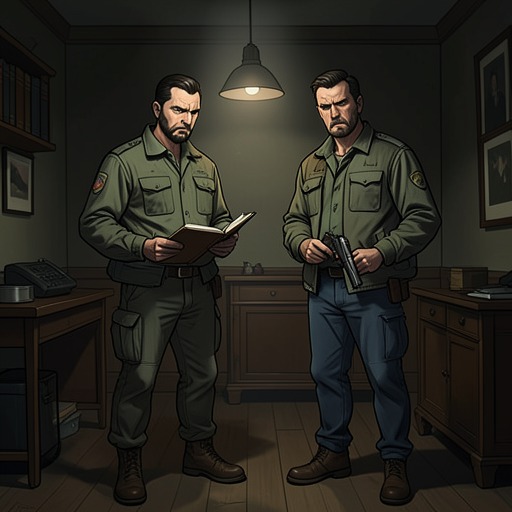
When Landor explains his thinking to Captain Hitchcock, the military question becomes how far the available clues can bear the weight of the theory. Hitchcock restates the implication as a possible society or cult near West Point, perhaps within the United States Military Academy itself, whose beliefs led to Fry’s killing and the removal of his heart as a devotional act. His formulation presses Landor to say plainly what the clues might mean; it does not amount to independent confirmation.
Landor resists turning inference into a definitive accusation. He describes a chain of possibility: markings at the crime scene may have occult meaning, and a specific set of directions may be relevant to the crime. He says only that Fry was killed in a way that could make his heart useful to a particular class of worshipper. Even when Hitchcock’s language becomes more dismissive, Landor’s answer keeps the focus on what the evidence may suggest rather than naming a culprit or claiming to know the group’s larger aims.
Meaning and evidentiary limits
Satanism thus functions as a working framework that connects otherwise separate details: Fry’s heart, possible impressions left by removed objects, the backward inscription, and the prospect of a secret community. Its practical value is that it gives Landor and Poe questions to pursue and people to consult. Its danger is that a coherent pattern can seem more conclusive than the individual signs warrant. The investigators’ own careful qualifications keep that tension visible: the markings may have occult meaning, and the heart may have served a worshipper, but neither possibility identifies who acted or proves that an organized group existed.
The concept remains suspended between explanation and suspicion. Poe’s reading of the inscription suggests opposition to Christ; Landor’s search for ritual traces and his conversation with Hitchcock broaden that reading into a possible account of Fry’s murder. Yet Landor explicitly distinguishes this account from a deduction. Satanism is therefore important less as a settled description of the crime than as a hypothesis whose symbolic force directs the investigation while its factual status remains unresolved.