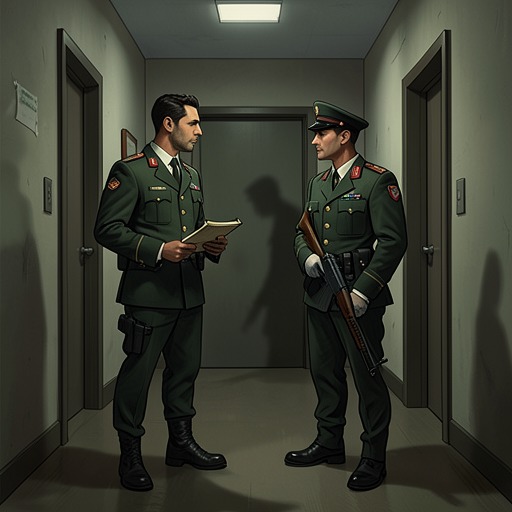
Sylvanus Thayer and Ethan Allen Hitchcock's Command Alliance
The Pale Blue EyeSylvanus Thayer and Ethan Allen Hitchcock's Command Alliance is both the working structure behind the United States Military Academy at West Point and a private pact that Augustus Landor reads in gestures as much as in words. Thayer proposes and commands; Hitchcock oversees the cadets and carries out the daily work. Beneath that division of labor, the two men show mutual reliance, a past rupture over military procedure, and a reconciliation expressed with striking economy: a hand on the shoulder.
Identity and Division of Authority
Hitchcock is introduced as Thayer's second in command and the officer responsible for watching over the United States Military Academy Corps of Cadets day after day. Landor sums up their arrangement through a saying he has heard: Thayer proposes, and Hitchcock disposes. Anyone seeking to deal with the Academy, he adds, must first deal with Hitchcock. The description makes Hitchcock the practical threshold to the institution, while Thayer remains its commanding authority. Their alliance is not a simple partnership of equals: its strength depends on differentiated responsibilities and a hierarchy that Landor says is never in doubt.
That balance is reflected in Hitchcock's own presentation. When he first appears to Landor, the darkness leaves only his hand clearly visible, with the rest of him uncertain. As he approaches, Landor notices a hard-middled figure, melancholy brown eyes, and a face that seems persistently compressed. The first impression of reserve gives way to a surprisingly mild voice. Hitchcock greets Landor as a retired man and asks whether retirement agrees with him; Landor replies that it agrees with his lungs. The exchange occurs before Hitchcock takes him to meet Thayer, placing the second-in-command between the visitor and the superintendent in a literal as well as institutional sense.
A Pact Conveyed in Gesture
Landor characterizes the alliance as resembling a marriage, but immediately limits the comparison: he means a pact between two bachelors, fluid and grounded in things left unspoken. The point is not a claim about a different kind of relationship; it is Landor's way of naming a closeness that cannot be reduced to their official titles. Their understanding appears less in declarations than in timing, touch, and the ease with which one man can answer the other's distress.
When Hitchcock voices his fear that the person responsible for the outrage remains at large, his concern is not presented as mere professional vigilance. Landor calls him sensitive and observes that, for all his hardness, he can bleed. Thayer gives Hitchcock a slight pat on the shoulders, and the tension leaves him. The gesture is brief, but its effect is immediate: Thayer comforts his deputy without interrupting the institutional discussion. Their alliance therefore includes a form of private care that can operate in public, discreetly and without explanation.
Estrangement and Reconciliation
The bond has not been uninterrupted. Landor later learns that Thayer and Hitchcock separated three years earlier over whether West Point's courts of inquiry violated the Articles of War. The disagreement concerned the limits and legitimacy of institutional procedure, a dispute substantial enough to divide the two men despite their close working relationship. Landor supplies no further account of the argument, so its exact course and terms remain unstated.
The separation did not last. A year after the rupture, Thayer called Hitchcock back, and Landor describes the breach as healed over. That sequence gives the alliance a history of disagreement without suggesting that disagreement dissolved it: the command relationship could be restored, though Landor's account does not say that the underlying legal question was settled. The earlier division also sharpens the meaning of Thayer's later touch. The pat belongs to a relationship that has survived a serious institutional conflict and resumed its familiar pattern of command and response.
Command in the Investigation
During the inquiry into the outrage at West Point, Hitchcock's fear that the perpetrator remains free becomes part of the room's collective concern. Thayer acknowledges his feeling and then redirects attention toward the practical purpose of the gathering: improving the Academy's position to find the perpetrator. Landor answers that Hitchcock deserves credit for putting the concern into words. The exchange shows the alliance functioning under pressure: Hitchcock gives voice to alarm, Thayer steadies him, and the superintendent restores the discussion to its investigative objective.
Thayer's authority is especially visible in the way the moment closes. Landor describes the alliance as fluid and partly unspoken, but insists that its hierarchy is constant: Thayer is in command, always. Emotional intimacy does not erase the chain of command; it helps make that chain workable. Through Landor's retrospective attention to a hand, a pat, and a recalled separation, the alliance emerges as both an administrative arrangement and a relationship sustained by habits of protection, return, and tacit understanding.