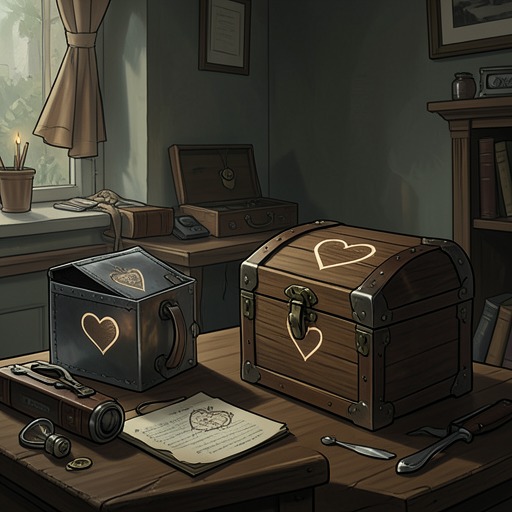
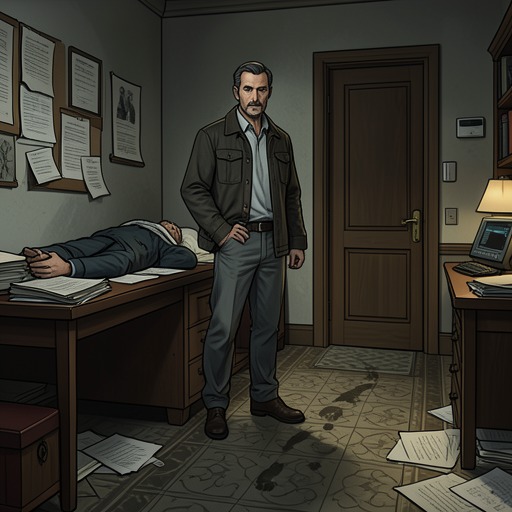
The cow heart found in Artemus Marquis’s quarters
The Pale Blue EyeThe cow heart found in Artemus Marquis’s quarters is a material clue whose apparent meaning changes under examination: first it resembles the human heart associated with Leroy Fry’s death, then its size identifies it as almost certainly a cow’s. Found beside a bomb shell that fails to explode, it appears to implicate Artemus Marquis, but Augustus Landor recognizes that it may have been planted to frame him. The heart therefore advances the investigation while making its evidence less, not more, straightforward.
Discovery and Appearance
In the aftermath of the fuse burning out without an explosion, Captain Hitchcock returns to the wood-box, retrieves the bundle he had dropped, and unwraps it with conspicuous care. Inside is a heart, described as “Oozing rust. As raw as life.” Its vivid, bodily appearance gives the discovery immediate force, but the wrapping and rust-colored surface do not establish what creature it came from—or who put it there.
The heart is brought to Dr. Marquis at the hospital. On a blacksmith bed in Ward 3-B, still wrapped, it recalls the setting in which Leroy Fry had once lain. That resemblance encourages the investigators to treat it as potentially human evidence. Augustus Landor notes that it was fortunate Dr. Marquis did not first ask where they had found it: the doctor is absorbed by the specimen itself. Landor remembers the cold of Artemus Marquis’s quarters, a detail that supports the heart’s preservation but does not settle its origin or explain its presence there.
Medical Identification
Dr. Marquis initially observes that the heart’s atria, ventricles, valves, and arteries resemble a human heart. The decisive distinction is scale. He estimates that the specimen weighs upwards of five pounds, whereas a human heart seldom exceeds nine or ten ounces; Landor recalls the earlier description of a human heart as no bigger than a fist. The doctor judges it too large to be a sheep’s and almost certainly a cow’s.
This identification replaces a visual resemblance with comparative anatomy. The heart’s general structure can look human, while its weight overturns that first impression. Dr. Marquis’s recollection of dissecting cow hearts in Edinburgh underscores the practical basis of his judgment: the specimen is not classified by its dramatic setting but by its measurable size and familiar anatomy. His conclusion identifies the likely animal source, not the specific animal or the person responsible for bringing the heart to the quarters.
Investigative Significance
Captain Hitchcock immediately connects the cow heart to the livestock heart-removal incidents at Haverstraw, concluding that it must have come from there. The identification thus links the object to a pattern beyond West Point and raises the possibility that the person responsible for the attack on Leroy Fry has also targeted animals elsewhere. For Hitchcock, that possibility disrupts a hoped-for separation between the cadet’s death and the earlier livestock cases: the heart makes those lines of inquiry converge again.
Yet the heart’s presence in the wood-box is itself suspicious. Hitchcock asks why Artemus Marquis, if he is the culprit, would leave it somewhere the barracks quarters are regularly inspected. Landor offers another explanation: someone else may have put it there in order to incriminate Artemus. The heart’s evidentiary value is therefore double-edged. Its animal identity connects it to the Haverstraw incidents, while its location may be a deliberate accusation rather than evidence of Artemus’s guilt.
The Unresolved Clue
The surrounding bomb deepens rather than resolves that doubt. It had been carried from the hall toward the window, but its fuse dies without an explosion; the shell remains in the yard. Hitchcock then retrieves the wrapped heart. Landor’s suggestion that the heart was planted prompts a further question: why would someone place a bomb with no powder outside Artemus’s door while Artemus was in recital? The two objects make the scene look staged, but the available evidence does not identify who arranged it or establish how the heart and shell were meant to work together.
As a nonhuman body, the heart is both specimen and instrument of inference. Its weight and anatomy let Dr. Marquis distinguish cow from human, but the investigation cannot read intention from flesh alone. The same object that appears to confirm a link to Haverstraw can also serve as planted evidence against Artemus. Its importance lies in that tension: it gives the investigators a concrete fact about what the heart is, while leaving unresolved who placed it there and what that placement was designed to make them believe.