The heart as ritual object and emotional symbol
The Pale Blue EyeThe heart in the novel is at once a material object around which a secret rite is organized and an emotional figure for love, grief, and betrayal. Its removal helps make a killing appear to belong to Satanism; its promised ritual use offers Lea Marquis a way to become free of her illness; and its eventual appearance in a small box makes visible the terrible distance between a hoped-for cure and the human cost attached to it. The heart’s meaning is therefore never only anatomical or only symbolic: the plot insists that the two remain painfully joined.
From bodily evidence to ritual premise
Augustus Landor approaches Leroy Fry’s missing heart as evidence of an intentional act. In conversation with Edgar Allan Poe, he connects the taking of the heart to religious imagery and asks whether the crime might have left traces of a ceremony. If ritual objects had been removed, he reasons, the marks they left behind could remain. His investigation turns on reading what is absent as carefully as what is present: a heart has been taken, and the traces of an organized rite may survive even when its objects do not.
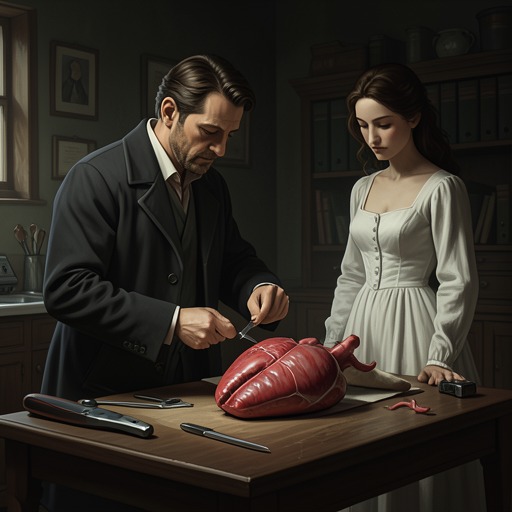
That reasoning gives the heart a double status. It is the bodily object at the center of the crime, but it is also a sign through which observers construct an explanation. The removal can point toward religious fanaticism, yet that interpretation is vulnerable to deliberate imitation. Later, Landor admits that he took hearts from sheep and cows, and that he removed the hearts of the other two men he killed to make the crimes look like the work of Satanists. He had practiced on animals because he lacked Artemus Marquis’s training, while acknowledging that handling a human heart was different. Thus an apparently legible symbol becomes evidence that can be staged: the heart suggests a ritual, but its presence cannot by itself establish who performed one or why.
The novel places this uncertainty against the ordered life of the United States Military Academy. At evening parade, the companies move in formations, and the gap once occupied by Leroy Fry is filled by another cadet. The ranks absorb the absence so effectively that only a trained observer might notice a missed step or a stumble. Against that collective order, the removed heart marks a loss that cannot be made whole merely by filling a place. The contrast does not make the parade part of the secret rite; it shows two different ways of managing absence, one by restoring formation and the other by turning bodily loss into a sign.
Sacrifice and the promised cure
The suspected rite becomes more than an investigative theory when Landor confronts Dr. Marquis with the progression of sacrifices in the family’s practice. He argues that animal sacrifice continued until animals were no longer considered sufficient, raising the question of the sacrifice of young men. His accusation links the missing heart to a system in which a body is treated as a means toward another person’s desired outcome. The heart is not taken as an isolated curiosity: it belongs to a sequence of escalating acts.
Dr. Marquis explains the appeal of that sequence through Lea’s illness. He says that Henri le Clerc promised her a cure if she did what he asked, and that she complied. According to the doctor, her spells became less frequent and less severe. The reported improvement helps explain why the promise could hold power for the family without proving that the rite offered a reliable cure. In this account, the heart is made to carry hope: it is presented as the final means of escape after an apparent easing of Lea’s symptoms.
The distinction between what Lea wants and what she is told she needs is crucial. Dr. Marquis says she wanted none of the human heart itself; Henri le Clerc had told her it was the only way to be free once and for all. Her stated desire is not for sacrifice but for release from what the family calls her curse or gift, and for the chance to be whole and to love. The heart’s ritual meaning is therefore imposed through a promise: it is made the price of an imagined return to ordinary life. The plot exposes the danger in converting a person’s longing for relief into a rationale for taking another person’s life.
The heart made visible
At the family’s private ceremony, the heart is at first concealed among objects and figures arranged within a fiery ritual space. Lea and her companions turn toward a shrouded bundle outside the magic circle. Artemus Marquis removes its clothing to reveal Edgar Allan Poe, lying pale and rigid. The scene establishes that the rite’s objects and participants are not simply abstract symbols: a living person is present as the ceremony reaches its decisive stage. Landor sees Poe and recognizes that he must act if he is to save him.
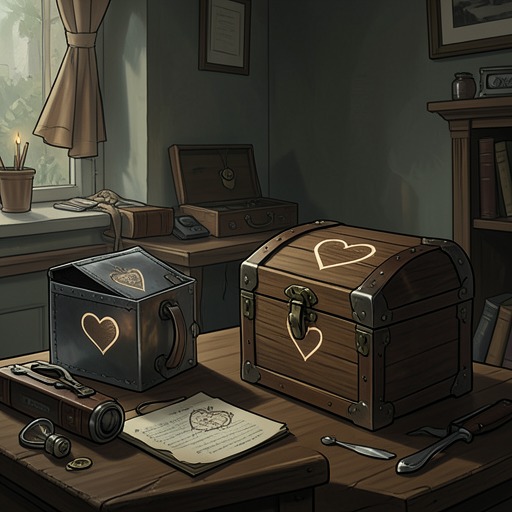
Later, Lea reaches into a niche in the stone wall and takes out a small wooden box, described as a cigar box, probably belonging to her father. She studies what is inside and presents it to her companions. The heart seems slight in its container, scarcely larger than a fist, a scale that sharply contrasts with the extraordinary importance assigned to it. Its smallness does not make it harmless. Rather, the plain box concentrates the rite’s contradiction: a modest object is expected to deliver freedom, while its acquisition rests on a grave human cost.
Landor understands the heart as both the beginning and the end of everything. Its removal begins the chain of investigation and suspicion; its appearance at the rite brings the family’s purpose into view and precipitates his decision to intervene. The object does not resolve the conflict between belief and evidence. It makes the stakes unmistakable: the promised cure depends on treating a human heart as a ritual instrument, while the investigation has already shown how easily the appearance of ritual can be manipulated.
Emotional meaning and betrayal
The novel’s figurative use of the heart becomes most explicit in the aftermath of Landor’s confession. Edgar Allan Poe tells him that he has broken his heart more completely than anyone else. The statement gives emotional force to an image that the plot has made literal through the taking and handling of hearts. It also reverses the logic of the rite: the most devastating injury in this exchange is not the removal of an organ but the destruction of trust between people who had worked together.
That reversal does not cancel the heart’s material history. The narrative keeps emotional heartbreak beside the physical heart used to frame murders as satanic, the heart promised as the means of Lea’s freedom, and the boxed heart raised during the family’s ceremony. Each meaning unsettles the others. As a ritual object, the heart is made to promise transformation; as evidence, it can misdirect; as an emotional symbol, it names a wound that survives betrayal. The motif’s force comes from this refusal to separate body, belief, and feeling: the heart can be treated as an object, but no ritual or explanation can make its human significance disappear.