The icehouse confrontation and collapse
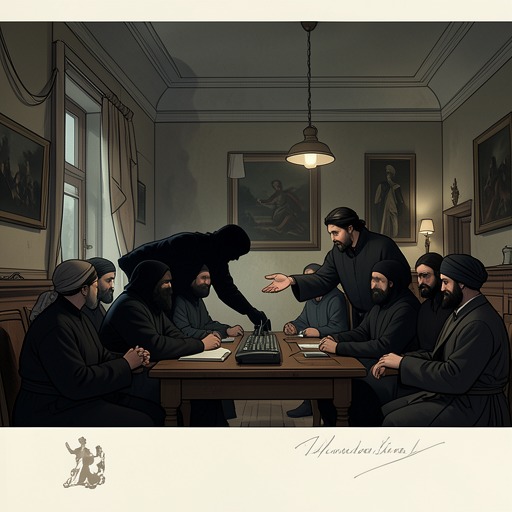
The Pale Blue EyeThe icehouse confrontation and collapse is the climax of the investigation and the failed final rite of the Marquis family. In the underground chamber, Augustus Landor presses the family toward an answer for the deaths of Leroy Fry and Randolph Ballinger. Artemus Marquis admits that he committed both murders and identifies Julius Stoddard as an accomplice who fled. As Lea Marquis attempts to use the heart in a ritual meant to secure new life, the brazier fire compromises the wooden ceiling; the ice stored above it crashes into the chamber. The disaster kills Artemus and Lea, leaving the family’s effort to command life and death undone by the very room they chose for their rite.
The confrontation and the confession
Landor’s tactic is to make the family see the consequences of silence. He tells Mrs. Marquis that someone must be held responsible and invokes the danger of allowing cadets to be killed without consequence. He then turns the accusation toward Lea, presenting the case against her as the likeliest explanation while Stoddard remains missing. The claim is a calculated pressure point, not a settled conclusion: Landor makes clear that he needs one person to hand over to the authorities and is prepared to let the rest of the family go if someone corrects him.
The strategy succeeds when Landor addresses Artemus directly. Artemus first acknowledges that the plan was his, not Lea’s. After an anguished exchange with his sister, he steps away from her and confesses to killing Fry and Ballinger. Landor asks how Stoddard was involved; Artemus describes him as an accomplice who panicked and ran. The confession changes the meaning of the confrontation: the suspected crimes are no longer merely the investigator’s reconstruction, and Lea is no longer the likeliest explanation Landor has offered to force a response.
Landor and Edgar Allan Poe restrain Artemus when he tries to rise, while Landor holds a torch near him and orders him to stop. The physical contest ends not in further argument but in a sudden disturbance elsewhere in the chamber. The shift is decisive: the investigation has obtained its answer, but the rite that brought the family together is still in motion, and the immediate danger has moved from accusation to Lea’s attempt to carry it out.
Lea’s attempt to complete the rite
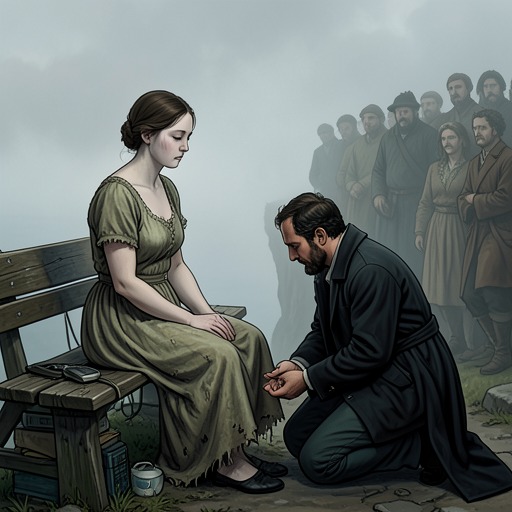
Lea stands before the rock altar and has consumed the heart rather than offered it. Landor understands this as her final attempt to gain new life by following Henri le Clerc’s instructions. His account presents her action as divided: she has followed the rite’s direction, yet cannot fully carry it through. The heart lodges in her throat, obstructing her breathing, and she collapses. The intended transformation becomes an emergency that the people around her can only try to meet with practical help.
Landor lifts Lea’s torso, Mrs. Marquis tries to assist, and Edgar Allan Poe urges her to keep breathing while help is expected. Artemus approaches with the lancet he had used to open Poe’s vein. Without explaining himself, he makes clear that he intends to create an airway for his sister. Mrs. Marquis tries to take the instrument from him, but Artemus proceeds. The scene briefly gathers the antagonists around a shared purpose: the man who has confessed to murder is now trying to save Lea, while Landor and Poe assist rather than continue the confrontation.
The attempted rescue does not restore the situation. When Mrs. Marquis tries to reassure Artemus that they can explain everything to Colonel Thayer, Artemus answers lightly but remains where he is, holding Lea close. Landor then sees that Artemus has turned the lancet on himself. The evidence of his act makes his apparent calm legible as a farewell rather than a plan to leave the chamber. The family’s effort to save Lea and Artemus’s decision to die unfold together, with no resolution secured by the promises of an explanation or a return to ordinary life.
The ceiling gives way
The fire that had illuminated the confrontation becomes the cause of the chamber’s collapse. The room is cut from rock, but its ceiling is wood; as the brazier flames weaken the beams, the ice stored in the West Point icehouse above begins to fall through. The blocks are massive, not the small pieces used to cool a drink. Their impact damages the stone floor and progressively makes the room and its entrance unsafe.
Mrs. Marquis calls to Artemus from the corridor and tries to draw him out. Landor pulls her back as the falling ice approaches. Artemus remains inside with Lea. The first blocks knock him down; subsequent impacts kill him. The disaster does not pause for the family’s grief or for Landor’s attempt to control the scene. The chamber’s collapse has become an impersonal force, overtaking the human choices that brought the characters there.
Amid the falling ice, Lea rises and walks despite the injury to her throat. For a moment her apparent return to life seems to fulfill the hope that shaped the rite, but the book does not present it as a lasting recovery. The ice continues to fall and crushes her as well. The doorway becomes impassable, and the ice spills into the hall. Landor, Edgar Allan Poe, and Mrs. Marquis remain outside the chamber, witnessing the destruction without being able to stop it.
Reversal and significance
The scene turns the promised cure into its opposite. Lea follows the instructions associated with Henri le Clerc, but consuming the heart threatens her life; her brief rising does not free her from the catastrophe. Artemus, who has admitted responsibility for two murders, first attempts to save his sister and then dies in the collapsing chamber. The family’s effort to control death through ritual ends in deaths caused by the fire and falling ice.
The confession also resolves a central uncertainty in the investigation while exposing the cost of treating the family’s secret as a private matter. Landor has forced Artemus to name himself as the killer and Stoddard as his accomplice, but his investigative success cannot protect those gathered around the altar. The event therefore joins revelation to irreversible loss: the truth emerges, yet there is no orderly transfer from confession to justice. Instead, the icehouse itself becomes the final agent of consequence, burying the rite and the Marquis family’s hopes beneath the material they had kept stored overhead.