The preserved human heart
The Pale Blue EyeThe preserved human heart is at once a possible remnant of Leroy Fry’s murder, the focal object of a secret ceremony, and the novel’s most concentrated image of grief made material. Hidden in a small wooden box at the icehouse, it draws together the investigation’s clues and the Marquis family’s ritual, while leaving a crucial uncertainty unresolved: even after the ceremony, the heart’s identity and its place among other missing hearts remain questions rather than settled facts.
Discovery and Physical Description
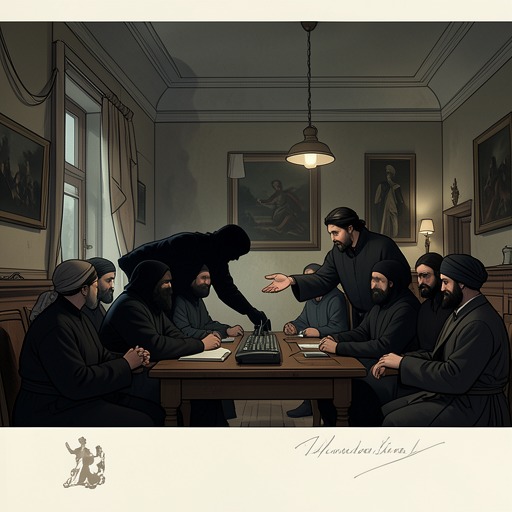
At the icehouse, Augustus Landor arrives as the Marquis family’s ceremony is underway. A circle of torches encloses a triangle of candles; tapers burn along the walls, and a brazier and a pine tree send fire almost to the ceiling. Against this spectacle, a shrouded form lies just outside the circle. Landor first makes out a bundle of clothes and a bare hand. Artemus Marquis removes the garments one by one, revealing Edgar Allan Poe, pale and rigid, with his coatee stripped away. The extreme cold, Landor realizes, is sufficient to keep a heart in good condition for many weeks.
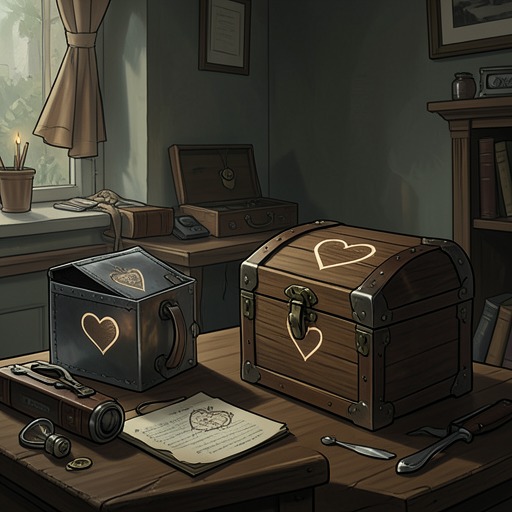
The ceremony’s attention turns to the heart when Lea Marquis reaches into a niche in the stone wall behind the rock altar and takes out a small wooden box, perhaps one of her father’s cigar boxes. She opens it and shows its contents to her companions. The object seems slight, scarcely larger than a fist, especially beside the elaborate firelit setting and the trouble expended to conceal and retrieve it. Its smallness does not make it incidental: Landor understands that the heart has been the beginning of the events and may also bring them to an end.
A Clue in the Investigation
The heart’s appearance in the icehouse makes concrete the crime that had first led Landor and Poe toward religious explanations: someone had taken Leroy Fry’s heart. Landor reasons that if the killing involved a rite, its objects might have been removed to hide the evidence, while their impressions could remain. The search for traces in the icehouse follows this distinction between things carried away and marks left behind. The heart is therefore both a physical object and evidence of an action whose setting and purpose must be reconstructed.
Its preservation and concealment also complicate the investigation. At a later point, Poe recalls details of the chamber and asks whether the heart there was Leroy Fry’s. If it was, he reasons, other missing parts are still unaccounted for: the hearts of farm animals, Randolph Ballinger’s heart, and another part of Ballinger’s anatomy. Landor suggests they may have been stored for future ceremonies. The exchange raises a possibility but does not establish it as fact. The heart seen in the box becomes the center of a larger pattern of suspected ritual use, while the whereabouts of other remains remain unresolved.
Ritual Object and Symbol
The object’s force depends partly on the contrast between its bodily reality and the ceremony’s elaborate staging. It is neither a grand relic nor a mysterious ornament: it is a human heart, small enough to fit inside a cigar box. Yet the circle, triangle, altar, candles, and fire place it within a deliberate ritual arrangement. Lea’s companions turn toward the shrouded form, and later she lifts the heart toward the ceiling. The ceremony makes the object appear to command the room even as it exposes how materially slight it is.
That contrast gives the heart several functions without reducing it to one certain meaning. It is a possible forensic link to Leroy Fry, a focus of the Marquis family’s rite, and a sign of how violence can be converted into ceremony. Landor’s investigation treats ritual as something that may leave practical traces; the family’s actions treat the heart as the center of an act whose full purpose the evidence does not disclose. The gap between these approaches sustains the object’s mystery. Its presence matters, but the precise beliefs attached to it cannot be inferred simply from the spectacle around it.
Memory, Absence, and Continuing Presence
The heart’s significance also resonates beyond the icehouse. At the United States Military Academy, the space once occupied by Leroy Fry in the evening formation has been filled by another cadet. The ranks appear complete, though a trained observer might notice a lost step or half shuffle. That substitution makes visible a contrast central to the heart’s story: institutions can cover a vacancy, but the missing person and the violence done to his body persist in memory and investigation.
Landor’s dream of Fry returns this tension in altered form. In it, the noose remains, but the hole in Fry’s chest has disappeared; he wears officer blue and holds charcoal and a cage of blue-eyed birds. The birds repeat that he will not tell, while a woman sings and the academy drums continue. Landor calls the episode fancy, not evidence about the heart’s identity or fate. Its images nonetheless join bodily absence to unanswered testimony: even in a dream that restores Fry’s chest, the murder’s silences remain.
The novel finally widens this connection between objects, memory, and the dead through Landor’s reflections on time. He imagines generations brought together, with the dead continuing their ordinary pursuits among the living. In that vision, Lea studies with Henri le Clerc and Edgar Allan Poe writes verses with Mathilde Landor. The preserved heart belongs to the same imaginative world of material remnants and continuing attachments: it cannot, by itself, restore the dead or explain every loss, but it gives absence a form that can be carried, hidden, found, and interpreted.