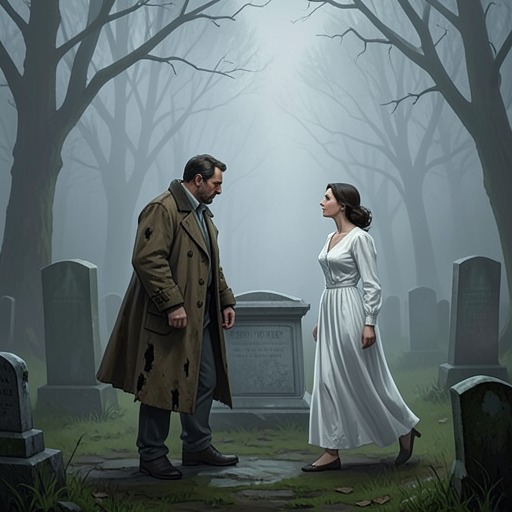
The sorrow for the dead is the only sorrow from which we refuse to be divorced.
The Pale Blue EyeThe sorrow for the dead is the only sorrow from which we refuse to be divorced. stands as an epigraphic key to the novel’s treatment of bereavement: the dead may be absent, but grief keeps them in relation to the living. Attributed in the opening pages to Washington Irving’s Rural Funerals, the sentence links private mourning to the book’s larger insistence that loss persists in the habits, memories, and stories of those left behind.
Wording and framing
The aphorism’s force rests on the contrast between sorrow and divorce. Grief is painful, yet the sentence describes separation from it as something the bereaved resist. The wording makes mourning more than a response to death: it becomes a bond, maintained even when the person who gives the bond its meaning is gone. Placed at the threshold of the narrative, the line prepares the reader for a story in which the past repeatedly presses into present experience.
Bereavement in daily life
Augustus Landor gives the idea an intimate, physical form when he describes sleeping alone after Amelia has been gone for years. He recalls the discomforts of sharing a bed, then admits that he cannot grow used to its emptiness: he still lies on his side and tries not to use too much blanket. The smallness of the habit makes the loss tangible; absence has altered how he occupies even an ordinary space. When Patsy clarifies that she was speaking of someone other than Amelia, Landor answers that she is gone too. The exchange leaves the second absence unnamed in that moment, but its distinction underscores how grief for one lost person does not cancel grief for another.
Dreams, objects, and belated recognition
The aphorism also illuminates the way the dead return in Landor’s account of his troubled sleep. After repeatedly visiting Leroy Fry’s preserved body at the Academy hospital, Landor dreams of Fry transformed: the wound in his chest is gone, he wears officer blue, and he holds charcoal and a cage of blue-eyed birds. His voice becomes the birds’ repeated assurance, “I won't tell,” while a woman sings and the West Point drums continue. Landor dismisses the dream as fancy, yet describes waking with the drum still in his chest and the dream’s shadows half visible. His own uncertainty about the boundary between dreaming and waking gives the return of the dead a formal echo: what should be past remains perceptible, even when the narrator tries to set it aside.
A later embedded story gives mourning a further consequence. A bereaved father opens a volume of Byron’s poetry and finds the chain his daughter had clutched after she was attacked. She had concealed it in a treasured book, and its lozenge-shaped brass plate bears the Corps of Engineers coat of arms. The object turns private sorrow into evidence: the father reads his daughter’s preservation of the chain as a message meant for him to discover and use. Grief here does not merely hold the dead close; it shapes what the living notice and what they do next.
The dead within the present
Near the novel’s end, Landor describes time as soft and pleated, capable under pressure of bringing people from different generations into the same space. The dead appear to him not as figures consigned to a distant afterlife but as continuing occupants of ordinary existence, carrying on the business they knew in life. He imagines Edgar Allan Poe writing verses with Mattie and other departed figures sharing his ground and air. This vision gives the epigraph its broadest reach: refusing separation from sorrow also means refusing a clean division between the living and the dead. As Landor approaches his own end, the possibility that Mattie may be among those he encounters makes that imagined continuity a source of comfort.