Uncertainty in Written Records and Interpretation
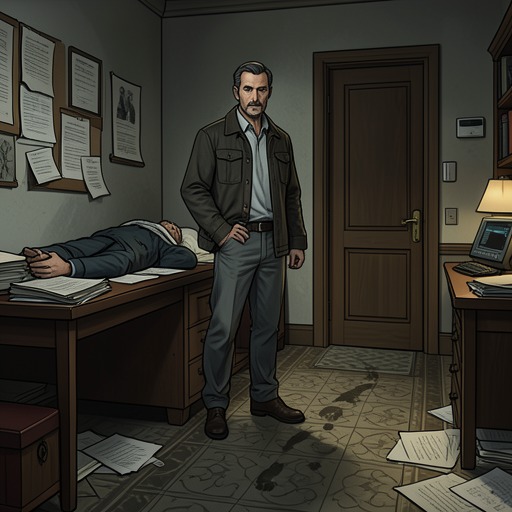
The Pale Blue EyeUncertainty in Written Records and Interpretation shapes the investigation by making evidence both indispensable and unstable. Witnesses remember selectively, observations set limits on what can be known, and written accounts bring their authors’ purposes and blind spots with them. As Augustus Landor gathers statements, reports, and scraps of paper, the growing record does not simply resolve the mystery: it can obscure one account with another, and its most consequential meanings may depend on who preserved or presented it.
Contingency, Testimony, and the Limits of Observation
Augustus Landor’s retrospective account of Epaphras Huntoon finding Leroy Fry makes the fragility of eyewitness knowledge concrete. The night was very dark, with clouds, a tiny moon, and only Huntoon’s lantern to light his way. Landor imagines that a small change in direction—one yard north or south—might have left Huntoon passing Fry without knowing he was there. The body’s discovery therefore depends on a narrow accident of place and visibility. Huntoon’s later testimony can report what he encountered, but it cannot make the encounter inevitable or transform the darkness into a complete view of the scene.
Medical examination offers another kind of evidence, with its own boundaries. A doctor identifies a contusion and estimates that the lump rises roughly a quarter inch above the skull. Asked what caused it, he can say only that a hard object came into contact with the head; without examining it further, he cannot identify more. His explanation of bruising also gives the missing heart forensic significance: a bruise depends on blood escaping its vessels, and without circulation there can be no such bruise after death. This reasoning narrows what is plausible, but it does not identify the object or person responsible for the injury. The distinction between a supported conclusion and an unanswered question is central to the novel’s treatment of evidence.
Documents That Multiply Rather Than Settle Meaning
The novel extends that uncertainty from witnesses and examination to the written record. Reflecting on whether Patsy might keep a diary, Landor considers the many texts already surrounding the case: Edgar Allan Poe’s poems and prose, Professor Pawpaw’s notebook, Joseph Locke’s notebook, the rumored journal of Captain Hitchcock, a scrap found in Fry’s fist, an engraving of a devils’ sabbath, and newspapers associated with Sylvanus Thayer and Blind Jasper. Landor does not picture these materials converging into a single account. Instead, they erase one another, making the distinction between a true word and a misleading one increasingly difficult to maintain. A diary may preserve an individual perspective, but the mere addition of another text cannot guarantee clarity.
Poe’s written reports demonstrate how a document can be informative while remaining shaped by its writer’s position. In his November 27 report to Landor, Poe describes the alarm and rumor following Randolph Ballinger’s murder, notes that his movements are being scrutinized, and remarks that fellow cadets seem to regard him with suspicion. The report records the atmosphere as Poe experiences it, but it is also a self-presentation by a person who knows he may himself be suspected. Its account therefore contributes to the investigation without standing outside the social pressures it describes.
That problem becomes especially clear when Poe reports on his covert observation of Lea and Artemus Marquis. He recounts hiding near their backyard conversation and acknowledges that he had to resist abandoning the eavesdropping. He presents persistence as a duty owed to Landor and the Academy, while explicitly denying that personal curiosity motivated him. Yet his position beneath a crabapple tree gives him only fragments: the siblings mostly whisper, and occasional words become audible, but he cannot assemble what he hears into a coherent narrative. The report exposes both a limit of access and a rhetorical interest. Poe tells Landor what he thinks he learned, but also argues for the propriety of how he learned it.
Reports, Objects, and Competing Interpretations
Poe’s December 5 report shows the documentary record shifting between public incident and personal testimony. He describes the first snowfall, the cadets’ excitement, and a snowball fight that threatens to become a larger skirmish before company commanders restore order. The dated report gives Landor a vivid account of that afternoon, but its immediacy is still mediated by Poe’s selected details and manner of telling. What is vivid on the page is not the same as an exhaustive or neutral account.
A different paper acquires force through the circumstances in which it is produced. When Landor asks Poe to show Lea’s note, Poe’s expression falters and he repeats the word as if its significance has momentarily escaped him. The exchange makes the note a material object within an inquiry, but the passage does not let the paper speak for itself: its relevance emerges through Landor’s knowledge that Lea slipped it into Poe’s pocket and through Poe’s response when challenged. The scene shows how an artifact may be interpreted through surrounding testimony and behavior rather than treated as self-explanatory proof.
Poe’s December 8 report likewise accompanies, rather than replaces, physical evidence. He describes retreating from Benny Havens’ establishment along the icy river shore, where he repeatedly stumbled and nearly fell into the Hudson River. The preceding account of the struggle records that he later found a dirt- and twig-smeared priest’s collar caught around his coat sleeve. The report supplies Poe’s account of his escape; the collar is a surviving object from the encounter. Read together, they offer different kinds of information, but neither alone establishes everything that happened. Their significance depends on comparing the account with the material trace.
The Record as Evidence and Concealment
The uncertainty surrounding documents reaches its sharpest point when Landor asks Poe to place two scraps side by side. Poe identifies one as the note found in Fry’s hand and the other as a note Landor himself had left for him. The juxtaposition makes the investigative record inseparable from Landor’s own actions: he has not merely interpreted evidence but has helped determine what paper entered Poe’s possession. Landor’s narration acknowledges that the message was intended to ease his conscience without succeeding. The scraps therefore function as evidence and as reminders that the investigator’s conduct can shape the archive on which an investigation depends.
Across testimony, medical reasoning, reports, diaries, and physical scraps, the novel does not treat uncertainty as a reason to abandon interpretation. Instead, it asks that conclusions remain answerable to the particular source, the conditions under which it was produced, and what it cannot establish. Landor’s retrospect, Poe’s reports, and the objects passed between them form no impartial repository: each is entangled with limited access, personal perspective, or deliberate handling. The record can expose a truth, but it can also multiply plausible readings—and, when its custodian is implicated, conceal the very responsibility it seems assembled to reveal.