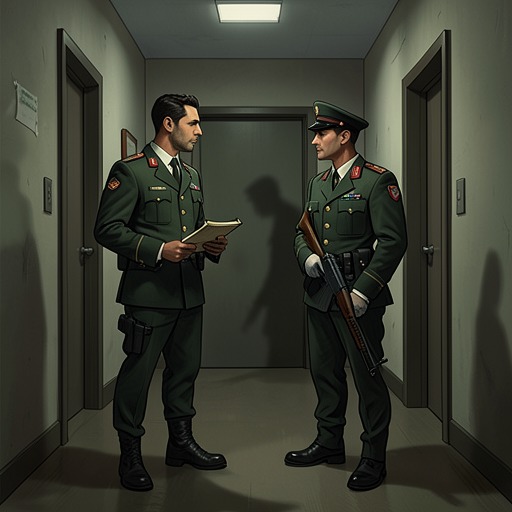
United States Military Academy
The Pale Blue EyeThe United States Military Academy is the novel’s enclosed military setting and the institution whose safety and authority are threatened by the deaths of cadets. Its physical grounds shape the investigation, while its rules govern Landor’s movements, Poe’s access to information, and the daily routines unsettled by fear. The Academy’s effort to preserve order becomes part of the mystery: it can regulate who goes where, but it cannot prevent violence or contain the rumors that follow.
Grounds and Spatial Order
Landor describes the Academy grounds as a place where buildings of wood, stone, and stucco seem to stand only by nature’s leave. Within this unsettled landscape lies The Plain, a broad parade ground of roughly forty acres, its surface pitted and patched with grass. It stretches north toward the Hudson River, which turns west behind the trees. Landor already knows both the name and purpose of the field: it is where cadets are made into soldiers. The contrast between the irregular terrain and the Academy’s ambition to impose discipline gives the setting a defining tension: military order is asserted within a landscape that does not appear wholly mastered.
The grounds also organize the investigation into the removal of Leroy Fry’s heart. Landor identifies a roughly twenty-yard-square area north and slightly northeast of the icehouse door as the scene of that crime. The surrounding landmarks make the position legible: officers’ quarters lie northwest, cadet barracks to the west, the Academy buildings to the south, and Fort Clinton’s guard post to the east. Landor concludes that the site was chosen because it offered the perpetrator a chance to work unseen. After searching around the icehouse on foot without finding what he needed, he recognizes that he has been examining the place from the wrong vantage point. The Academy’s buildings and posts, intended to order and watch the grounds, also create blind spots.
The Plain and the icehouse therefore serve different but connected purposes in the story. The parade ground represents the Academy’s public work of formation and display; the secluded area beside the icehouse exposes the limits of its oversight. The same landscape that trains cadets and organizes military movement contains a concealed setting for the crime that imperils the institution.
Command, Access, and Surveillance
The Academy is governed through a visible hierarchy. Sylvanus Thayer is superintendent, and Captain Hitchcock is second in authority as commandant. Landor’s first official meeting with Thayer takes place in the superintendent’s basement office, reached through the quarters by way of Thayer’s former-soldier servant, Patrick Murphy. The office is notably dark, with its windows screened by bushes and its candles seeming to illuminate little beyond themselves. The scene locates authority within the institution while giving its first encounter with Landor an atmosphere of restricted visibility.
Landor is not free to investigate as he pleases. The Academy assigns Lieutenant Meadows to escort him, and it initially rejects his request for independence on the grounds that the military reservation must be patrolled and visitors kept safe. The compromise allows Landor to walk the outer perimeter alone, with paroles and countersigns to answer sentinels who stop him. He may not enter the core grounds without an escort or speak with a cadet unless an Academy representative is present. He is also instructed not to discuss the investigation with anyone inside or outside the institution. These conditions make the boundaries of inquiry concrete: access, conversation, and movement are all subject to military control.
That control is not absolute. Landor negotiates an outer route for himself, while Poe devises a discreet way to exchange messages: Landor can leave folded notes beneath a loose rock at the southern edge of the spring in Kosciusko’s Garden, avoiding Poe’s closely shared barracks room. Their workaround shows how confidential investigation must adapt to an environment where privacy is scarce and ordinary contact can be observed. The Academy’s restrictions do not end the inquiry, but they make secrecy and cooperation essential to it.
Barracks, Routine, and Fear
The cadets’ living conditions give physical form to the Academy’s demands. In South Barracks, Edgar Allan Poe shares Number 22 with two roommates in a room only thirteen feet by ten, divided by a partition. Its sparse furnishings include candle sconces, a woodbox, a table, a chair, a lamp, and a mirror; cadets sleep on narrow pallets on the floor, rolling them up each morning with their blankets. The room offers little space for private life or individuality. Landor finds an engraving of Byron beneath Poe’s trunk lid and a small cameo portrait among his belongings, personal objects set against the barracks’ standardized austerity.
Collective routines are equally pronounced in the cadet mess. Hundreds of young men assemble, stand at attention, and wait for permission to sit before eating. In the rush that follows, Landor is largely ignored, allowing him to speak with a steward whose long experience has given him detailed knowledge of cadets’ habits and prospects. The episode shows that information circulates through ordinary service and observation as well as through official channels. The Academy’s routine gathers its members into a regimented whole, yet its daily life also produces informal witnesses and knowledge.
After Randolph Ballinger fails to return from guard duty, an initial search is abandoned after twenty minutes as an ice storm makes movement across the Highlands difficult. It cannot resume until conditions permit. The storm further isolates the Academy, while fear spreads through its enclosed community. In Edgar Allan Poe’s report to Landor, cadets are said to sleep with muskets nearby and to speculate wildly about the killings; at evening parade, the guard is doubled so no cadet goes out alone. The added duty would ordinarily invite complaints, but the cadets accept it as a measure of protection. Surveillance, normally an instrument of institutional discipline, becomes a reassurance sought by those who fear the grounds themselves.
When Julius Stoddard disappears, rumor again outruns certainty. Theories multiply among cadets and others connected to the Academy, faculty households consider leaving, and sentries stand back to back. The ordinary schedule persists beneath this alarm. After the later crisis, the Army drummer’s dawn cadence sounds across The Plain and reaches cadets, officers, and soldiers; the day’s routine resumes without an alarm or interruption. That return to procedure does not undo what happened. It marks the Academy’s capacity to continue functioning even as its people carry knowledge and consequences that the public rhythm cannot express.
Institutional Stakes and Narrative Significance
Thayer’s charge to Landor makes the investigation an institutional matter as well as a search for an individual culprit: Landor must discover who committed the crime and help ensure it does not happen again. Thayer regards the violation of Fry’s body as an offense against the Academy itself and insists that, if an insider is responsible, the offender must be removed from the post. The stated stakes are therefore both personal and organizational: a dead cadet has been wronged, and the Academy’s authority depends on confronting the possibility that the offender belongs to its own community.
As the inquiry develops, its possible reach complicates the command structure. Landor and Captain Hitchcock had considered what to do if a cadet, soldier, or faculty member proved responsible, but the possibility of a faculty member’s son had not been accounted for. Hitchcock’s personal familiarity with Artemus Marquis makes that prospect difficult to separate from the Academy’s institutional obligations. Later, Hitchcock argues that with two cadets dead and another missing, he cannot justify putting another young man in danger. He also anticipates criticism of Thayer for assigning the inquiry to a civilian rather than an officer. The disagreement reveals the pressure exerted by the case on both the Academy’s safety responsibilities and its preferred procedures.
The book’s acknowledgments distinguish this fictional crisis from the historical record: they state that no cadets were murdered or seriously injured during Sylvanus Thayer’s tenure. The United States Military Academy in the story is thus a real institution recast as the setting for an invented investigation involving historical figures. Its carefully managed space and routine give the mystery its structure, while the crimes expose how vulnerable that order is when secrecy arises within the community it is meant to protect.