West Point cadet regulations
The Pale Blue EyeWest Point cadet regulations form a pervasive system for governing the lives of cadets: where they may go, what they may do, and how closely they are watched. The rules appear not as an exhaustive written code but through concrete restrictions and their consequences, from a ten-demerit penalty for leaving barracks after hours to the threat of dismissal for a forbidden engagement. Their reach makes the Academy a world of enforced routines, monitored boundaries, and clandestine exceptions.
Definition and Scope
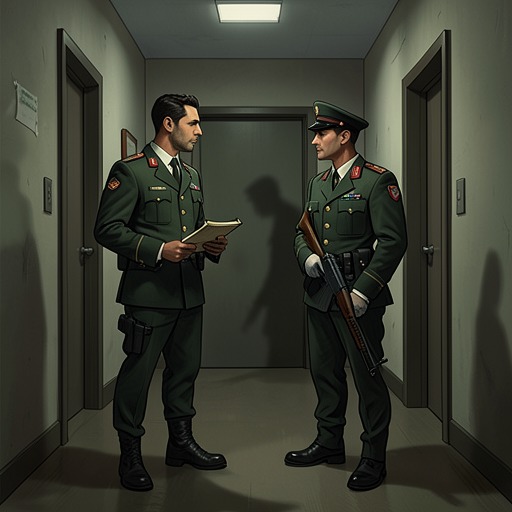
The regulations shape both conduct and access. Augustus Landor explains that Leroy Fry, if he left his barracks room between ten and eleven-thirty at night, risked punishment for being out after hours. Captain Hitchcock identifies the penalty as ten demerits. Landor reasons that such a risk implies a special purpose and someone waiting for Fry, using the Academy’s rule not merely as background but as evidence in his investigation.
The restrictions reach into private life as well. Edgar Allan Poe tells Landor that Jared has an inamorata in North Carolina and is engaged to marry her after graduation; according to Poe, the existence of this attachment alone is enough to earn Jared dismissal. The Academy’s authority thus extends beyond the barracks and classroom, threatening a cadet’s future over a relationship maintained outside the institution.
Surveillance and Movement
The Academy’s control is sustained by observation as much as by stated penalties. In Landor’s account, officers inspect barracks quarters every day. A cadet who reports himself sick is expected to answer a double knock at his door, making absence itself something that must be accounted for. When Edgar Allan Poe claims illness to get away from duties, he chews chalk to make his tongue appear white, receives calomel powders and an excuse from Dr. Daniel Marquis, then slips through a loose fence board in the woodyard to meet Landor. The elaborate deception shows how a routine medical excuse becomes a way to evade institutional scrutiny.
Rules also govern movement beyond barracks. At Benny Havens’ tavern, Landor finds Edgar Allan Poe in daylight, when cadets ordinarily visited at night to avoid the watchdogs. Landor considers three possible infractions: leaving the West Point reservation without authorization, visiting a place where liquor is sold, and going there for the purpose of drinking. The scene makes the boundary between the Academy and the outside world tangible: crossing it is a disciplinary act, even when many cadets have done the same.
The Academy’s restrictions are reinforced through its control of Landor’s own access during the investigation. He asks for freedom to move alone, but is told that West Point must be closely patrolled to ensure visitor safety and protect operations. The compromise allows him to walk the outer perimeter and gives him the passwords needed to satisfy sentinels, while barring him from the core grounds without an escort and from speaking with cadets unless an Academy representative is present. These conditions apply to the investigator rather than to cadets, but they reveal the same institutional insistence on supervised movement and controlled contact.
Prohibitions and Penalties
The restrictions touch ordinary pleasures as well as formal duties. Landor reflects that cadets are denied alcohol, sex, cards, chess, tobacco, music, and novels. His list conveys how little room the institution leaves for unsupervised recreation; even chess, a seemingly quiet pastime, is described as normally forbidden. The broad range of prohibitions makes discipline a continuous presence in daily life, not simply a response to misconduct.
The consequences vary in severity. Leaving barracks after hours carries a specified ten demerits, while a prohibited engagement is described as grounds for dismissal. Other passages depict cadets taking risks without naming a particular penalty: Edgar Allan Poe joins an after-hours gathering in North Barracks, and Artemus Marquis invites him to play cards. These scenes establish the rules’ scope without suggesting that every breach receives the same punishment.
Evasion and Unequal Access
The regulations produce a double life of visible compliance and private evasion. After tattoo, Edgar Allan Poe makes his way out of his quarters by light treading and quick thinking, relying on two fast-sleeping roommates. At North Barracks, cadets have covered the windows with blankets and assembled bread and butter from the mess hall, potatoes from the officers’ mess, a chicken taken from a barnyard, and apples from a nearby orchard. The gathering is not an official Academy activity; its secrecy, timing, and assembled food mark it as an improvised space beyond the regular order.
That space is not free of hierarchy. Randolph Ballinger mocks Edgar Allan Poe and acts as a self-appointed guardian of Artemus Marquis’s circle, while Artemus’s invitation to a later card game carries the force of social authority. The rules press on everyone, but cadets do not encounter them identically: status, connections, and the willingness of others to conceal a breach shape who can participate and who becomes a target. Artemus’s influence within the group does not erase the Academy’s authority; it creates a smaller, informal order operating inside it.
Discipline as Spectacle
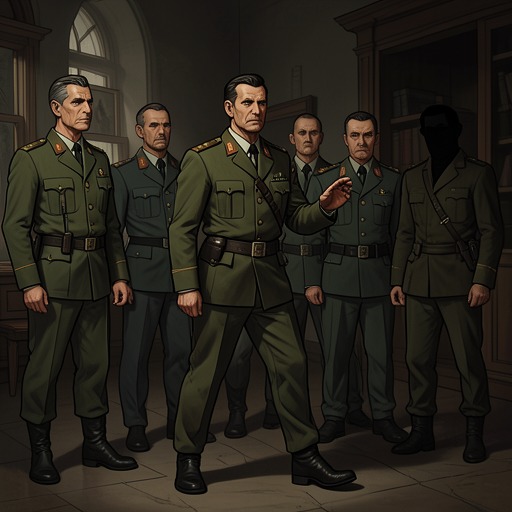
The evening parade gives the Academy’s disciplinary system its public image. On The Plain, cadets assemble in four companies as the band plays and the evening gun fires. At the command, two hundred guns clash into position, and the formations turn together. The ordered movement makes individual bodies legible as parts of a collective performance.
That performance also absorbs loss. By the time news of Leroy Fry’s death circulates among the cadets, another man occupies the place Fry had held in the ranks. The gap is bridged so smoothly that a casual observer might not notice; only a trained watcher might catch a lost step or half-shuffle. The parade therefore embodies both the strength and the cost of the regulations: the Academy can preserve the appearance of seamless order even after a cadet has vanished from it. Across the novel, the cadets’ secret excursions and gatherings expose the limits of that control, while the drills, inspections, and penalties show how insistently the institution works to restore it.