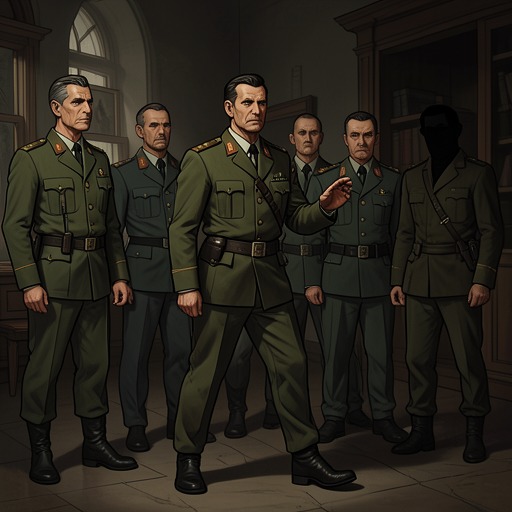
West Point paired-guard policy
The Pale Blue EyeThe West Point paired-guard policy made companionship a condition of cadets venturing abroad at a moment when fear had taken hold of the Corps. Announced at evening parade, it doubled guard posts and required each cadet to have a companion, turning an ordinary obligation of military discipline into a sought-after safeguard.
Policy and Implementation
The announcement came after a cadet had petitioned Colonel Thayer to cancel the rest of the term, including final examinations, because fear for their lives was making it difficult for cadets to study. The response was not to suspend the Academy’s routines but to intensify its guard arrangements: no cadet could venture abroad without a companion at his side.
The increase had a practical consequence for the guard roster. Cadets would have to report for sentinel duty twice as often. The policy therefore joined two forms of order—paired movement and more frequent watch—rather than offering protection by withdrawing cadets from their duties.
Fear and the Burden of Duty
The policy’s reception marks the severity of the moment. Under ordinary conditions, doubling guard requirements might have produced widespread complaints. Instead, the cadets regarded the extra duty as a blessing if it could purchase even a small increase in safety. A routine obligation had acquired the meaning of protection because the men assigned to perform it feared what might happen when they were alone.
That response makes the policy more than a security instruction. It registers how fear altered the Corps’ relationship to its own discipline: the extra demands of institutional life remained burdensome, but now seemed preferable to unaccompanied exposure. The companionship requirement offered limited reassurance, not an end to the danger or a guarantee of safety.
The Academy’s Controlled Space
The policy belongs to a wider pattern of regulated movement at West Point. When Augustus Landor sought freedom to move about the post without an escort, the Academy refused unrestricted access on the grounds that the military reservation had to be closely patrolled. The compromise allowed him to walk the outer perimeter alone, with paroles and countersigns to satisfy sentinels, while barring him from the core grounds without an escort and from speaking with cadets unless an Academy representative was present.
Landor’s restrictions were not the paired-guard rule: he was a private citizen under separate conditions, while the evening-parade order specifically required a companion for cadets venturing abroad. Taken together, however, the arrangements show how movement at West Point was monitored and bounded, with sentinels, escorts, and recognized companions shaping who could go where and under what supervision.
Significance
The policy’s force lies in the contrast between its formal language of guard duty and the cadets’ fearful willingness to accept its cost. By requiring companionship and doubling the watch, the Academy answered anxiety through intensified supervision and shared movement. The order did not resolve the fear; it made that fear visible in the cadets’ changed understanding of a duty they might otherwise have resisted.