West Point’s crisis of survival
The Pale Blue EyeWest Point’s crisis of survival arises from the Academy’s uncertain political standing and the danger that Leroy Fry’s death will intensify existing attacks against it. Colonel Thayer presents the institution as young, contested, and obliged to defend its right to endure; with the Fry investigation under public scrutiny, he seeks to keep control of the inquiry before its findings—or its failures—become a pretext for the Academy’s destruction.
A Young Institution Without Assured Permanence
In speaking with Augustus Landor, Colonel Thayer emphasizes how little history the Academy has behind it: it has existed for fewer than thirty years, and Thayer himself has been superintendent for nearly half that period. Neither the institution nor its leader, he concedes, has earned permanence. His point is more than a statement about age. The Academy’s continued existence is not treated as a settled fact but as something vulnerable to political judgment.
Thayer describes a divided public: the Academy has acquired estimable friends, but also formidable detractors. Its critics, he says, commonly accuse it of elitism and of favoring the sons of wealthy families. He counters that picture by pointing to cadets whose fathers are farmers, mechanics, and manufacturers, presenting the institution as a small-scale image of the country rather than a preserve for the privileged. The contrast shows how the Academy’s public legitimacy depends partly on which account of its social character prevails.
That defense does not erase the institution’s exposure. Thayer says that however many officers West Point produces, and however honorably they serve the country, the Academy remains in the position of defending itself. Its achievements do not, in his account, end the argument over whether it deserves to exist. The crisis is therefore structural as well as immediate: a continuing struggle for public and political legitimacy, sharpened by the fact that the Academy cannot assume its future is secure.
Fry’s Death as a Political Threat
The death of Leroy Fry makes the Academy’s vulnerability immediate. Landor raises the possibility that reports of cadets breaking under what critics call Thayer’s brutal regime—and taking their own lives—could further damage the superintendent and the institution. Thayer answers that news of Fry’s death has already escaped his control. He cannot prevent people from interpreting it as they choose, an admission that public meaning can outrun official authority.
The allegations against Thayer are personal as well as institutional. He recounts being called a tyrant, a despot, and a barbarian. In the conversation, those accusations acquire a sharper edge because they can be attached to the death of a cadet: a tragic case may appear to confirm the critics’ description of Academy discipline. The evidence does not establish that Fry’s death was suicide; rather, it shows how the possibility and the public interpretation of his death threaten to become part of a broader indictment.
Thayer identifies the most dangerous audience as hostile parties in Washington, who, he fears, are looking for a reason to raze the Academy. His concern shifts the stakes of Landor’s investigation beyond the resolution of an individual case. If the inquiry appears unmanaged, or if it reinforces claims that the Academy is cruel and incapable of governing itself, Fry’s death could become ammunition in a campaign against West Point’s existence.
Control of the Inquiry
Thayer’s immediate objective is to keep the investigation out of the hands of those political opponents. He wants to show them that the Academy has matters in hand and that someone is actively investigating. Landor recognizes the calculation: a visible inquiry may buy the institution time by persuading its critics that the case is being addressed. Thayer agrees that this might hold them off, though only for a while. The exchange makes clear that the investigation serves both a fact-finding purpose and a defensive institutional one.
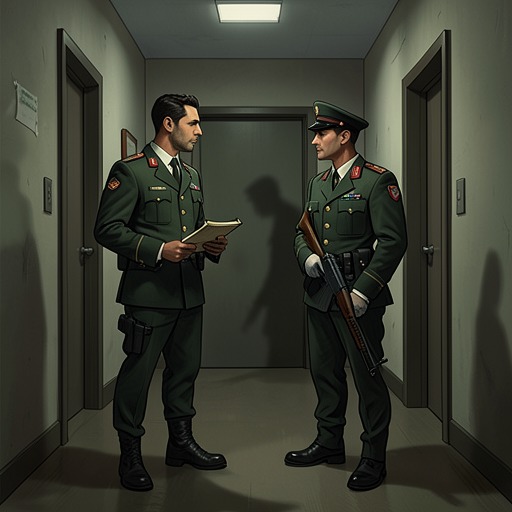
That pressure shapes Landor’s working conditions. Although he ordinarily prefers to go about alone, the Academy assigns Lieutenant Meadows to escort him, and Landor later asks for freedom from an armed guard, Meadows’s company, and other forms of supervision. The Academy refuses, citing its obligation to patrol the military reservation, protect visitors, and avoid compromising operations. These arrangements show that the inquiry takes place inside a command structure that regulates movement as well as information. Landor is asked to investigate, but his access and independence remain bounded by the institution whose future his findings may affect.
The restrictions create a tension between the appearance of control and the investigator’s need to work freely. Thayer wants evidence that the Academy has matters in hand; Landor, in turn, argues that constant accompaniment interferes with the solitary work he considers necessary. The exchange does not resolve that tension. Instead, it presents institutional security as both a practical responsibility and a constraint on an inquiry whose credibility matters to the Academy’s defense.
Institutional Stakes and Uncertainty
The crisis is defined by the gap between West Point’s claim to national service and its continuing need to justify itself. Thayer invokes the officers the Academy produces and the honor they bring the country, yet recognizes that those accomplishments may not protect it from charges of elitism or brutality. The institution’s public image is consequently bound to the handling of a single cadet’s death: an unresolved case can be interpreted as evidence about the Academy as a whole.
The moments surrounding Landor’s appointment establish the precariousness of that position without showing its final resolution. Thayer cannot control how Fry’s death is construed, and the investigation can at best delay hostile action if it demonstrates institutional competence. West Point’s crisis of survival is thus not simply a fear of closure; it is the ongoing effort to preserve legitimacy under political pressure, when both the facts of a tragedy and the Academy’s response to it may be turned into arguments for or against its continued existence.