Witches' Sabbath
The Pale Blue EyeWitches' Sabbath is both a grotesque image in a book and an interpretive frame for the investigation of Leroy Fry's missing heart. In the hands of Edgar Allan Poe and Augustus Landor, the account of a witches' feast turns a suspected act of violence toward questions of religion and ceremony. Its importance lies not in proving that a literal Sabbath took place, but in showing how ritual imagery can organize scattered clues—and how easily an image can shape what investigators think they see.
The Sabbath as an Investigative Premise
Landor proposes religion as a starting point after Poe has connected the taking of Leroy Fry's heart with the Bible. Landor distinguishes his own approach from direct biblical study, but accepts the possibility that the crime bears the marks of religion. He recalls that Fry had fallen in with a disreputable group and later joined the Prayer Squad; Thayer, on seeing Fry's body, had thought of a religious fanatic. These details do not establish a ritual motive. They furnish a pattern that makes the question reasonable enough to pursue.
Landor's method is material and provisional. If a ceremony had used stones, candles, or other objects, he reasons, its perpetrator might have carried them away to avoid leaving evidence. Yet the objects' impressions could remain after the objects themselves were gone. With a search party already on its way and a heart to deal with, the perpetrator might have had little time to erase those traces. The Sabbath therefore enters the investigation less as a settled explanation than as a way to search the icehouse for absences: marks left by things no longer present. Poe listens with his hands folded, an image that gives his stillness a priestly cast without resolving whether he shares Landor's reasoning or is simply considering it.
The Feast in the Book
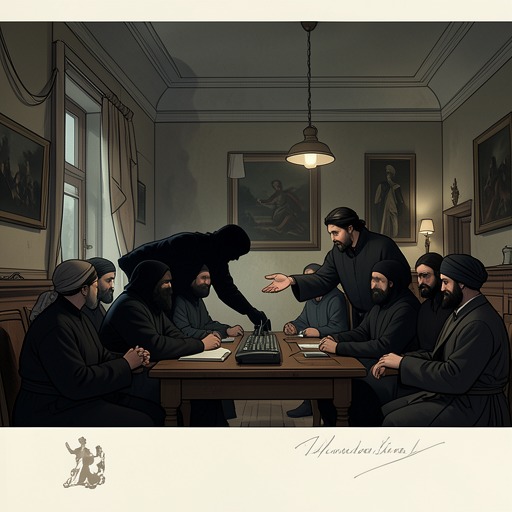
A visit to Professor Pawpaw's quarters supplies a visual and textual version of the Sabbath. Poe studies an engraving spread across two pages: hags ride large rams; winged demons carry off living babies; skeletons and fiends dance around a central, mannerly goat seated in a golden chair. The composition gathers monstrous bodies and festive order into one scene. Its center is not an abstract devil but a figure enthroned amid a crowded spectacle, making the feast appear at once organized and grotesque.
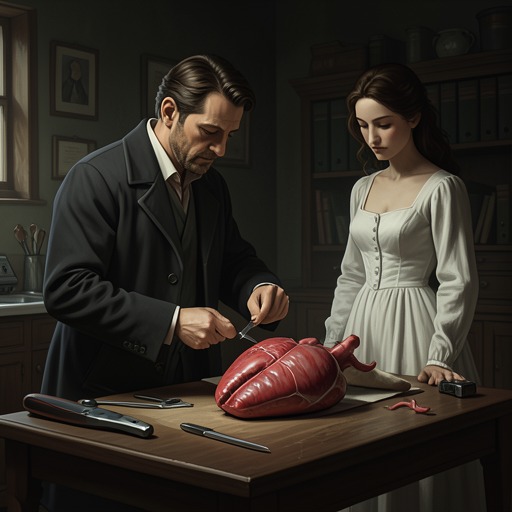
Poe asks permission to read from a passage about the Sabbath ritual, explaining that he is still translating. The text, attributed in his reading to de Lancre, describes what the feast contains. It names unclean animals not eaten by Christians, then the hearts of unbaptized children, and finally the hearts of hanged men. At that last item Poe stops and grins at Professor Pawpaw and Landor. The sequence gives the passage a pointed relevance to Fry: his heart has been removed, and his death by hanging makes the final item resonate with the case. The resemblance sharpens suspicion, but it does not by itself identify a perpetrator or prove that the passage describes the crime.
Public Order and Hidden Ceremony
The Sabbath image gains force beside the Academy's evening parade. On the Plain, four companies of cadets move through a tightly ordered display as the band plays, the evening gun fires, and the flag descends. The commands produce the clang of two hundred guns and bodies turned together toward an imagined enemy. By then, news of Fry's death—part fact, part rumor—has circulated among the cadets. Yet the place he occupied in the ranks is filled by another, and the formation absorbs the loss. A trained observer might notice a lost step, a shuffle, or a stumble; the institution's larger rhythm continues.
This public display and the hidden ceremonial imagery are not the same kind of rite. The parade is collective, visible, and regulated; the ceremony Landor imagines is concealed, reconstructed from traces, and associated with an individual crime. But both scenes make bodies and coordinated arrangement legible as signs. In the parade, discipline turns many cadets into a single formation. In Landor's inquiry, the placement or removal of objects may disclose an act that someone tried to hide. The juxtaposition makes the Academy's smooth order uneasy: visible conformity can cover an absence, while a gap may survive only as a slight disturbance in the pattern.
The Icehouse Image Revisited
Later, Landor sees a chamber through a chasm in the wall. Its walls carry rows of burning tapers; torches form a circle on the floor, with a triangle of candles inscribed within it. A fiercely stoked brazier throws flames nearly to the ceiling, and a pine tree beside it is also aflame. Amid this dense arrangement of light, Landor makes out three figures moving purposefully: a small monk in a gray homespun robe, a priest in cassock and surplice, and an Army officer wearing what appears to be Joshua Marquis's old uniform. He calls the scene the Marquis family's private theater.
The staging recalls the earlier search for ceremonial traces and the book's crowded Sabbath engraving: figures in religious dress, a marked floor, and deliberate movement within a charged space. The echo makes the Sabbath image newly available to the reader, but the evidence does not make the chamber a witches' Sabbath in any literal or historical sense. Rather, the image supplies a vocabulary through which concealed actions can be read, even as the striking visual spectacle risks making resemblance feel like proof. Across the parade, the engraving, and the icehouse, ritual form can signify discipline, imagined evil, or secret purpose; what it means depends on who arranged the bodies and objects, and on what the observer can actually establish.