Ariadne Oliver, who meets the suspects
The Pale HorseAriadne Oliver, who meets the suspects is a well-known writer of detective stories whose professional imagination repeatedly turns toward puzzles and murder. Mark Easterbrook encounters her at work when she is struggling to make a story function, and later sees her discuss murder as an expectation at a gathering and as a question about possible remote killing. These glimpses show a writer whose detective-fiction instincts shape the way she talks about the world, without making her frustration or speculation itself a solution to the book’s mystery.
Identity and Work
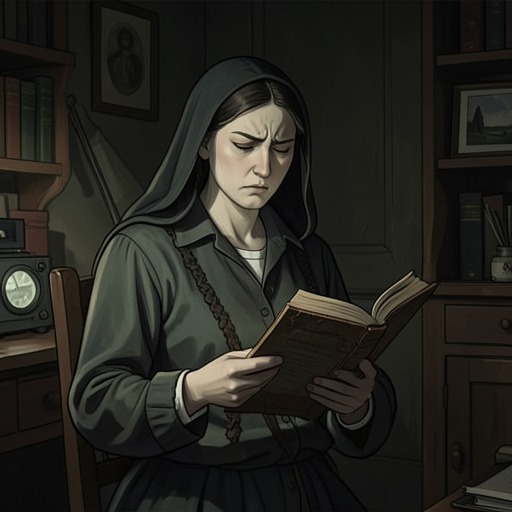
Mark Easterbrook visits Ariadne Oliver, who meets the suspects at the residence of his friend after receiving a request from his cousin Rhoda Despard. He is looking for an excuse to put off his own work, but finds the novelist absorbed in a problem of hers. Her maid, Milly, warns him that she is in a mood and suggests that his arrival might help. The visit thus introduces Ariadne Oliver, who meets the suspects through both her public identity as a successful genre writer and the everyday labor behind that identity: she is trying to get a story written, and finding the effort difficult.
Her workroom is a good-sized room with wallpaper depicting exotic birds nesting in tropical foliage. The setting places her inside a distinctly literary space, but her attention is not on its decoration. She paces, looks around the room and out of the window, and appears unable to settle on how her plot should proceed. The scene makes her creative difficulty visible as an interruption to ordinary conversation: Mark has arrived, but at first she remains absorbed in the problem that has brought her to a standstill.
The Stalled Detective Story
The immediate obstacle is a fictional character who has seen a cockatoo. Ariadne Oliver, who meets the suspects is troubled because the character ought to mention the bird, yet that disclosure would ruin the story’s design. Her difficulty is therefore not simply a lack of an idea; the idea she has constructed depends on withholding a detail that, within the imagined situation, should naturally be reported. The cockatoo becomes a compact example of the tension between a writer’s desired arrangement and the behavior that a plausible character would produce.
When she finally turns her attention fully to Mark, she tells him she feels she is going mad, then resumes voicing her complaint about the plot. The shift from inward absorption to direct address briefly opens a route back to company, but it does not immediately resolve the creative problem. The scene presents Ariadne Oliver, who meets the suspects as intensely occupied by the mechanics of detection fiction: she is thinking not just about what happened in a story, but about how a clue can be made to matter without making the construction feel impossible.
Murder as a Question
Later, in conversation with Mark, Ariadne Oliver, who meets the suspects raises the possibility of killing someone by remote control. Mark first understands the phrase in a technological sense, imagining a button and a radioactive death ray. She rejects that interpretation and clarifies that she means black magic rather than science fiction. The exchange distinguishes two different kinds of explanation—an imagined scientific device and an occult claim—without establishing that either is responsible for any death. Her question opens a line of speculation; it is not presented as proof or as knowledge of a particular crime.
At a gathering, Mrs Dane Calthrop, who watches the Pale Horse residents, studies Ariadne Oliver, who meets the suspects thoughtfully and asks what she expected to happen at the fête. Ariadne answers that she had expected a murder or something of the sort. The answer carries the familiar expectation of the detective-story writer into a social occasion: where another person might anticipate a conventional party mishap, she names the genre’s most consequential possibility. The episode links her earlier concern with how to arrange a fictional clue to a later readiness to imagine murder among the events people discuss in company.
Friendship and the Wider Plot
Ariadne Oliver, who meets the suspects is one of Mark’s friends, and their exchange is easy enough for him to offer to take her to a Chelsea coffee bar. She is wistful about the idea of widening her experience, but declines his invitation for that evening because she is occupied with writing—or, as she explains, with worrying because she cannot write. This small refusal gives her creative preoccupation a practical consequence: even an appealing outing must wait while the stalled work occupies her attention.
She also tells the group that she must return to town for the funeral of Mary Delafontaine, a very old friend whom she believes would have wanted her there. Mark recognizes the name, and the others are surprised by his reaction. Ariadne’s stated reason for going is personal loyalty, not professional curiosity; the moment places friendship and obligation alongside her more conspicuous fascination with murder. Across these encounters, she appears as both a familiar presence in Mark’s social world and a writer whose genre-shaped expectations help bring the subject of murder into conversation. The scenes establish her habits of attention and her relationships, while leaving the cockatoo puzzle, the question of remote killing, and the fête’s anticipated violence distinct rather than treating them as a single answer.