Father Gorman's list of names
The Pale HorseFather Gorman's list of names is a hastily made, physically precarious record that turns a dying woman's suspicions into an investigative clue. Hidden in his shoe after his cassock pocket fails him, the paper outlives its author and helps Inspector Lejeune connect a sequence of apparently natural deaths to an organized scheme of murder.
Origin and physical survival
Walking back through the gathering twilight after visiting Mrs Davis, Father Gorman weighs how much of her extraordinary account might have come from delirium and high fever. He nevertheless decides that certain names must be recorded while they remain fresh in his memory. The urgency is practical: names are precisely the kind of detail he knows he may forget, and the St Francis Guild will be assembled when he returns.
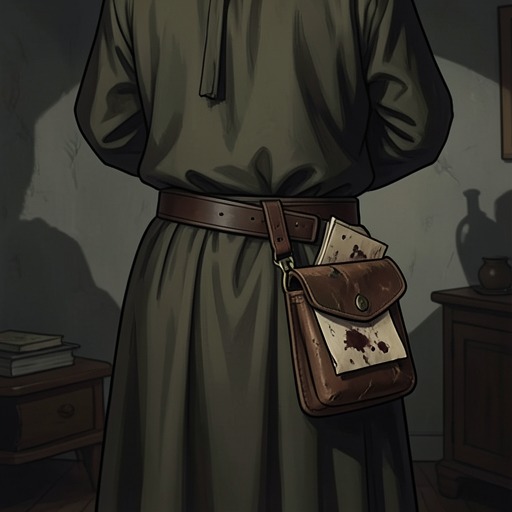
His notebook is unavailable. A seamstress, Mrs Gerahty, has not mended the cassock lining as requested, and the hole has let the notebook, pencil, and coins slip through. Father Gorman manages to retrieve a pencil and a coin or two, but cannot get the notebook. At a small café he asks for paper and is given a torn paper bag. On this scrap he writes the names, folds it, and remembers just in time that his pocket has a hole. He presses the folded memorandum into his shoe, a place he has used before for papers he needs to keep safe.
The list's survival depends on this improvised change of hiding place. After Father Gorman is murdered, the killer apparently searches for something, but the paper in the shoe escapes notice. Inspector Lejeune later produces a flimsy, creased sheet from a drawer: the surviving document is no longer just a private aide-mémoire but evidence available to the investigation.
Names and first readings
Lejeune describes the document's contents as a list of names. The names visible in the investigation include Ormerod, Sandford, Parkinson, Tuckerton, Corrigan, and Delafontaine. When Jim Corrigan sees the list, he notices that his own name appears on it. The discovery gives the paper an immediate personal charge, but the list alone does not explain why any name was written down or establish that everyone named was a victim.
Mark Easterbrook later studies a copy that Corrigan produces from his pocket. He tries to attach familiar people to several entries: he knows two people called Parkinson, recalls a Major Ormerod and a former rector named Sandford, and pauses over Tuckerton, wondering whether the name refers to Thomasina Tuckerton. These identifications are tentative, not conclusions. Their importance is that the names can be matched against Easterbrook's own knowledge and the deaths already under discussion, turning the list into a puzzle whose meaning has to be reconstructed from separate accounts.
The manuscript's route also changes its status. Father Gorman wrote on a scrap because his notebook was inaccessible; after the murder, Lejeune has the recovered paper, and Easterbrook is shown a copy rather than the original. The list thus passes from an urgent private record to a police clue and then to a document examined by someone outside the investigation. Each transfer makes its contents more usable, while the incomplete and uncertain identifications preserve the question of what the names signify.
Connection to Mrs Davis and the deaths
The list's meaning emerges through Mrs Davis's work and memory. Lejeune proposes that it records people she had called on professionally who subsequently died. This interpretation gives the entries a disturbing sequence: the relevant connection is not simply that the named people are dead, but that Mrs Davis had visited them before their deaths. Lejeune stresses that the known deaths appeared to have natural causes, and that there is no evidence, at this stage, to establish the beneficiaries' guilt.
Eileen Brandon's recollection supplies a concrete example. Shown the names, she does not remember each person she visited, but the name Ormerod brings back Mrs Davis's account of a man who died suddenly of a cerebral hemorrhage. Mrs Davis had said that he had been on her list a fortnight earlier and had looked in the pink of condition. His unexpected death upset her. She later joked that people she called upon seemed to die after looking at her, comparing herself to Typhoid Mary, but Eileen remembers that Mrs Davis did not seem entirely comfortable with the coincidence.
That recollection clarifies both the list's basis and its limits. It reflects Mrs Davis's visits and the subsequent deaths she noticed; it is not, by itself, proof that a particular visitor caused a particular death. The pattern becomes significant because the deaths seemed natural, while other people stood to profit from them. Lejeune sees evidence of a carefully designed agency for removing unwanted persons, one that does not need ordinary thugs or gunmen and leaves little to distinguish a murder from a natural passing. The names are a fragment of that larger pattern, not a complete record of its reach.
The clue that makes the list dangerous
Lejeune's reconstruction distinguishes the deaths on the list from the more immediate secret behind Mrs Davis's account. Before she died, she had recognized someone leaving a house where he had no business to be, disguised as some kind of workman. Lejeune reasons that this recognition may have made her dangerous: the visitor might have realized that she knew who he was, and she might have passed that information to Father Gorman. If so, the priest had to be silenced before he could pass it on.
The list therefore performs two related but distinct functions. It points toward a pattern of visits followed by deaths, and it preserves the names Mrs Davis shared with Father Gorman. But Lejeune's account suggests that her recognition of the supposed workman—not simply the existence of the list—may have exposed the person behind the pattern. The paper has survived because it was hidden; its author has not. Its evidentiary value lies in keeping the investigation connected to Mrs Davis's account, while its gaps leave the detective to infer which piece of her knowledge triggered the murder.
As an object in the mystery, the list concentrates the contrast between ordinary appearance and concealed design. It is made from a torn bag when a notebook cannot be reached, folded to fit inside a shoe, and recovered after a search has failed to find it. Its plain contents acquire weight only when joined to Mrs Davis's memory, the sudden deaths, and Lejeune's theory of the disguised visitor. What begins as Father Gorman's precaution against forgetting becomes a surviving trace of the chain of knowledge the killer sought to break.