Father Gorman, whose murder starts the inquiry
The Pale HorseFather Gorman, whose murder starts the inquiry, is introduced through an act of pastoral duty: summoned to the bedside of a dying woman, he offers the comfort of his calling and listens to a confused but urgent account of wrongdoing. He leaves with names he fears he may forget, written on a scrap of paper that survives his killing. The list turns a private confession into the first tangible thread of the investigation, while the uncertainty surrounding the woman’s warning gives his final visit an unsettled significance.
Identity and Pastoral Role
Father Gorman appears as a working priest accustomed to responding to people in distress. He carries a small leather case when he is summoned to Benthall Street, and he goes without delay to the woman who has asked for a priest. The room is neat and furnished in an old-fashioned style, but its order cannot disguise the woman’s grave condition; he recognizes at once that she is very ill.
His response is steady rather than theatrical. When the woman struggles to confess, Father Gorman speaks with the authority and reassurance of his office and belief. The scene presents his ministry as practiced work: he has spoken in this way many times, and his words help ease the agitation in the room. He does not dismiss the woman’s distress or demand a coherent account before offering comfort. His immediate concern is to meet her in the extremity of the moment.
The Visit to the Dying Woman
The woman’s account is fragmentary. Between breaths, she speaks of grave wrongdoing and insists that she cannot die without confessing. After Father Gorman has completed his ministry, she resumes speaking and gives him a warning that something must be stopped. The narrative does not make the full meaning of her words clear at the bedside, nor does it establish how much of her account is reliable.
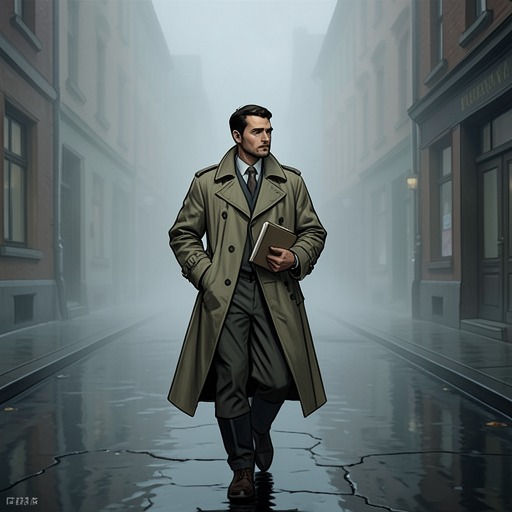
That uncertainty follows Father Gorman from the house. Walking back through the gathering twilight, with fog thickening, he considers how much of the story might have come from delirium and high fever. He believes that at least some of it is true, but cannot decide how much. His response is neither to treat every detail as fact nor to discard the warning altogether: he decides that certain names must be recorded while they are still in his memory.
The List and Its Survival
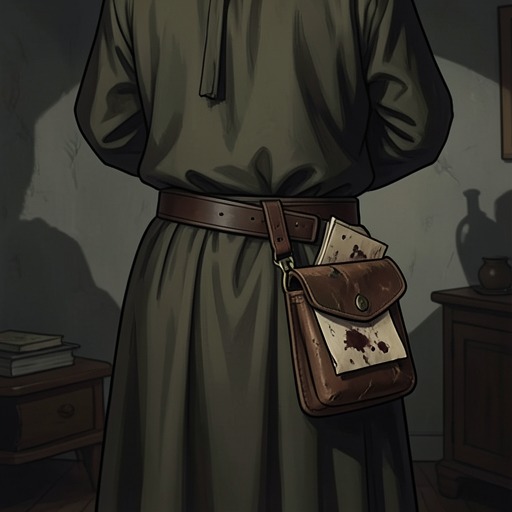
Father Gorman intends to make a note, but discovers that his notebook has slipped through a gap in the lining of his cassock. The practical mishap forces him to improvise. At a small café he orders coffee and asks for paper; what he is given is a torn paper bag. On it he writes the names, conscious that names are exactly the sort of detail he might otherwise forget.
The scrap’s humble form becomes important after his death. Inspector Lejeune later produces a flimsy, creased piece of paper and identifies its contents as a list of names. The contrast is consequential: Father Gorman had no notebook to hand and used whatever paper was available, yet this makeshift record preserves information that might otherwise have vanished with him. The list is not an explanation of the woman’s story, but it gives the inquiry a concrete object to follow.
Murder and the Inquiry
Father Gorman is murdered after visiting the dying woman, and his death turns the names he recorded into evidence in a murder investigation. The police consider whether the killer wanted the paper itself rather than the small change Father Gorman carried. This possibility links the killing to the visit and its concealed information, although the list’s presence does not by itself settle what the murderer knew or intended.
The inquiry also reconstructs Father Gorman’s final walk through a witness’s account. Zachariah Osborne says he saw a man following the priest on a foggy night and gives a detailed description, including features he claims to have seen in profile when the man relit a cigarette. Inspector Lejeune later explains that Osborne’s certainty drew his attention: the fog and the distance made some of the claimed details impossible to distinguish. Osborne’s account proves to be a lie, so Father Gorman’s passage through the street becomes both a lead and a test of the evidence offered in his name.
Narrative Significance
Father Gorman’s role in the novel is brief in duration but decisive in consequence. He does not solve the mystery, and the evidence does not show him reaching a settled judgment about the dying woman’s story. Instead, his combination of pastoral attention and caution shapes what survives: he listens, recognizes uncertainty, and still takes the practical step of writing down the names.
The list connects the woman’s last warning to the investigation that follows Father Gorman’s murder. Its survival makes his interrupted journey matter beyond the immediate scene, while the disputed account of a follower shows how his death generates leads that must be scrutinized rather than accepted at face value. He is therefore both the victim whose killing begins the inquiry and the source of its first durable clue.