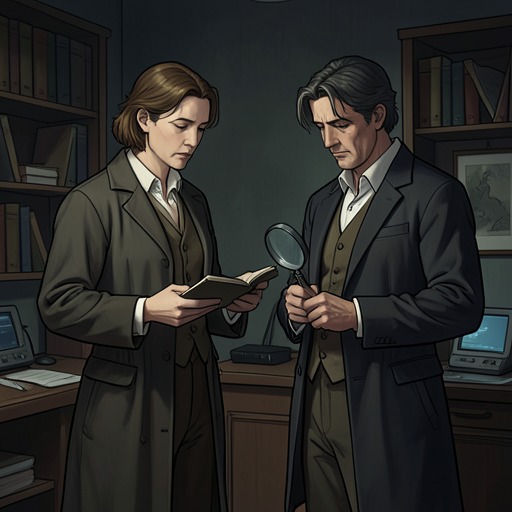
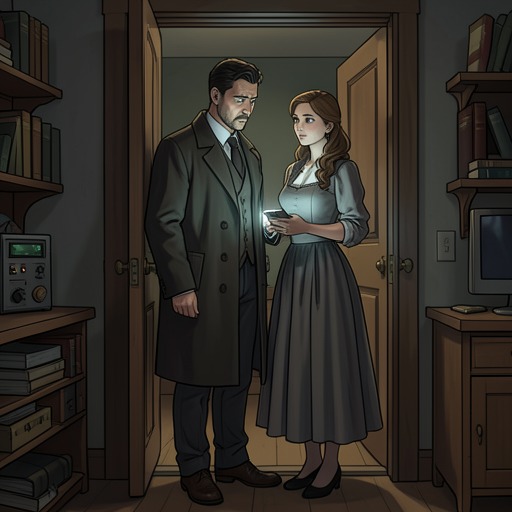
Hermia Redcliffe
The Pale HorseHermia Redcliffe is Mark Easterbrook’s friend and a perceptive, well-educated companion whose response to his murder inquiry exposes a difference between intellectual fascination and practical engagement. She initially frames the strange events Mark describes as colourful remnants of the past; he insists that the names on a list belong to a present danger. Their conversation ends with his request that she help investigate, making her potential role in the inquiry emerge through disagreement rather than shared assumptions.
Identity and Introduction
Mark first appears with Hermia after they have attended a performance of Macbeth at the Old Vic. They leave in hard rain, and Hermia complains that it always rains when one goes there. Mark rejects her generalisation with a playful counterpoint: she remembers the rainy occasions and forgets the others. The small exchange gives their friendship an easy, teasing quality, but also introduces a difference in how they interpret experience: Hermia makes a sweeping observation, while Mark answers by questioning the evidence behind it.
Hermia is twenty-eight. Mark describes her as handsome, with an almost flawless Greek profile and dark chestnut hair coiled at the nape of her neck. His sister calls her Mark’s girlfriend, a label whose knowing emphasis irritates him. The account therefore establishes their closeness without simply defining it as a romance: Hermia is Mark’s friend, while the family’s designation of their connection remains a source of mild embarrassment for him.
A Companion in Mark’s Social World
After leaving the theatre, Mark and Hermia discuss the production as they make their way through the confusing routes around Waterloo Station. They then dine at Fantasie, where their table is close to that of David Ardingly and Poppy. David introduces Poppy as his particular pet and contrasts the serious, highbrow pair with the popular entertainment he and Poppy have just seen. Hermia is thus presented among people who are ready to sort one another by taste and temperament: she and Mark are grouped as the intellectually serious ones, though the inquiry soon tests what that seriousness means in practice.
The scene also places Hermia in a setting of ordinary sociability before Mark brings the murder investigation into their conversation. Dinner, black coffee and the exchange of impressions give way to a subject that he considers urgent. This movement matters because Hermia is not introduced as an investigator or as someone already drawn into the case; Mark turns to her from within their established friendship, asking her to cross from conversation into action.
History or Immediate Danger
After dinner, Mark tells Hermia his story. She listens intelligently and with interest, but her response is not the shock or alarm he expects. She remarks that exciting things happen in the country, then imagines the subject as a lively survey of witches, black masses, isolated superstitions and séances. Her catalogue is knowingly colourful: she sees material for amusing articles about old beliefs persisting in remote places.
Hermia’s reaction does not mean that she has failed to follow Mark’s account. She tells him that she finds it tremendously interesting, but understands it as a page out of history, a survival of forgotten medieval lore. Her interest is genuine; its emphasis is simply different from his. She converts the alarming material into a cultural subject that can be observed and written about, while Mark is preoccupied with the people on the list and with what has happened, or may happen, to them. The contrast makes the list a pivot in their exchange: to Hermia it belongs to a past that can be studied; to Mark it points toward consequences still unfolding.
From Listener to Possible Investigator
Mark sharply tells Hermia that she does not really understand what he has been saying. His objection is not that she has misunderstood the old beliefs he described, but that she has treated them as the main point. He is interested in facts, he explains, and in the fates of named people—not in an amusing historical account. His insistence changes the terms of their conversation: the question is no longer whether the subject is fascinating, but whether it demands action.
He then asks Hermia to help him investigate and to get to the bottom of the matter. Her immediate response is to ask what kind of help he means. The exchange stops at the point where Mark has made the request; the evidence here does not establish what she subsequently does. What it does establish is the opening of a possible partnership, created when Mark makes his practical purpose explicit and invites his friend to share it.
Narrative Role
Hermia’s importance in these scenes lies in the distinction her response draws between fascination and commitment. She is neither indifferent nor uninformed: she listens with intelligence, and the subject holds her interest. But her first instinct is to place the phenomena at a historical and literary distance, turning them into material for articles. Mark’s correction restores their immediate human stakes, centring the names and the danger rather than the atmosphere of witchcraft and superstition.
That contrast also shapes how the reader receives Mark’s account. Hermia supplies a plausible, composed interpretation that makes the events seem like eccentric survivals of an earlier age; Mark’s frustration insists that this interpretation cannot explain away the present facts. Her final question leaves the relationship at a threshold. She has not yet been shown acting as an investigator, but Mark’s direct appeal changes the conversation from the recounting of a strange story to a request for shared inquiry.