Jessie Davis, née Archer
The Pale HorseJessie Davis, née Archer, enters the story at the point where illness and secrecy converge: gravely ill in a room on Benthall Street, she summons Father Gorman and tries to confess before she dies. Her private revelation is not disclosed in the available account, but the circumstances of the visit establish her as the source of a troubling secret and connect her briefly, decisively, to the events that follow.
Identity and Background
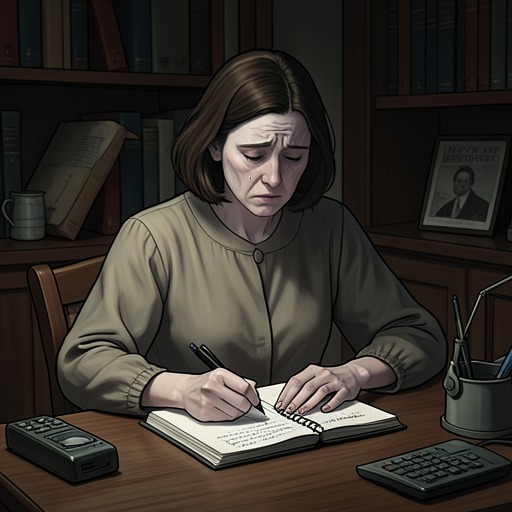
Jessie is known in the account as Mrs Davis, but an inquiry later establishes that Davis was not her real name. She was born Archer, married a man with the same surname, left him, and returned to her maiden name. The explanation makes her identity a matter of change rather than simple concealment: the name under which she is encountered belongs to a later part of her life, while Archer links her to a marriage she had left behind.
Her husband is described as a small-time thief who stole from department stores and accumulated several convictions. He is dead by the time his history is checked. The account gives no basis for treating his petty crimes as Jessie’s, or for assuming that his past explains the sin she tells Father Gorman. Instead, the contrast leaves two kinds of information side by side: an ordinary, verifiable history of marriage and separation, and a serious confession whose substance remains withheld.
Illness and the Request for a Priest
The account of Jessie’s final illness is marked by a brief apparent recovery. She had been unwell, improved enough to return to work, and was warned that she had gone back too soon. When she returned on the second evening, she had a high fever and could scarcely climb the stairs. Her condition worsened over the following day: her eyes were glassy, her cheeks flushed, and her breathing became laboured. She refused the suggestion that a doctor be called.
Only when her speech was failing did Jessie insist that she needed a priest quickly. The request was specific: it could not be the local vicar; she wanted a Roman Catholic priest. That urgency, coupled with her refusal of medical help, gives the episode its narrowing focus. Those around her can see her physical decline, but the particular need she expresses belongs to a religious and personal history they do not know.
The Confession on Benthall Street
A boy sent by Mrs Coppins brings the summons to the presbytery, explaining that a woman at number twenty-three Benthall Street is dying and that the vicar will not do. Father Gorman comes out carrying a small leather case. At the house, Mrs Coppins ushers him into a clean, orderly room furnished in an old-fashioned Victorian style. Jessie lies in a bed near the window, turning her head feebly; her condition is apparent to him at once.
She speaks in broken, breathless fragments about wickedness and the need to confess a grievous sin. Her wandering eyes half close, and her words run into a rambling monotone. The scene does not disclose what she confesses. It instead shows Father Gorman responding through the familiar words of his calling and belief: he speaks with authority and reassurance, and the room becomes peaceful as the agony leaves her eyes. The encounter offers no explanation of her secret, but it makes clear how much she needs to speak and how readily he receives her.
A Private Religious Identity
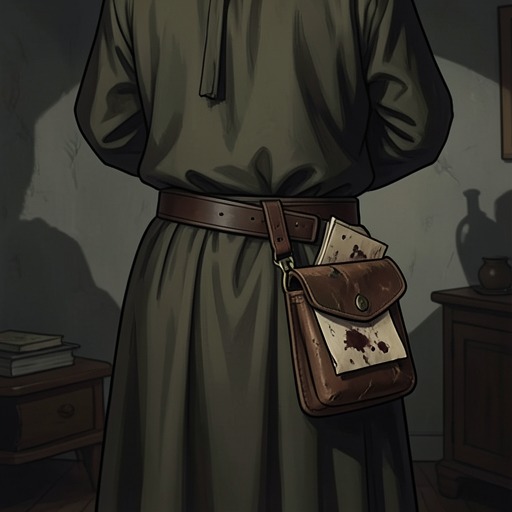
Jessie’s Catholic faith had not been apparent to the people who knew her. The woman recounting the illness tells Lejeune that she had never known Jessie was Roman Catholic and had never seen a crucifix about her. Yet a crucifix was tucked at the bottom of Jessie’s suitcase. Lejeune knows of this object but does not mention it while listening to the account.
The difference between what was visible in Jessie’s surroundings and what lay packed away is a concrete measure of how little those around her understood about her inner life. The crucifix supports the truth of her request without revealing why she had kept her faith, or its signs, out of sight. Her identity is therefore disclosed in layers: first through the urgent demand for a Catholic priest, then through an object hidden among her belongings, and finally through the inquiry that recovers her former surname.
Narrative Role and Limits of the Record
Jessie’s importance rests less on a fully narrated life than on the information and uncertainty gathered around her. Her illness prompts a last-minute summons; her confession gives the visit an undisclosed moral weight; her concealed crucifix confirms a religious identity unknown to her acquaintance; and the discovery of Archer restores a piece of her personal history. Each detail answers one question while leaving another open.
The restraint around her confession is especially consequential. The account establishes that Jessie considered her sin grave and feared dying without confessing, but it does not identify the act or explain its connection to her earlier life. Nor does her husband’s record of petty theft supply that missing explanation. Jessie remains, in this episode, both a vulnerable person in need of spiritual care and the holder of knowledge the narrative does not immediately make available. That gap gives her brief appearance an enduring place in the mystery without turning her private history into a certainty the evidence cannot support.