Lady Hesketh-Dubois
The Pale HorseLady Hesketh-Dubois is Mark Easterbrook’s godmother and one of three women whose apparently natural deaths become entangled with his suspicions about the claims made by Thyrza Grey. She is remembered as an affluent, forceful Victorian traditionalist; after her death, a bequest of three pictures gives Mark a personal reason to think back over her life, while the circumstances of her death remain suggestive rather than proven criminal.
Identity and Background
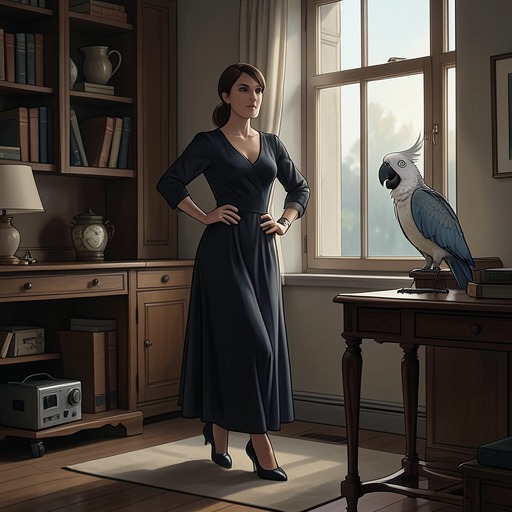
Mark describes Lady Hesketh-Dubois as an old-fashioned woman of the Victorian era, the widow of a former governor of an unnamed island. She was rich and liked her comfort, travelling abroad in winter to places such as Estoril. Her home, in Mark’s recollection, was crowded with Victorian furniture and ornate Victorian silver that he considered unattractive. The material details sketch a life shaped by wealth and settled habits, rather than by any public role in the investigation.
She had no children and was devoted to her two poodles, which Mark remembers as fairly well-behaved. He characterizes her as opinionated and a staunch Conservative, but also kindly, autocratic, and very set in her ways. These qualities sit together in his account: her generosity and affection did not make her yielding, and her kindness coexisted with a strong preference for having things her own way.
Godmother and Bequest
After Lady Hesketh-Dubois’s death, the solicitor Mr Soames White contacts Mark to tell him that her will entitles him to choose three of her pictures. White notes that Mark had once admired some of them. Mark recalls her watercolours of Indian scenes as particularly charming. The bequest is modestly presented: White stresses that none of the pictures is outstandingly valuable, while the remembered admiration gives the gift a personal connection to Mark’s earlier relationship with his godmother.
The inheritance also prompts Mark to discuss Lady Hesketh-Dubois with Jim Corrigan. Corrigan has gone to her house hoping to learn something about her, and Mark can offer more than a caretaker because he knew her as his godmother. When Corrigan asks whether she might have been blackmailed, Mark supplies a portrait of her character and circumstances, but the available account gives no answer establishing that she was blackmailed. The question belongs to Corrigan’s inquiry; it is not evidence of a secret or a motive on Lady Hesketh-Dubois’s part.
Death and Place in the Investigation
Later, Mark tells Mrs Dane Calthrop that he believes three women are dead: Lady Hesketh-Dubois, Thomasina Tuckerton, and Mary Delafontaine. He emphasizes that all three died in their beds and that their deaths were recorded as natural causes. He connects this pattern to what he thinks Thyrza Grey’s claims would mean, but then qualifies the connection: Thyrza was not speaking of any actual people. The distinction matters. Lady Hesketh-Dubois’s death helps Mark frame a troubling pattern, but the conversation does not prove that Thyrza caused it or that Lady Hesketh-Dubois was killed.
Her role is therefore both intimate and uncertain. The will and Mark’s recollections establish her as a particular person—his godmother, a devoted owner of poodles, and a comfortable, opinionated woman—while her death enters the investigation as one case in a pattern Mark is trying to understand. The contrast between an apparently ordinary death at home and the possibility Mark is considering gives her memory investigative weight without resolving the question of what actually happened.