Mark Easterbrook and Ginger's investigative partnership
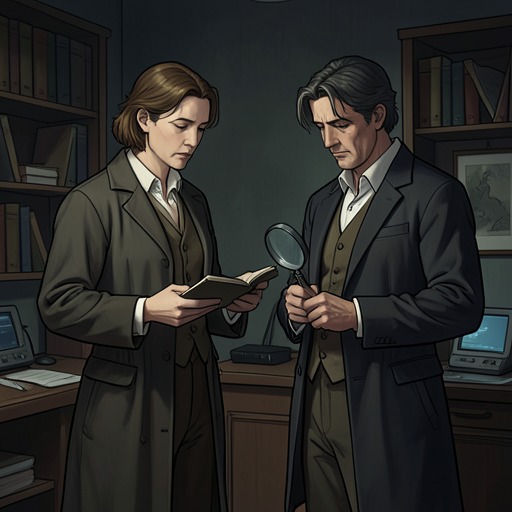
The Pale HorseMark Easterbrook and Ginger’s investigative partnership turns Mark’s solitary alarm about the Pale Horse into a practical inquiry. Its defining movement is from disclosure to shared action: Ginger accepts the seriousness of his concern, asks what he intends to do, and offers to help investigate, while their subsequent conversations divide the work among specific leads and questions.
A confidant becomes a partner
When they meet for a drink at the White Cockatoo, Ginger looks much as she did at Much Deeping: tousled red hair, freckles, and alert green eyes, now accompanied by the tight trousers, Sloppy Joe jersey, and black woollen stockings of her London style. Mark’s attention to her familiar appearance and his admission that he likes her establish the personal warmth beneath the investigative alliance. He has taken considerable trouble to find her because her surname, address, and telephone number were unknown to him; his opening claim that he has a problem leads not to a casual request but to a disclosure of the Pale Horse affair.
Mark tells Ginger the story more briefly than he had told Hermia Redcliffe, partly because Ginger already knows the Pale Horse and its occupants. Even so, as he finishes, he avoids looking at her. He fears her response might be indulgent amusement or outright disbelief, and the account seems more absurd to him as he tells it. Drawing patterns on the table with a stray fork, he gives visible form to his discomfort without withdrawing the story. Ginger’s brisk question about what he will do changes the encounter: instead of judging whether the account sounds plausible, she treats its implications as requiring a response.
Her insistence that someone must act against an organization killing people gives Mark the reassurance he needs. His impulse to embrace her and the warmth he feels when he realizes he is no longer alone make this a moment of emotional as well as practical support. The partnership starts not with certainty about how the crimes work, but with Ginger refusing to let uncertainty become an excuse for inaction.
Dividing the inquiry
Ginger proposes that they find out what the Pale Horse’s activities mean and offers to help, while acknowledging that her job limits her time. She points out that work can be done outside office hours, framing the investigation as a shared undertaking that must fit around their ordinary obligations. Her practical manner counterbalances Mark’s uncertainty: he asks how they can proceed, and she answers by identifying leads rather than promising an immediate solution.
They agree on the importance of first establishing whether they are on the right track; only once they are sure should they proceed at full speed. Within that cautious plan, Ginger takes on inquiries of her own. She suggests looking into Lou, knows places where she is likely to encounter her, and considers whether Luigi might know something. She also identifies contacting Poppy as the first priority. The division of effort is informal but purposeful: Ginger uses her access to social circles and acquaintances, while Mark follows other leads, including seeking an appointment with Thomasina Tuckerton’s stepmother.
Testing a possible connection
Ginger widens the investigation beyond the apparent mechanics of the Pale Horse by questioning why Thyrza Grey told Mark what she did. She distinguishes the question from the easy explanation that Thyrza is simply irrational: the puzzle, as she puts it, is why Thyrza chose Mark in particular and whether there might be some tie between them. Mark’s agreement that this possibility explains his unease shows how her question gives shape to a suspicion he has not resolved. Their partnership therefore includes testing the investigator’s own position in the case, not only gathering information about other people.
This scrutiny complements their agreement to verify leads before advancing. Ginger’s question does not establish that a connection exists; it identifies an unresolved possibility that could alter the meaning of Mark’s first encounter with Thyrza. The distinction matters to their method: they treat a suggestive encounter as a question to investigate, not as proof.
Social inquiries and an expanding agenda
Ginger and Mark arrange contact with Poppy through David, who is available three nights later and brings Poppy along to supper at Fantasie. Ginger and Poppy withdraw for an extended time to powder their noses and return on notably good terms. At Ginger’s instruction, the party avoids controversial topics. The occasion demonstrates her ability to make a social meeting useful without turning it into an overt interrogation; after Mark drives Ginger home, she reports what she has learned from Lou.
Her account helps distinguish Lou’s quarrel with Thomasina from a likely connection to the Pale Horse. The man at the centre of the dispute was Gene Pleydon, who had pursued Lou before turning his attention to Thomasina. Lou’s version, as Ginger reports it, was that the quarrel had not been serious, although Thomasina had pulled Lou’s hair out by the roots. Lou now has another boyfriend, and the Pale Horse does not appear to register with her when Ginger raises it. Ginger therefore concludes that Lou is unlikely to have been a client; Luigi likewise thinks there was little in the quarrel, though he believes Thomasina was serious about Gene. The inquiry does not settle every question about Thomasina, but it narrows the suspicion around Lou.
Ginger also asks what Mark has done about Thomasina’s stepmother. Mark explains that she has been abroad, is due back the next day, and has been sent a letter requesting an appointment, written by his secretary at his direction. Ginger welcomes the progress but fears the investigation might peter out. She then returns to the case’s originating mystery: Father Gorman was killed after visiting a dying woman, apparently because of something she told or confessed to him. Ginger asks what became of that woman and who she was, reasoning that her identity and fate should provide a lead. The partnership thus develops from shared alarm into a continuing sequence of questions, contacts, and checks, with Ginger repeatedly pushing the inquiry toward the next actionable uncertainty.