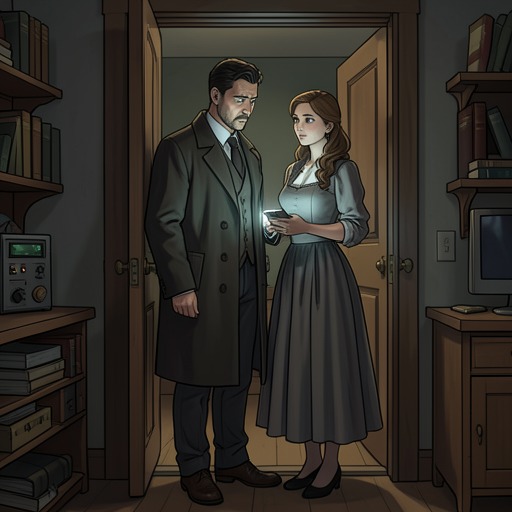
Mark Easterbrook and Hermia Redcliffe's romantic relationship
The Pale HorseMark Easterbrook and Hermia Redcliffe’s relationship begins as a settled, intellectually companionable courtship that Mark assumes may lead to marriage. Its decisive tension is already present in his private response to the idea of their future: he values Hermia’s intelligence and admires her, yet imagines their life together with a sudden, disquieting sense of boredom. When he later asks her to join his investigation, her mild refusal turns that unspoken doubt into a sharper recognition that the partnership he has relied on may not offer the engagement he needs.
An Established Courtship
Mark and Hermia are introduced as friends who have just attended a production of Macbeth. Their conversation continues over dinner at the Fantasie, where the narration presents Hermia as a handsome twenty-eight-year-old with a classical profile and dark chestnut hair. Mark’s sister already refers to her as his girlfriend, though her marked emphasis makes the label irritating to him. The teasing suggests that their attachment is familiar enough to be noticed and named by others, even as Mark remains sensitive to the social definition of it.
The surrounding company makes the relationship visible through contrast. At the Fantasie, they encounter David Ardingly, an Oxford history lecturer, and Poppy, whose lively, apparently silly manner differs from Hermia’s seriousness. David jokes that Mark and Hermia are highbrow and serious, placing them together as a recognizable pair. The exchange treats their intellectual respectability as part of their shared identity, but it also exposes how readily other people can describe them as a couple before Mark has fully examined what being one means to him.
Affection, Compatibility, and Doubt
David’s teasing about Mark having a steady partner prompts Mark to recognize that the phrase fits his relationship with Hermia. He has long assumed that they would marry someday, and his affection is real: he likes her better than anyone he knows and believes they have much in common. That expectation is not presented as a formal promise or a decision made between them; it is Mark’s private conviction about the direction of a relationship that has become familiar and dependable.
The prospect of their future, however, produces an unexpected bodily and emotional response. Mark imagines the two of them attending important plays and discussing art and music. Hermia seems, by every conventional measure he can name, the perfect companion. Yet the image makes him want to yawn, and an irreverent thought intrudes: the life he pictures may be no fun. The contrast matters because his objection is not that Hermia lacks intelligence, beauty, or shared interests. Those qualities are precisely what he admires. His unease arises from the possibility that suitability and affection have come to stand in for excitement.
This moment complicates his previous certainty without erasing it. Mark is shocked by his own judgment, suggesting that the doubt is not a settled verdict but a perception he has not allowed himself to articulate. The relationship therefore carries two currents at once: a sincere attachment grounded in admiration and common ground, and a fear that its polished compatibility may conceal an emotional dullness. The thought appears while David and Poppy are present, making their more playful pairing an immediate contrast, but the evidence locates the discomfort within Mark rather than establishing that Hermia or their relationship is objectively deficient.
The Investigation as a Test of Partnership
When Mrs Dane Calthrop urges Mark to act quickly and find someone to help him investigate, he considers several possibilities. Jim Corrigan is busy, and Mark doubts that David would believe him. Hermia comes to mind as a person with a clear brain, admirable logic, and the potential to be a tower of strength. He thinks of them as a pair, then identifies her as his steady partner. In this practical moment, his relationship represents trust as well as habit: Hermia is someone whose judgment he expects could support demanding work.
After Mark tells her his story over dinner, Hermia listens intelligently and with interest, but her light response is not what he expected. Her manner seems indulgent rather than shocked or stirred. Mark asks her to help investigate, and she explains that she is terribly busy: she has an article for the Journal, work on Byzantium, and promises to two students. She gives him concrete commitments rather than dismissing the investigation as unimportant. Mark accepts her explanation, and she is visibly relieved; the exchange does not establish hostility or a quarrel, but it does show that he had hoped for an involvement she was unwilling or unable to offer.
Her refusal changes how Mark interprets their familiar dynamic. He reads her indulgent expression as resembling a mother’s response to a little boy absorbed in a new toy, and rejects that position for himself: he is not a child looking for a mother. The comparison is Mark’s judgment, not an account of Hermia deliberately treating him as a son. It reveals the unease beneath his request: he wants a partner who will meet his urgency as an equal, not simply regard his pursuit as harmless enthusiasm. The investigation thus becomes a test of the relationship’s practical and emotional reciprocity, even though Hermia’s workload supplies an ordinary reason for saying no.
Reassessment and Limits
After considering Hermia across the table, Mark inventories what he admires: she is handsome, mature, intellectual, and well read. He then concludes, with sudden bluntness, that she is also dull. The force of the reassessment lies in its reversal of the earlier ideal. Traits that had made her seem perfectly suited to him now appear insufficient, while his sense of being indulged intensifies the gap between companionship and equality he wants.
The evidence leaves this change at the point of recognition. Mark’s doubts are clear, and his request for help exposes different expectations of involvement, but the scenes do not establish a breakup, a final decision about marriage, or Hermia’s own private account of the relationship. What they do establish is the instability of Mark’s assumption that shared taste, admiration, and the likelihood of marriage guarantee lasting satisfaction. His partnership with Hermia remains affectionate and substantial in his mind, yet the case forces him to measure it against a more immediate need: to be taken seriously and joined in action.