Mark Easterbrook and Mrs Dane Calthrop's investigative alliance
The Pale HorseMark Easterbrook and Mrs Dane Calthrop’s investigative alliance begins when his unsettled questions about distant killing meet her practical understanding of evil and her willingness to act. She helps him turn an uneasy suspicion into a defined inquiry: people on a copied list may be dying, and the investigation needs a concrete connection between those names and the Pale Horse. Their partnership is founded less on certainty than on complementary judgment—his access to the clues, her readiness to recognize what is at stake, and a shared determination to prevent further harm.
Formation of the alliance
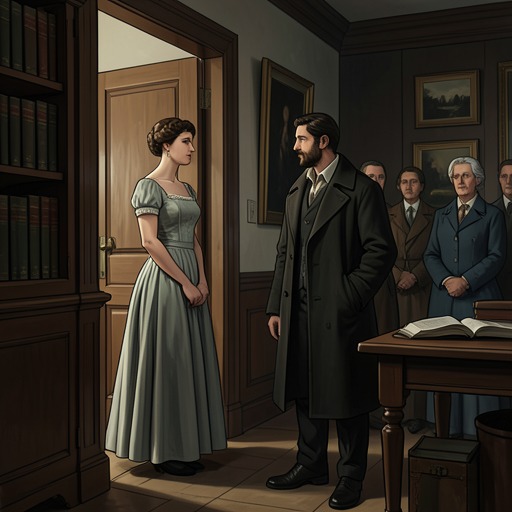
Mark arrives intending to see Mrs Dane Calthrop’s husband, the vicar, but becomes doubtful about speaking to him. Mrs Dane Calthrop intervenes, explaining that goodness does not necessarily equip someone to understand evil and deciding that she should hear Mark’s concerns herself. Her distinction between her husband’s religious responsibility to forgive sins and her own capacity to identify and classify them establishes the practical, unsentimental basis of her role. She presents knowledge of wrongdoing as useful because it can help prevent harm to other people, even when it cannot itself make the wrongdoer repent.
The confidence between them develops quickly. Mark, who describes himself as a scholar, author, and man of the world, finds himself prepared to lay his troubles before a weather-beaten woman whose experience he trusts, though he cannot explain why she seems the right person. That instinct matters to the alliance: he is not approaching her with a settled case or a formal plan. He is bringing her a problem he has not yet managed to interpret, and she gives him room to make it intelligible.
From unease to a defined question
Mark begins by telling her that he has recently had tea with Thyrza Grey. Mrs Dane Calthrop understands that the encounter has disturbed him and distinguishes between theatrical claims and the possibility of genuine malevolence. In her assessment, Bella Webb might be no more than a village witch who frightens people for attention or advantage; Sybil Stamfordis may be foolish while still genuinely functioning as a medium. She remains uncertain about Thyrza Grey, whom she suspects may have encountered some real piece of occult knowledge and mixed it with exaggeration to strengthen her own importance and control.
This response does not simply reassure Mark that the apparent supernatural threat is false. Instead, it gives his uncertainty sharper boundaries. Mrs Dane Calthrop treats boastfulness and occult display skeptically while leaving open the possibility that there is something consequential behind them. Mark then asks the question at the center of his anxiety: whether one person could kill another at a distance without a visible connection. Her careful clarification—that he means a plain physical death—keeps the discussion anchored in an outcome that could be investigated rather than in an undefined supernatural claim.
The list and the feared pattern
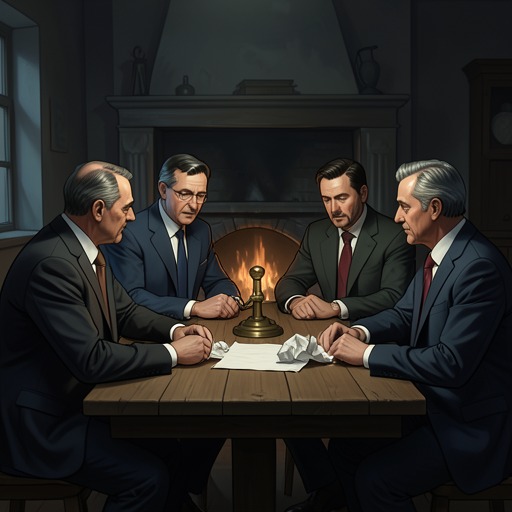
Mrs Dane Calthrop’s most consequential contribution comes when she asks what happened before the tea with Thyrza Grey. Mark recounts Father Gorman’s murder and the casual mention of the Pale Horse in a nightclub, then produces the list of names he copied from a paper shown to him by Dr Corrigan. The list gives their exchange a material focus: the possibility of distant killing is no longer an isolated question, but one that Mark is testing against named people and previous events.
When Mark offers blackmail or drugs as possible explanations for the names’ common connection, Mrs Dane Calthrop rejects those suggestions as distractions from what is actually troubling him. She recognizes that he suspects the people on the list are dead. Mark confirms that three have died: Lady Hesketh-Dubois, Thomasina Tuckerton, and Mary Delafontaine. Each died in bed from natural causes, the same kind of death Thyrza Grey claims would follow her methods. Mrs Dane Calthrop’s insight helps expose the pattern Mark fears, while the apparently natural deaths preserve the central difficulty: suspicion has formed, but proof has not.
A practical, unfinished partnership
Mrs Dane Calthrop responds to the possibility of a death network with urgency. She tells Mark that whatever lies behind it must be stopped and insists there is no time to lose. Rather than taking over his investigation, she pushes him to discover what can be done and asks whether he has a friend who could help. Mark considers whom he might involve and settles on Hermia Redcliffe as a possible ally; Mrs Dane Calthrop’s prompt has therefore helped move him from private alarm toward a collaborative inquiry.
She also commits herself to watching the three women at the Pale Horse. Her commitment is cautious, not credulous: she still doubts that the women are the complete explanation, even as she thinks Thyrza Grey may have found or heard of something real and built a confused display around it. The alliance is consequently a division of attention rather than a declaration that the occult account is true. Mrs Dane Calthrop will observe the suspected practitioners; Mark must pursue the larger connection.
Her clearest investigative principle is the need for a tangible link between one of the names and the Pale Horse. This requirement marks both the strength and the limit of their agreement. They share a grave suspicion and a desire to prevent harm, but neither treats suspicion as conclusive evidence. Mrs Dane Calthrop helps Mark name what he fears, insists on action, and identifies what the inquiry still lacks. In that combination of moral urgency and evidentiary restraint, their alliance becomes a turning point from unsettling speculation toward a search for proof.