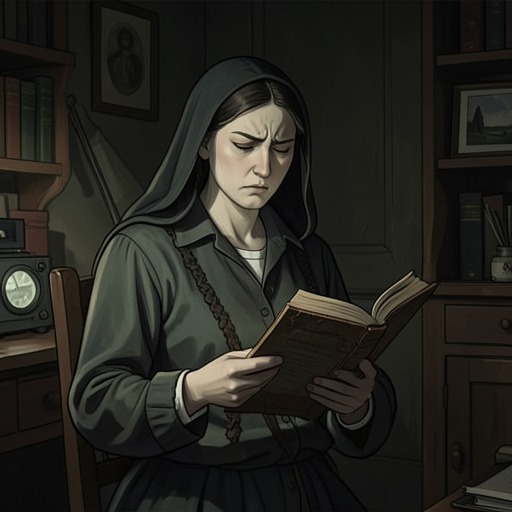
Mrs Dane Calthrop, who watches the Pale Horse residents
The Pale HorseMrs Dane Calthrop, the vicar’s wife in Much Deeping, becomes an incisive ally to Mark Easterbrook because she treats evil as a subject requiring both moral attention and practical scrutiny. She neither accepts the Pale Horse’s occult claims at face value nor dismisses the possibility that something genuinely dangerous lies behind them; instead, she helps turn unease into a search for a concrete connection.
Identity and First Impressions
At a fête, Mrs Dane Calthrop studies Ariadne Oliver and abruptly asks what she had expected to happen there. Oliver answers that she had expected a murder, or something of the kind. The exchange gives Mrs Dane Calthrop an immediate investigative quality: she does not merely join the conversation but presses its participants to say plainly what they anticipate. The remark also places a murder expectation within an ordinary social gathering, where it sounds both startling and, in retrospect, revealing of the anxieties gathering around the case.
Mark later reaches the vicarage after walking along muddy lanes and up an ill-kept drive. The bell beside the front door is rusty and does not ring. Mrs Dane Calthrop appears at the door and explains that it has been repaired twice but never stays working, so she has to remain alert in case an important visitor arrives. The small domestic inconvenience neatly introduces her attentiveness: she has made herself responsible for noticing what might otherwise go unheard. Mark had come to see the vicar, but his uncertainty about proceeding gives way when Mrs Dane Calthrop takes charge of the conversation.
A Parish Knowledge of Evil
Mrs Dane Calthrop explains that her husband is a good man, and that this can make certain matters difficult: good people, in her view, do not really understand evil. She regards that understanding as her own responsibility. As a vicar’s wife, she says, it is important to know about the sins occurring in the parish. Her formulation is brisk rather than confessional. She approaches wrongdoing as something that must be recognized in its actual forms, not safely left outside the boundaries of respectable life.
That stance shapes her response when Mark tells her about his tea with Thyrza Grey and the other women at the Pale Horse. She understands that the encounter has unsettled him and agrees that the three can be difficult to take. But she is wary of their boasting: in her experience, people who are truly wicked may keep quiet, while those whose sins are less serious make them sound grand and important. The distinction does not settle whether the women are dangerous. It instead warns Mark not to confuse dramatic claims with proof.
Occult Claims and Uncertainty
Mrs Dane Calthrop separates ordinary village witchcraft from the more disturbing possibility that such claims conceal something real. She describes a familiar kind of village malice: a woman can exploit a farmer’s anxiety when his hens die by hinting darkly at an earlier slight. Bella Webb might, she allows, be only a witch of this petty, intimidating sort. But Mrs Dane Calthrop does not use that commonplace explanation to dismiss every possibility. She allows that something older, appearing occasionally in country places, might involve real malevolence rather than a wish merely to impress.
Her judgments of the three women remain deliberately unequal. She considers Sybil Stamfordis silly, yet accepts that she really is a medium, while admitting that the word itself does not explain what a medium is. About Thyrza Grey she is less certain. The Egyptian mysteries and prophecies from pyramid texts invoked by Sybil strike her as nonsense, but she suspects Thyrza may have encountered some genuine material and assembled it into a confused display to magnify her importance and control of occult powers. This is not an endorsement of supernatural killing: it is a refusal to let the women’s foolishness prove that no serious danger exists.
From Suspicion to a Tangible Link
When Mark asks whether one person could destroy another from a distance without any visible connection, Mrs Dane Calthrop does not offer a simple resolution. After Mark has thought of someone, she becomes brisk and businesslike, undertaking to keep an eye on the three women while cautioning that they do not yet seem to be the answer. Her assessment preserves the uncertainty at the heart of the inquiry: a suspect’s occult performance may be a cover, an exaggeration, or evidence of knowledge whose source is still unknown.
She identifies what the investigation lacks: a tangible link between one of the names and the Pale Horse. That demand gives her skepticism a constructive purpose. Rather than treating either belief or disbelief as a conclusion, she directs attention toward a connection that can be established. In the investigation, Mrs Dane Calthrop’s strength is this combination of local moral awareness and evidentiary discipline: she takes the possibility of evil seriously without allowing its theatrical language to stand in for proof.