Mrs Davis's deathbed confession
The Pale HorseMrs Davis's deathbed confession is the moment that turns an unidentified dying woman's fearful fragments into a matter Father Gorman feels bound to pursue. She speaks of grave wickedness and insists that something must be stopped, but dies before the account can become clear. The scene's force lies in that gap: her appeal is unmistakably urgent, while its details remain uncertain even to the priest who receives it.
Setting and urgency
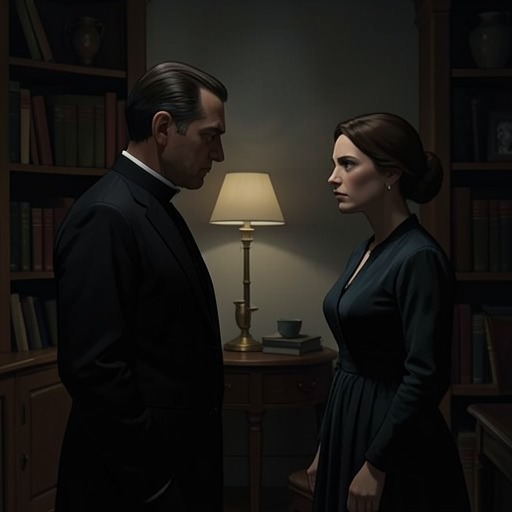
Mrs Coppins brings Father Gorman into a clean, neat bedroom furnished with old-fashioned Victorian furniture. Mrs Davis lies in the bed near the window, so ill that the priest recognizes her condition at once. Mrs Coppins presents his arrival as reassurance, then retires, leaving the priest alone with the woman whose need is more immediate than any orderly account of events.
Mrs Davis speaks between panting breaths. Her eyes wander and half-close as she struggles to say that there is not much time, that wickedness has occurred, and that she cannot die without confessing a grievous sin. Her words arrive in broken pieces rather than as a coherent narrative. The scene establishes both the urgency of her appeal and the difficulty of interpreting it: she appears to be trying to disclose something consequential, but illness interrupts her before she can explain it fully.
Confession and the priest's response
Father Gorman approaches the bed and answers in the manner of his calling. He offers words of authority and reassurance, grounded in his belief; the immediate change is visible in the room and in Mrs Davis's expression. The tension in her eyes subsides, and the agony that had marked them goes out. His ministry brings her peace, even though it does not resolve the troubling matter behind her confession.
That distinction shapes the scene. The priest can comfort the dying woman, but comfort is not the same as understanding what she has tried to tell him. After he has ended his ministry, Mrs Davis speaks once more. Her renewed effort makes clear that the confession is not only about her own need for peace: she is trying to pass on an unfinished warning before she dies.
The warning and her death
Mrs Davis's final words return to the need for something to be stopped and trail off before she can make the danger explicit. Father Gorman reassures her that he will do what is necessary and that she can trust him. His promise answers the appeal she has managed to voice, but the exchange leaves him responsible for acting without the fuller explanation that might have made her meaning certain.
A doctor and an ambulance arrive together a little later. Mrs Coppins receives them with gloomy triumph and makes plain that they have come too late: Mrs Davis is dead. The arrival cannot restore the possibility of further questioning. The confession therefore ends not with a complete revelation but with a death, leaving Father Gorman to carry an account whose urgency he has accepted and whose truth he has yet to assess.
Immediate consequence and narrative significance
Walking back through the gathering twilight, Father Gorman considers the story extraordinary and wonders how much may have come from delirium and high fever. He does not dismiss it: he judges that some of it is true and decides to note certain names while they remain fresh in his memory. The scene thus preserves uncertainty without reducing the confession to fevered speech. His response is practical as well as pastoral; he means to retain what can still be retained and investigate what can still be acted upon.
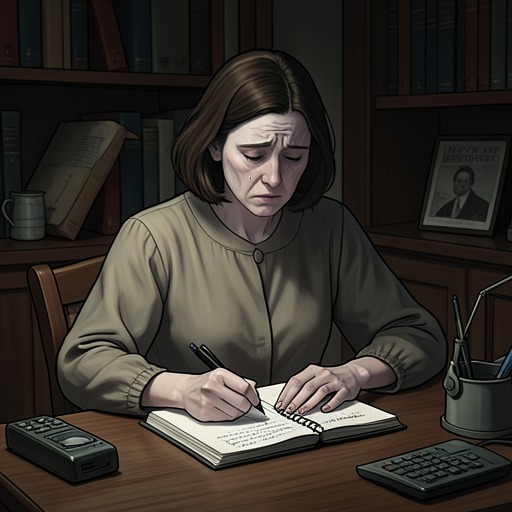
Even that task becomes difficult. At a small café, Father Gorman discovers that his notebook and pencil have slipped through a hole in the lining of his cassock, which Mrs Gerahty had been asked to mend. He retrieves a pencil and a few coins, but cannot reach the notebook, so he asks for paper. The mundane failure follows directly on the heels of the deathbed appeal: the names are still in his mind, but the object meant to preserve them is out of reach. The confession consequently initiates an inquiry through both its incomplete warning and the priest's effort to record it before memory fails. Its unresolved details are not incidental; they are the reason the promise to act must lead beyond the bedroom.