Mystical ritual and modern science
The Pale HorseMystical ritual and modern science is the story’s central interpretive tension around the Pale Horse: occult gestures appear beside electrical equipment and arguments about new scientific discoveries, inviting belief that an unexplained method might join the two. The tension is consequential but not proof of supernatural killing. It helps make Thyrza Grey’s operation persuasive, while later allowing Mark Easterbrook to read its ritual and scientific trappings as a deliberate distraction.
Uncertainty and the Limits of Knowledge
When Inspector Lejeune considers whether Thyrza Grey can kill through a gaze, a trance, or projected will, he rejects those particular claims but admits he cannot be certain that every unfamiliar phenomenon is impossible. His caution rests on the speed with which once-unbelievable communications became ordinary: people can hear a clock’s chimes by two different kinds of waves, and a voice from New York can reach a drawing room without a connecting wire. Those examples establish that scientific knowledge can overturn common assumptions; they do not establish that Thyrza’s occult powers work. The distinction keeps open a narrow space between skepticism and proof, rather than making the police officer a believer.
Mrs Dane Calthrop develops the same uncertainty into a more pointed hypothesis. She argues that much of the ceremony is probably theatrical equipment for creating atmosphere, but that something effective may be concealed among those trappings. She suggests that a new discovery might be adapted by an unscrupulous person, and notes that Thyrza’s father was a physicist. This is conjecture, not a demonstrated account of the deaths. Its force lies in making a modern, material explanation seem conceivable at the very moment the visible performance invites an occult one.
The Pale Horse’s Staged Ritual
Mark’s visit to the converted barn gives the contrast a physical setting. The building has no entrance from the house; on an overcast night, the group enters from outside into a lit room. Its arrangement separates it from ordinary domestic space: a raised divan covered with purple cloth and cabalistic signs stands at the center, with a brazier and a copper basin nearby. An oak-backed chair is placed near the wall for Mark. The setting makes the ceremony legible as a prepared performance, with its own objects, positions, and sequence.
Thyrza’s conduct complicates that impression. Her manner becomes matter-of-fact and controlled, and Mark compares her bearing to that of a surgeon preparing for a difficult operation. She puts on a long overall made of metallic-looking woven material and mesh-like gauntlets, explaining that precautions are necessary. The protective clothing makes the scene resemble technical work as well as occult practice: the garments suggest that something is being handled, although the passage does not establish what the precautions protect against.
The ritual proceeds through repeated actions. Bella Webb brings in a living white cock, then draws signs in chalk around the brazier and copper bowl while chanting. Thyrza explains that ritual can affect the human spirit through words and phrases sanctified by time and use, comparing its effects with the poorly understood hysteria of crowds. Her account offers a psychological and social rationale for ceremony even if its supernatural explanations are doubted: atmosphere and inherited forms can influence participants without proving that magic is real.
The Machine Beside the Ceremony
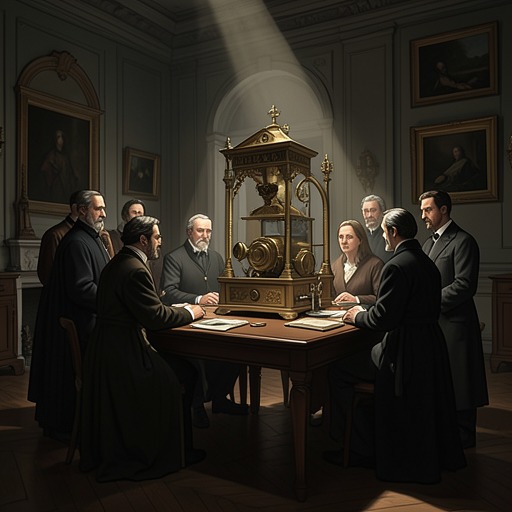
The room’s apparent occult equipment also has a technological counterpart. Thyrza wheels what Mark had taken for a radio cabinet toward the divan; it opens to reveal a large, complicated electrical contrivance, which she adjusts. At the ritual’s close, the machine’s hum ceases before Thyrza invokes the joining of old magic and new science. The machine is therefore not merely mentioned as an abstract possibility: it is visibly built into the ceremony and placed beside the divan and ritual objects.
That pairing supports several readings without confirming any of them at this stage. To a visitor impressed by the ceremony, the machine might appear to make occult power operational. To a skeptic, it could be an ordinary electrical device dressed up to suggest forces not understood by the audience. The sequence also gives the ritual a practical theatrical structure: the chalked signs, chant, animal, protective clothing, and electrical cabinet all contribute to a display in which the apparent ancient and modern elements reinforce one another.
Reversal: Trappings and Misdirection
Later, Mark interprets the display in the opposite direction from the scientific hypothesis. He recalls Thyrza’s earlier talk about the Borgias and rare, untraceable poisons, and concludes that the trances, white cocks, brazier, pentagrams, and reversed crucifix are designed for the crudely superstitious. The electrical cabinet, in his account, is another piece of showmanship, suited to people more readily persuaded by talk of rays, waves, and psychological phenomena. Fear of fallout and strontium 90, he reasons, makes contemporary audiences vulnerable to a scientific-sounding explanation just as older beliefs made others vulnerable to witchcraft.
Mark’s conclusion is that the Pale Horse itself functions as a stalking horse: attention is directed toward an impossible or harmless spectacle so that observers will not investigate what is happening elsewhere. On this reading, the public claims of occult power are useful precisely because they are too implausible to support a murder prosecution, while the machine can be examined and dismissed as harmless. His account changes the meaning of the earlier uncertainty. Scientific progress still explains why people hesitate to declare every unfamiliar claim impossible, but the story does not validate the séance as a supernatural method. Instead, its convergence of ceremony and apparatus becomes an instrument of misdirection, showing how belief in both ancient magic and modern science can be manipulated.