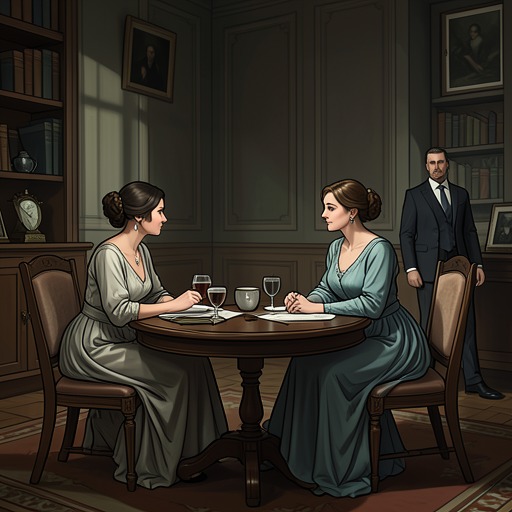
Poppy reveals Bradley's contact details to Ginger
The Pale HorsePoppy’s disclosure of Bradley’s contact details to Ginger turns the Pale Horse theory from speculation into a practical line of inquiry. By winning Poppy’s confidence with a carefully invented story, Ginger obtains the name and address of the person who handles the organization’s business arrangements; Mark Easterbrook then follows that lead to a real office in Birmingham.
The disclosure and its immediate result
Three days after Mark Easterbrook’s previous conversation, Ginger telephones him with something she says she has obtained for him: a name and an address. She asks him to write them down, and gives him Bradley’s name and the address of 78 Municipal Square Buildings, Birmingham. The news catches Mark off guard. Ginger’s brief announcement is consequential because it supplies not merely another rumor about the Pale Horse, but a specific intermediary whom Mark can approach.
The address also makes the information actionable at once. Mark asks what it is all about, while Ginger acknowledges that she does not know everything herself and doubts that Poppy does either. The uncertainty matters: Poppy has disclosed a route into the organization’s business, not a complete account of its operations. The contact is a starting point for investigation rather than proof, by itself, of how the Pale Horse works or who is responsible for its alleged killings.
How Ginger obtained Bradley’s name
Ginger explains that she has been working on Poppy and that softening her up made it possible to get information. Her method depends on a kind of confidence between women: as Ginger presents it, Poppy did not regard telling her as a serious breach or as information that would matter. Ginger characterizes this as a social opening Mark would not readily understand, and her explanation distinguishes her approach from a direct interrogation. She creates the circumstances in which Poppy will talk, rather than simply asking for the name of a suspected contact.
The pretext is an invented romantic and financial predicament. At lunch, Ginger tells Poppy a story about a married Catholic man whose supposedly invalid wife refuses to divorce him, remains in pain, and is unlikely to die for years. Ginger presents the wife’s death as preferable to the continuation of that predicament and says she has considered turning to the Pale Horse, although she does not know how to proceed or what it would cost. The story gives Poppy a plausible reason to discuss the organization’s services without making Ginger appear to be investigating it.
Ginger adds a financial inducement to the fiction. She claims to have expectations from a wealthy great-uncle who is still alive and whom she would hate to lose, while suggesting that the inheritance might make it possible to pay something in advance. The expectation is real, she tells Mark, but she has introduced it because it helps the story. In response, Poppy says that the Pale Horse charges a great deal and that a prospective client must first go to Bradley to settle the business side. That practical instruction is the key information Ginger extracts: Bradley is presented as the first point of contact for arranging a transaction.
Doubt, corroboration, and the next step
Mark reacts with disbelief, asking whether Poppy gave the information openly and whether she seemed frightened. Ginger’s answer is that Poppy did not think the disclosure counted as anything serious. She also reasons that an organization seeking a continuing supply of clients would have to make its services discoverable in some fashion. Her explanation offers a possible reason for the apparent openness, but it does not settle whether Poppy understood what she was helping to arrange. Mark remains unconvinced, and the conversation preserves the distinction between a lead and a verified account.
When Ginger asks whether he will go to Birmingham to see Bradley, Mark says that he will, while still qualifying the plan with doubt about whether Bradley exists at all. That qualification gives the disclosure its immediate test: a name and address must survive contact with the ordinary, checkable world. At Municipal Square Buildings, a large office block, Mark finds number 78 on the third floor. The ground-glass door identifies C.R. Bradley as a commission agent and invites visitors to enter. Bradley, contrary to Mark’s expectation, is real. The contact obtained through Ginger’s performance has therefore carried the inquiry from hearsay to a physical destination, although the office sign alone does not establish the full nature of Bradley’s connection to the Pale Horse.
Significance in the investigation
The episode shows how the investigation advances through social access as well as formal questioning. Ginger turns an apparently casual lunch and a fabricated personal crisis into a channel for information; Poppy’s disclosure, in turn, directs Mark toward the person said to handle the commercial arrangements. The sequence links intimacy, money, and murder without yet proving the mechanism behind the organization’s claims. Its decisive change is modest but concrete: Mark moves from wondering whether such a contact exists to standing outside Bradley’s identified office in Birmingham.