Sybil Stamfordis
The Pale HorseSybil Stamfordis is presented as the medium in Thyrza Grey’s circle, a figure whose sincere-seeming occult claims help give the group its supernatural character. She describes unusual experiences dating to childhood, including automatic writing and an apparent sensitivity to a place where a murder had occurred. Yet the narrative also frames her as credulous and confused about occult traditions, leaving open a distinction between her own beliefs and the uses Thyrza may make of them.
Identity and Introduction
Mrs Dane Calthrop identifies Sybil Stamfordis as a friend who lives with Thyrza Grey and acts as a medium. She adds that Sybil is often seen wearing scarabs and beads and sometimes a sari, despite never having been to India. The detail situates Sybil within a recognizable performance of esoteric identity: the objects and clothing signal an interest in the occult, but do not establish the source or extent of any ability.
When Mark Easterbrook visits the group, Thyrza calls Sybil in from another room. Sybil joins the visitors wearing a brightly colored sari and speaks in a faint, fluttering voice. The introduction makes her appearance part of the atmosphere around Thyrza’s household, but the contrast between that atmosphere and the questions raised by the visitors keeps it from serving as proof of her claims.
Her Claims of Mediumship
Sybil says that the occult attracted her from childhood and that she recognized unusual powers in herself early on. She recalls automatic writing arriving without her understanding what the process was, describing herself as holding a pencil while unaware of what was happening. She also recounts fainting during tea at a friend’s home because she sensed that something terrible had occurred in the room; she says that the explanation came later, when a murder from twenty-five years before was discovered to have taken place there. Her account rests on a claimed correspondence between an unexplained feeling and a past event, rather than on a demonstrated method for verifying her impressions.
Sybil takes satisfaction in telling the story and looks around the group after relating it. That response gives the account a social dimension: she does not merely report an experience but presents it as evidence of her exceptional sensitivity. The visitors, however, do not all respond with conviction. The scene leaves her claim visible as a claim, mediated through her own telling and the reactions of those listening.
Place in Thyrza’s Circle
Thyrza describes Sybil as a first-class medium and says that she has never worked for money. She characterizes the ability as a gift and places Sybil alongside herself and Bella Webb in a team whose members possess powers in different degrees. This is Thyrza’s assessment, not independent confirmation, but it establishes Sybil’s importance to the circle’s public account of itself. Her mediumship is presented as one part of a collective capacity rather than as a solitary act.
Thyrza also distinguishes Sybil’s supposed ability from her understanding of occult ideas. She says Sybil mixes voodoo, demonology, and black magic indiscriminately, calling her silly in some respects while insisting that she has power. The contradiction is central to Sybil’s characterization: within Thyrza’s description, intellectual confusion does not rule out a useful gift. Sybil can therefore be both an object of condescension and a valued member of the group.
Belief, Performance, and Uncertainty
Another observer similarly finds Sybil’s accounts of beads, draperies, voodoo, and reincarnation foolish, yet suspects that she might still be capable of making strange things happen. The thought is tentative: Sybil might be usable by some force precisely because she is so uncritical, though the speaker admits difficulty explaining the impression. The exchange preserves uncertainty rather than resolving it. Sybil’s apparent credulity may weaken her authority as an interpreter of the occult, but it does not, within the conversation, settle whether she has an ability others can exploit.
This uncertainty also separates Sybil from Thyrza. Sybil supplies the circle with a personal story of spontaneous powers; Thyrza supplies a confident framework for interpreting those powers and organizing them into a group. The narrative gives Sybil room to speak for herself, but much of her significance is defined by Thyrza’s evaluation and by other people’s doubts.
Narrative Role
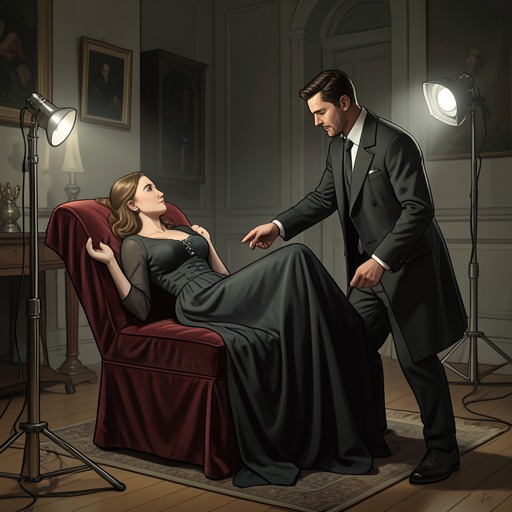
During Mark Easterbrook’s later visit to the converted barn, the narrative foregrounds Thyrza’s direction of the preparations, Bella Webb’s handling of a white cockerel, and an electrical contrivance brought beside the divan. Thyrza explains that ritual can affect the human spirit even when an observer regards its forms as empty. The scene thus shifts emphasis from Sybil’s childhood stories to the group’s arranged space, actions, and equipment. It does not, in the evidence presented here, show Sybil performing mediumship during that procedure.
That shift gives Sybil a distinct narrative function. Her claims introduce the possibility of occult power, while the later preparations make the circle’s activity appear organized and materially staged. The difference does not prove that Sybil’s experiences are false, nor does it validate them; it keeps belief, suggestion, and practical mechanism in view at once. Sybil remains an uncertain figure whose reported gift is important to the group’s identity, even as the narrative directs attention toward what the group does around that belief.