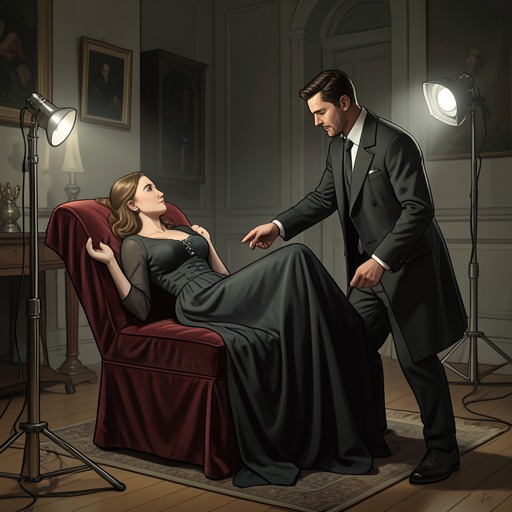
Sybil's mediumistic trance
The Pale HorseSybil’s mediumistic trance is the bodily and theatrical center of the Pale Horse séance: a genuine state that Thyrza Grey directs and uses to make a staged ritual appear to command death at a distance. Seen first through Mark Easterbrook’s wary observations, the trance unsettles the boundary between Sybil’s own agency and the role Thyrza assigns her. The later explanation preserves the reality of Sybil’s mediumship while separating it from Thyrza’s claims about what the ritual can accomplish.
Formation and Setting
The trance takes place in a converted barn reached from outside the house, not through an interior entrance. That separation matters to the scene’s atmosphere: Mark and Thyrza leave the darkness of an overcast night and enter a long room arranged for a purpose unlike its daytime use as a pleasant library. Indirect, cold light, rather than the room’s lamps, illuminates a raised divan covered with purple cloth and cabalistic embroidery. A brazier, an old copper basin and a heavy chair complete an arrangement that makes the space feel at once domestic and deliberately set apart.
Thyrza seats Mark in the oak-backed chair and prepares Sybil on the divan, arranging her draperies with solicitous attention. She wheels a canopy over the divan, leaving Sybil in shadow while the surrounding room remains dimly lit; she explains that too much light would interfere with a complete trance. The transition is practical as well as theatrical. The canopy controls what Mark can see, while the room’s carefully managed light and movement distinguish Sybil’s exposed body from the ordinary setting around it.
Thyrza’s manner also changes. Mark perceives not the showy occultism he associates with Sybil, but a purposeful, professionally controlled seriousness, which he compares to a surgeon approaching a dangerous operation. Before the séance, Thyrza puts on a long, apparently metallic-woven overall and fine-mesh gauntlets, saying that precautions are necessary. The protective clothing gives the proceedings an air of physical risk even as the ritual’s supernatural explanations remain unverified.
The Trance and Its Signs
When Sybil lies still beneath the canopy, Thyrza oversees the conditions of her trance. After a pause in which the room contains only the breathing of Sybil and Bella, Sybil suddenly speaks in a deep male voice with a guttural foreign accent, markedly unlike her own. The voice identifies itself as Macandal when Thyrza addresses it by that name. Thyrza then draws back the canopy. Sybil appears deeply asleep, her features smoothed and, to Mark, almost transformed by her repose.
The exchange gives the trance a defined ritual function. Thyrza asks the voice to protect the body it inhabits from physical injury and to dedicate its vital force to her purpose, so that death may pass through it according to whatever natural laws are available in the recipient’s body. The voice assents. This is a claim made within the séance, not proof that a spirit has entered Sybil or that death can literally be transmitted through her. The scene lets the audience hear the terms of Thyrza’s intended operation while keeping their supernatural meaning uncertain.
Thyrza explicitly argues that ritual can affect the human spirit even when a visitor dismisses it as meaningless. Repeated words and inherited forms, she says, have an effect, and the mass hysteria of crowds is evidence that collective responses exist even when their causes are not fully understood. The trance is therefore framed not only as an occult spectacle but as a state shaped by ceremony, expectation and authority. Thyrza’s account supplies a psychological rationale without confirming her supernatural claims.
Ceremony, Persuasion, and Apparatus
Bella Webb adds a physical sequence around Sybil’s altered state. She brings in a live white cock, draws signs in chalk around the brazier and copper bowl, and places the struggling bird with its beak on the curved line, where it becomes still. Chanting in an incomprehensible guttural voice, Bella intensifies the ceremony. Her conduct appears to express a sincere belief in witchcraft, rather than merely repeating Thyrza’s performance for Mark’s benefit.
Thyrza then turns to a cabinet Mark had taken for a radio. It opens to reveal a complicated electrical device on wheels, which she carefully moves beside the divan and adjusts. She sets a glove in position by reference to a compass direction and switches on a small violet light. Addressing Sybil’s inert body, Thyrza tells her that she is released from her mortal sheath, free to unite with the owner of the glove, and urges her toward death as the only final peace. Her appeal invokes Macbeth and Tristan and Isolde, joining death to sleep, satisfaction and love. The language turns the trance into an instrument of suggestion: it gives Sybil a repeated idea to inhabit while Thyrza controls the setting and the terms of the supposed spiritual encounter.
As the words echo and the box begins to hum, its bulbs glowing, Mark feels his capacity for detached mockery give way to alarm. He understands the scene as one in which Thyrza is using Sybil, not as a partner directing the ritual. At that point he wonders whether the machine produces rays that act on the cells of a particular mind. The question records his fear, not an established explanation of the trance or the apparatus.
Agency and Retrospective Meaning
The later account clarifies the distinction between Sybil’s genuine gift and Thyrza’s authority over it. Mark considers Sybil a real medium who enters a trance without knowing what happens while she is in that state; she believes what Thyrza tells her. Bella, by contrast, genuinely believes in witchcraft and rejoices in her supposed powers. The women are not simply interchangeable accomplices: the séance draws on different kinds of belief, while Thyrza occupies the controlling position.
That explanation changes the meaning of Sybil’s deep voice without making the trance itself a fraud. The mediumistic state is real within the account, but the identity and purpose attached to it are directed by Thyrza. Mark’s sense that Sybil’s mind is no longer her own is his interpretation of her vulnerability under Thyrza’s influence, not independent proof of Macandal’s presence. The bodily stillness, changed voice and apparent transformation provide the spectacle; Thyrza supplies its explanation and turns it toward a death wish.
The machine, too, belongs to the contrast between appearance and operation. Mark eventually concludes that the Pale Horse’s occult setup is a stalking horse: it draws attention toward supposedly supernatural powers that could not sustain a murder charge, while the electrical box can be examined and dismissed as harmless. The trance helps make that diversion persuasive because it offers witnesses a vivid, apparently extraordinary event. Its significance lies in this double effect: Sybil’s actual susceptibility and mediumistic gift lend force to the ritual, while Thyrza’s theatrical authority exploits them to conceal a different method of killing.