Thallium salts
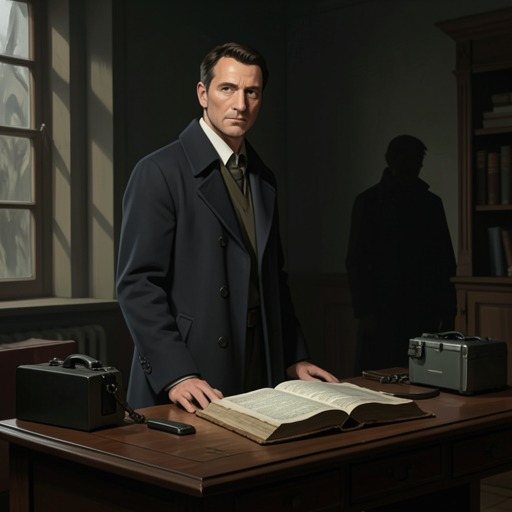
The Pale HorseThallium salts are the concealed instrument behind the deaths attributed to the Pale Horse’s mysterious methods. Their capacity to produce varied, misleading symptoms helps disguise poisoning as illness; the recurring loss of hair eventually gives Mark Easterbrook a clue that connects apparently separate cases and exposes the practical mechanism beneath the occult performance.
Properties and Uses
The investigation identifies thallium as a substance with both ordinary applications and lethal potential. Mark explains that it had once been used to remove hair, particularly for children with ringworm, before its danger became known. It remained in use as rat poison and could also be administered internally, though with careful dosage based on a patient’s weight. Mark further notes that it is tasteless, soluble, and easy to obtain. Those properties make it useful to a poisoner precisely because the substance need not announce itself in the victim’s food or drink, and a purchase need not be traced to the person who benefits from a death.
Its medical history also supplies an important clue. Because thallium had been used as a depilatory, the eventual loss of hair is not an unrelated symptom but a recognizable consequence of exposure. The clue is not immediately available as an explanation: the different illnesses reported in earlier cases conceal the common agent until the pattern is reconsidered.
Symptoms and Recognition
Mark’s deduction begins with a recurrence that initially looks like coincidence. In recounting a conversation with Ariadne Oliver, he hears how she connected Lady Hesketh-Dubois’s final illness and the loss of her thick white hair with Mary Delafontaine and the girl Mark had seen in a Chelsea coffee place. The girl’s hair had come away in handfuls during a fight; Ariadne’s point is that hair does not ordinarily pull out so readily by the roots. Her comparison turns a detail that Mark had previously misunderstood into a possible sign of disease shared by otherwise separate people.
When Mrs Dane Calthrop finds Mark staring at the telephone after Katherine Corrigan becomes ill, she treats the illness as evidence rather than accepting his hope that it is a simple cold. Mark initially resists her inference and insists on a commonplace explanation. The hair-loss pattern changes the weight of the evidence: once he learns that Katherine Corrigan’s hair is coming out by the roots in handfuls, he identifies thallium poisoning and fears that time may be short. The clue matters because it recurs across cases, not because any one symptom alone provides a complete diagnosis.
Mark supports his conclusion by recalling an article about earlier poisonings and by looking up the substance’s effects. He describes factory workers who died one after another under strikingly different diagnoses, including paratyphoid, apoplexy, alcoholic neuritis, bulbar paralysis, epilepsy, and gastro-enteritis. In another case, a woman poisoned seven people whose recorded diagnoses included brain tumour, encephalitis, and lobar pneumonia. Thallium’s symptoms may begin with diarrhoea and vomiting, intoxication, or pain in the limbs; they can be mistaken for polyneuritis, rheumatic fever, or polio, and one patient was placed in an iron lung. Skin pigmentation may also occur. This range of presentations explains how a shared poison could leave a trail of apparently unrelated illnesses rather than an obvious series of murders.
Use by the Pale Horse
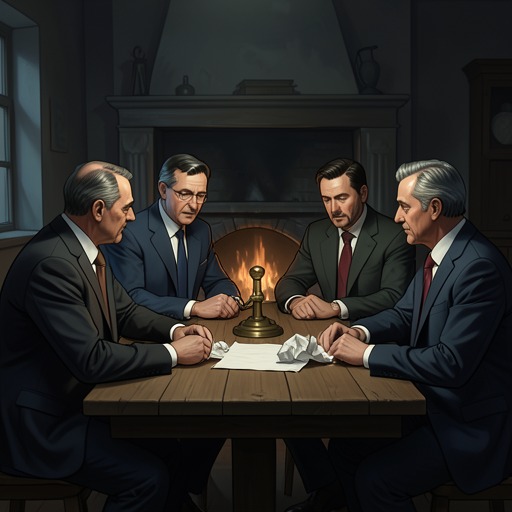
The poison also explains the Pale Horse’s rule that a client must stay away from the intended victim. As Inspector Lejeune reasons, if the client has no access to the victim’s food or drink and makes no purchase of poison, suspicion is less likely to fall on the person who ordered the death. The actual administration can be left to someone with no connection to the victim, who appears only once. The separation between client and poisoner is therefore not incidental: it is part of a method designed to prevent an ordinary investigation from finding a motive, an opportunity, and a purchase in the same person.
The apparent supernatural process thus functions as cover for a material act. When Mark explains the cause to Mr Venables, he distinguishes the claimed powers of Thyrza Grey, Sybil Stamfordis, and Bella from the straightforward fact of thallium poisoning. In his account, a pseudo-scientific and psychological setup, reinforced by superstition, distracts attention from the administration of poison. The ritual’s theatrical mystery and the poison’s ordinary, obtainable nature work in opposite directions: one encourages belief in extraordinary forces, while the other supplies a concealed practical cause.
Physical Evidence and Significance
The explanation becomes tangible at Priors Court. Lejeune tells Mr Venables that a packet of thallium is hidden in his potting shed and that investigators have examined some of it for testing. The discovery initially appears to implicate Venables, but the packet is revealed as planted evidence. Lejeune identifies Zachariah Osborne, a pharmacist formerly of Barton Street, Paddington, as the person who placed it there. Osborne had tried to cast Venables as the villain, not knowing of Venables’s disability, and then refused to admit his mistake. The packet therefore serves both as evidence of the poison’s availability and as part of Osborne’s attempt to misdirect suspicion.
Thallium salts mark the point where the investigation moves from a pattern of deaths and symptoms to a testable material explanation. Hair loss links illnesses that had received different diagnoses; the poison accounts for their variation; and the packet at Priors Court connects the method to a specific attempt to frame another person. The discovery does not validate the Pale Horse’s claimed occult power. It reveals how an accessible poison, medical confusion, distance between client and victim, and a staged atmosphere of supernatural influence combine to make murder appear inexplicable.