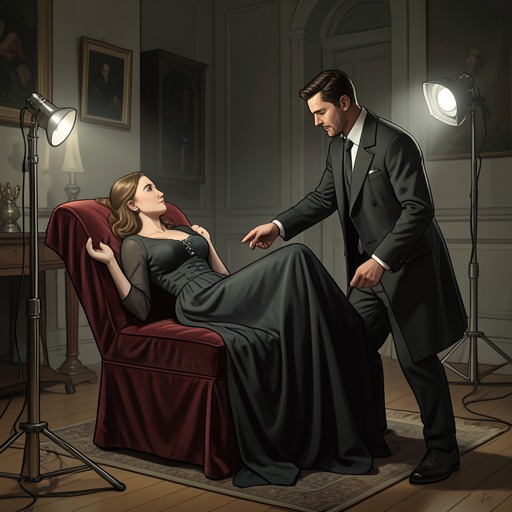
Thyrza Grey and Sybil Stamfordis's working partnership at the Pale Horse
The Pale HorseThyrza Grey and Sybil Stamfordis’s working partnership at the Pale Horse combines shared domestic life and occult practice with a marked division of temperament and role. Sybil is presented as Thyrza’s medium and spiritual collaborator; Thyrza, while insisting that Sybil has exceptional abilities, speaks of her with a skeptical, almost managerial frankness. Their association belongs to a wider team that includes Bella Webb, but Thyrza’s account makes clear that the women do not contribute in the same way.
Identity and Introduction
Sybil Stamfordis lives with Thyrza Grey and is known as the medium in their circle. Mrs Dane Calthrop introduces her as Thyrza’s friend and describes her as someone who wears beads and scarabs and sometimes a sari, although she has never been to India. The details establish Sybil’s conspicuously assembled occult persona before she appears in person: her clothes suggest a visual language of mysticism, but do not point to a coherent cultural background.
When Sybil comes through a door to join the visitors, Mark Easterbrook sees a tall, willowy woman with dark, rather greasy hair and a fluttering voice, wearing a bright emerald-green sari. Sybil’s manner and appearance help make the Pale Horse’s occult world visible, but they also sharpen the distinction between display and the abilities Thyrza claims lie beneath it. Sybil herself expresses affection for the old inn sign, saying it helped influence the women to buy the house. Their shared attachment to that emblem gives their household a common point of identification, even as their approaches to the supernatural differ.
Thyrza’s Account of Sybil
Thyrza warns Mark Easterbrook not to judge her by Sybil. She calls Sybil silly in some respects and says she combines voodoo, demonology, and black magic without distinguishing among them. Yet Thyrza does not dismiss her as a fraud. She describes Sybil as a first-class medium, a person able to act as a living bridge between the ordinary world and strange, uncanny powers. In Thyrza’s account, Sybil has never used the gift for money, and her ability is exceptional.
This assessment makes the relationship more complicated than a simple contrast between a credulous medium and a skeptical leader. Thyrza regards Sybil’s occult vocabulary as confused while treating her supposed mediumship as genuine. The distinction is hers: she claims the authority to separate Sybil’s mixture of beliefs from the power she believes it conceals. Sybil’s eccentricity does not disqualify her from the partnership; in Thyrza’s telling, it coexists with a talent that gives her a necessary place in it.
Thyrza also describes the women as having powers in different degrees and begins to characterize them as a team, grouping Sybil and Bella Webb with herself. The account makes the arrangement collective without making its members interchangeable. Sybil’s stated function is mediumship; Bella is separately identified as a witch and as the group’s cook. Thyrza’s description positions her as the person who names those distinctions and presents the group’s varied claims as parts of a coordinated whole.
A Shared Occult Identity
The women’s identities are also narrated through a deliberately mixed set of cultural and folkloric labels. Thyrza associates her own second sight with her Scottish father and her Irish mother. She identifies Sybil as their pythoness and says Sybil is of Greek extraction, while Bella represents Old English tradition. This is not a single, consistent doctrine so much as a composite identity: the group draws on several inherited or borrowed traditions to explain its members’ places in the enterprise.
The contrast between Thyrza’s classification and Sybil’s dress is telling. Sybil’s sari and occult accessories make her appearance conspicuously eclectic, while Thyrza supplies a more organized account of what each woman represents. That difference accords with Thyrza’s earlier criticism of Sybil’s tendency to mix occult systems indiscriminately. The partnership thus contains both the eclecticism Thyrza mocks and the more deliberate framework she uses to give the group coherence.
The village’s awareness of the women’s séances contributes to their shared public identity. When visitors enter the room where the séances are held, Thyrza acknowledges that local people know their business and that the group has acquired a sinister reputation. She treats that reputation briskly, as part of how the household is regarded, rather than as proof of any single supernatural claim. Sybil is one of the central figures in that reputation because she is known as the medium, but Thyrza is the person who explains and manages its meaning for outsiders.
Roles and the Séance Setting
A later séance scene gives a close view of Thyrza’s conduct, though it does not show Sybil participating. On a dark, overcast night, Mark Easterbrook follows Thyrza from the house to a converted barn with no entrance from the house itself. By day the barn had seemed a pleasant library; at night, indirect cold light, a raised divan covered in purple cloth and cabalistic signs, a brazier, and an old copper basin make it a space set apart from ordinary domestic life.
Thyrza’s manner changes there. Mark perceives a seriousness he compares to that of a surgeon preparing for a dangerous operation. She puts on a long overall made of metallic-looking woven material and fine-mesh gauntlets, explaining that precautions are necessary. The scene contrasts with Sybil’s fluttering manner and conspicuous costume: Thyrza’s authority is rendered through controlled movement, preparation, and practical safeguards, rather than through an elaborate personal display.
Thyrza argues that ritual can affect the human spirit even when an observer regards it as nonsense, comparing its force to the unexplained phenomenon of mass hysteria. Bella Webb brings in one of the White cockerels, and later Thyrza opens what had looked like a radio cabinet to reveal The machine used in the Pale Horse ritual, a complicated electrical contrivance. These details show the séance’s combination of inherited forms, theatrical staging, and modern equipment. They clarify the wider enterprise in which Sybil’s mediumship is said to operate, but they do not establish that Sybil takes part in this particular session.
Significance of the Partnership
The partnership’s defining tension is the gap between Sybil’s assigned spiritual function and Thyrza’s control over how that function is understood. Thyrza both diminishes Sybil’s judgment and affirms her exceptional gift; the same speaker who calls Sybil’s beliefs a confused mixture insists that her mediumship is real. The resulting portrait leaves room for genuine belief, performance, and organization to coexist without treating them as equivalent.
Their association also helps the Pale Horse present itself as more than the work of one occult personality. Sybil supplies the figure of the medium, while Thyrza describes a team of women with differentiated powers and presides over the practical conditions of the séance. The contrast between Sybil’s visible mysticism and Thyrza’s procedural seriousness makes the group’s authority feel at once theatrical and carefully managed. The narrative preserves Thyrza’s claims about Sybil as claims, while showing how the partnership’s shared identity is built through domestic proximity, public reputation, ritual, and the distribution of roles.