Witchcraft and occult powers
The Pale HorseWitchcraft and occult powers form a contested explanation for harm in the novel, suspended between folklore, performance, spiritual belief, and the possibility of real danger. Rather than offering one settled definition, conversations involving Ariadne Oliver, Thyrza Grey, Sybil Stamfordis, Bella Webb, and Mrs Dane Calthrop expose different ways of imagining the supernatural: as an old village superstition, an elaborate mixture of occult traditions, a genuine human capacity, or a vocabulary disguising more ordinary means. The question that persists beneath these accounts is whether someone can destroy another person without a visible connection.
From folklore to the possibility of remote harm
The subject first enters as a question from Ariadne Oliver, who is struggling to write and asks Mark Easterbrook whether it is possible to kill by remote control. She distinguishes the idea from science fiction and radioactive machinery, then identifies what she means as black magic. The distinction matters: the conversation moves away from technology that can be seen and tested toward an agency whose operation is difficult to verify. Ariadne dismisses wax figures and pins as an unsuitable explanation, but invokes stories about voodoo and juju in which people supposedly die after being acted upon at a distance. Her account is hearsay rather than proof, yet it establishes the possibility the other characters will debate.
A separate exchange gives witchcraft a recognizably English, domestic setting. Poppy is told that witches need not be spectacular figures: they might be quiet, ordinary older women living in rural villages. In the example, neighbors avoid offending such a woman and sometimes bring gifts, while misfortunes such as failed crops, cows ceasing to give milk, or a child’s accident are attributed to her displeasure. The belief works socially even without an openly stated threat. It offers an explanation for bad luck and gives the supposed witch influence through other people’s fear. This village model makes occult power less like a public display than an unspoken arrangement of caution and accommodation.
The Pale Horse circle and its different claims
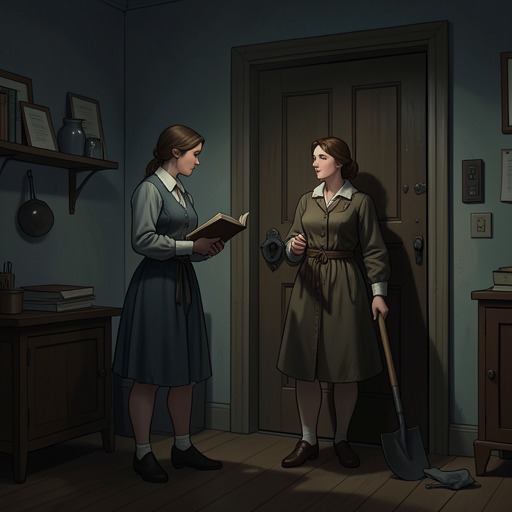
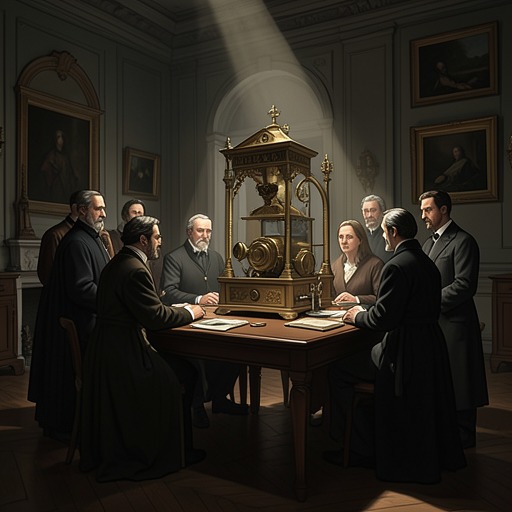
At tea with Thyrza Grey, the conversation turns from general folklore to a specific group. Thyrza is described as interested in spiritualism, trances, and magic. Sybil Stamfordis is identified as her friend and a medium; Bella Webb, their cook, is said by Mrs Dane Calthrop to have a reputation for witchcraft in Little Dunning, inherited within her family. The details place different kinds of occult practice alongside one another: mediumship, ritual interest, and village witchcraft. Mrs Dane Calthrop gives the account matter-of-factly, but the people hearing it do not respond as if all of these claims have been established.
Sybil presents her own history as evidence of unusual ability. She says that, even as a child, automatic writing came naturally to her: she would sit with a pencil without knowing what was happening. She also describes herself as unusually sensitive and recalls fainting in a room where, she later learned, a murder had taken place twenty-five years earlier. The anecdote is offered with satisfaction, as an instance in which her response seemed to anticipate hidden knowledge. It remains Sybil’s interpretation of her experience, not independent confirmation, and the polite distaste of the listener underscores the gap between her certainty and the skepticism around her.
Her account of travel gives that personal history a larger frame. Sybil says she explored yoga in India but found it too sophisticated for what she sought: primitive powers and their beginnings. She describes Haiti as a place where she encountered what she calls the original springs of the occult, although she also acknowledges corruption and distortion. She recounts being told that the child born after twins has special powers, connecting that belief to her own birth after older twin sisters. Her description of death dances emphasizes their theatrical apparatus, including skulls, crossbones, gravedigger’s tools, and undertakers’ clothing; she also names Baron Samedi and Legba. In her presentation, performance and belief are inseparable, but the elaborate imagery does not persuade everyone listening.
Thyrza’s distinction between display and power
Thyrza objects to treating occult belief as nothing more than superstition, fear, or religious prejudice. She argues that elemental truths and powers may persist beneath the explanations people place over them. At the same time, she is sharply critical of Sybil’s account. She describes Sybil as mixing voodoo, demonology, and black magic into an indiscriminate whole, calling much of its presentation ridiculous. Yet Thyrza does not conclude that the underlying capacity is false. She insists that Sybil has power and calls her an exceptional medium, a person able to act as a living bridge between the ordinary world and uncanny forces. She adds that Sybil has never used the gift for money, distinguishing her claimed ability from a simple commercial performance.
Thyrza also includes Bella in this account of shared but unequal abilities. She says that she, Sybil, and Bella possess powers in different degrees and presents them as a team. This claim changes the emphasis from individual eccentricity to cooperation: the group is described as combining distinct capacities. The evidence offered in the conversation does not independently establish what those capacities can accomplish, so Thyrza’s confidence remains a claim to be weighed against the doubts voiced by others.
Love, death, and modern methods
For Thyrza, the history of occult practice reduces to two urgent human desires: love and death. Rituals, invocations, and patterns, she argues, are outward trappings; the practical truth behind a love potion is the substance that produces its effect. This explanation both demystifies and preserves the occult. It strips ceremony of its apparent supernatural necessity while suggesting that the ceremony can conceal an effective operation. Her account therefore shifts attention from the spectacle of magic to the means beneath it.
Death, she says, has always been the more substantial trade. She contrasts the famous poisons associated with the Borgias with ordinary white arsenic, claiming that the old, dramatic reputation concealed a commonplace substance. But she also insists that the present has moved beyond such poisons: science has enlarged what can be done, and she dismisses conventional poisoning as outmoded. Her remarks link occult language to modern possibility without explaining the new methods she implies. The result is a tension between ritual’s antique surface and an unsettling claim that contemporary knowledge has expanded the means of causing death.
Skepticism without easy dismissal
Mrs Dane Calthrop offers the most carefully qualified account. She warns Mark Easterbrook that people who boast about wickedness may be less dangerous than those who keep quiet, and observes that village witchcraft can be a petty way to frighten neighbors and obtain favors. A supposed curse may gain force because ordinary misfortunes are interpreted as its fulfillment. Yet she does not reduce every case to that mechanism. Bella might be only a village figure exploiting fear, she suggests, but might also belong to something older and genuinely malevolent. She likewise considers Sybil foolish in many respects while accepting that Sybil may truly be a medium; Thyrza’s nature remains uncertain to her.
That range of judgments keeps the idea of occult power unsettled. Ariadne begins with stories of distant death; Thyrza separates theatrical superstition from what she regards as genuine ability; Sybil treats personal experience and ritual knowledge as evidence; and Mrs Dane Calthrop distinguishes ordinary manipulation from the possibility of something more troubling. When she asks whether a human being could destroy another from a distance, the question gathers these competing explanations into one unresolved problem. Witchcraft in these conversations is neither simply disproved nor confirmed: its force lies in the space between visible evidence, belief, social fear, and the modern possibility of concealed harm.