Zachariah Osborne's exposure and arrest
The Pale HorseZachariah Osborne’s exposure and arrest brings the investigation’s apparently supernatural deaths back to an ordinary, carefully engineered crime. At Priors Court, Divisional Detective-Inspector Lejeune turns Osborne’s false identification of Mr Venables against him: the chemist’s supposedly decisive witness account was not merely wrong, but a fabrication that concealed Osborne’s own pursuit and murder of Father Gorman. The revelation also explains how the Pale Horse operation used consumer research and impersonated workers to replace familiar household products with poison.
The visit to Priors Court
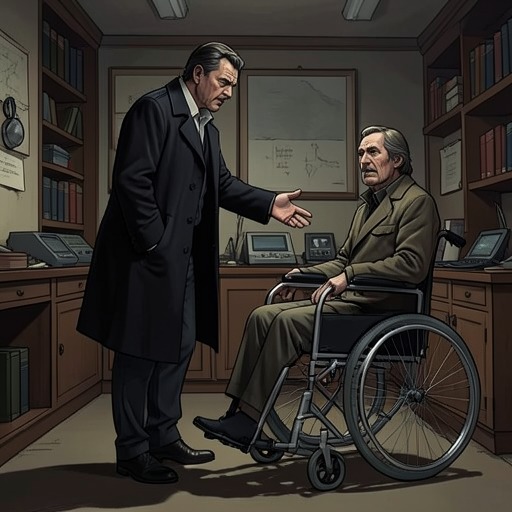
Some three weeks after Lejeune had promised that the police would pursue every available lead, a car arrived at Priors Court. Four men got out: Mark Easterbrook, Divisional Detective-Inspector Lejeune, Detective-Sergeant Lee, and Osborne. Osborne was plainly delighted to have been included in the party, an eagerness that Lejeune immediately checked by telling him to hold his tongue.
The group’s approach to Mr Venables was framed as a request for assistance. Lejeune reminded him that Father Gorman had been murdered in West Street, Paddington, on October 7, and said that Venables might have been nearby between 7:45 and 8:15 that evening. Venables denied being in the district, adding that he did not think he had been in London at all. This exchange placed Osborne’s identification before the man he had accused, while giving Lejeune the opportunity to test the accusation against the rest of the evidence.
The case against Osborne had begun with his own claim to have seen a man following Father Gorman. His description was unusually specific: he spoke of a tall, very thin man with sloping shoulders, long hair beneath a Homburg, a prominent nose, and a conspicuous Adam’s apple. Lejeune initially recognized that such a detailed account might come from an unusually accurate observer. But the description also raised a question about the conditions under which Osborne said he had seen the figure.
The witness account turns suspect
Lejeune later explained that Osborne’s certainty was what made him worth questioning. The night was foggy, and Lejeune had gone to Osborne’s shop and stood where the chemist claimed to have stood. From that position, a figure across the street seemed too indistinct for a witness to make out so many features. Osborne supplied an explanation: the fog cleared in patches, and at one such moment he saw Father Gorman and the man behind him. The follower, he said, had flicked on a lighter to relight his cigarette, briefly showing his profile.
That account contained a detail Lejeune considered impossible to observe from Osborne’s stated position. A profile might have made the nose visible, but the Adam’s apple was too precise a feature for the distance and visibility Osborne described. The overconfident detail did not establish that he had seen the killer; it suggested that the scene he described was not the scene he had witnessed. Lejeune’s suspicion had started when Osborne responded to the police appeal with a palpable lie, and the lie drew attention to a man who seemed unusually eager to make himself important.
Osborne’s insistence on identifying Venables also gave the accusation a practical purpose. At Priors Court, Lejeune disclosed that Osborne had planted a packet of thallium salts in Venables’s potting shed, apparently trying to make him appear guilty. Osborne had selected a man he believed could serve as the villain in his story without knowing that Venables was disabled. His attempt to make the evidence point elsewhere thus furnished a further, concrete link between his false identification and the poisoning plot.
Lejeune explains the operation
Rather than treating the deaths as the effect of Thyrza Grey’s claims, Sybil Stamfordis’s trances, or Bella’s rituals, Lejeune gave Venables the direct explanation: the cause was thallium poisoning. He then described a scheme divided among distinct roles. A disbarred solicitor, Mr Bradley, handled its financial arrangements from an office in Birmingham. Prospective clients visited him and entered a bet on whether a chosen person would die within a stated period. Bradley, who liked wagering, generally predicted death; the client generally hoped to win. If Bradley won, the client had to pay promptly or risk unpleasant consequences.
The client next visited the Pale Horse, where Thyrza and her associates staged a display intended to impress and frighten. The performance gave an occult appearance to a process whose practical mechanism lay elsewhere. Lejeune’s account made the show part of the criminal arrangement, not proof that the group could kill by supernatural means.
The route to a victim began with questionnaires distributed by women employed in legitimate consumer-research work. They received lists of people in a particular neighbourhood and asked about their preferences and purchases. The questions ranged across ordinary goods: cereals, cake mixes, soap flakes, detergents, cosmetics, medicines, aspirin, cough pastilles, sleeping pills, and remedies for common complaints. The inquiries seemed desultory rather than directed toward a coherent research question. They did not ask for samples, or for descriptions of homes, locks, or residents’ schedules; that absence made burglary reconnaissance an inadequate explanation. Their concealed use was to establish which familiar products a prospective victim used.
Once the target’s habits were known, the scheme’s originator could approach under a plausible working identity: as a mansion-flat porter, a gas or electricity meter reader, a plumber, an electrician, or another workman. He carried credentials that appeared proper if anyone asked to see them. While apparently checking meters, pipes, or water pressure, he substituted a preparation for a similar household product that the victim regularly used. After making the substitution, he left and did not return to that neighbourhood. The victim might remain well for several days; when illness appeared, neither the patient nor the doctor had an obvious reason to suspect a familiar proprietary product taken for years.
False identification and exposure
Lejeune explained that the police had ways to confirm a suspected person’s movements and disguises, including concealed photography. They had obtained pictures of a uniformed flat porter, a gas man, and other apparent workers. Disguises such as false moustaches or different dentures had not prevented recognition: Katherine Corrigan, then using the alias Mrs Mark Easterbrook, and Edith Binns had both recognized the man.
Lejeune then turned Osborne’s accusation around. Osborne had not been standing outside his shop watching a follower across the street. He had been across the street himself, following Father Gorman until the priest turned into West Street; Osborne caught up with him there and killed him. The detailed description that once seemed to mark Osborne out as an exceptional witness now served as a clue to the lie and a means of exposing his role in the murder.
Osborne reacted with disbelief and anger. When Lejeune introduced him to Mr Venables as Zachariah Osborne, the pharmacist formerly of Barton Street, he told Venables that Osborne had planted the thallium salts in the potting shed. Osborne protested that he had done more than Lejeune understood, but Lejeune treated the outburst as the response of a man whose efforts to be clever had failed. He began to warn Osborne that anything he said would be taken down; at that point, Osborne began to scream. The scene ends with the accusation publicly reversed and the formal arrest procedure beginning, rather than with Osborne making a confession.
Significance
The exposure resolves the central contradiction between the Pale Horse’s theatrical claims and the deaths attributed to it. The rituals helped persuade clients that a hidden power was at work, while questionnaires, access to household routines, and a worker’s disguise supplied a physical method of poisoning. The ordinary familiarity of the substituted goods was itself a protection: patients and doctors had little reason to suspect the products victims had used before.
Osborne’s part in the case also shows how his appetite for recognition became a liability. He volunteered a detailed account that seemed to make him an invaluable witness, but his excessive certainty invited Lejeune to examine what the fog, distance, and momentary light could actually have allowed him to see. His effort to redirect suspicion toward Venables, including planting poison in the potting shed, made the false story more elaborate without making it more credible. At Priors Court, the apparent witness is exposed as the murderer, and the supposed occult mechanism gives way to a comprehensible criminal system.