Zachariah Osborne, the retired chemist
The Pale HorseZachariah Osborne, the retired chemist, first enters the investigation as a seemingly useful witness: the proprietor of a chemist’s shop who says he saw a man following Father Gorman on the night of the murder. His unusually detailed description and emphatic confidence initially promise a rare, dependable identification. But the very precision that distinguishes his account also makes it suspect. Tested against the fog and the distance across the street, it becomes the first sign that Osborne’s desire to be important has become dangerous. His professional setting, his appetite for recognition, and his invented certainty converge in a character who turns the promise of expertise into a weapon of concealment.
Identity and ambitions
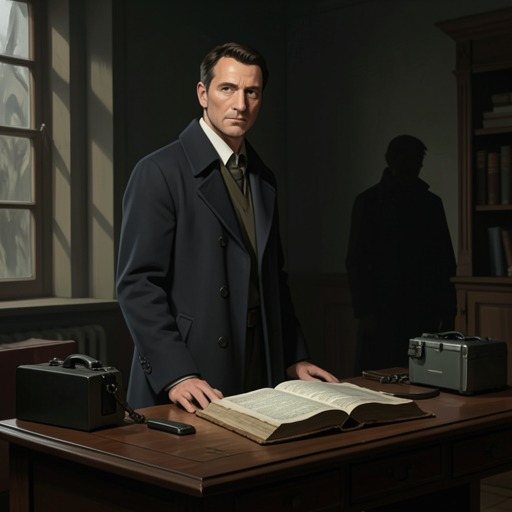
Osborne is introduced at his chemist’s shop on the corner of Barton Street. He is small and middle-aged, with a bald, domed head, a round face, and glasses. When Inspector Lejeune comes to question him, Osborne draws him through the dispensing area into a small private room, closes the curtain behind them, and leans forward with evident excitement. The staging makes the interview feel like a confidence, but it also shows how eagerly Osborne takes possession of the occasion: the murder inquiry gives him the audience he has long wanted.
His interest in murder is not merely professional. Osborne says he has always hoped that a murderer would come into his shop to buy poison, allowing him to identify the customer at trial. He presents remembering faces as a personal hobby and assures Inspector Lejeune that he would recognize the man he saw. The boast is revealing in two directions. It explains why Osborne is so ready to supply an elaborate account, while foreshadowing the distance between his imagined role as a celebrated witness and the criminal role he has actually chosen.
Inspector Lejeune later describes a man who had tried his fortunes on the stage before returning to his father’s old-fashioned business. In Lejeune’s assessment, Osborne had wanted to be more important than he was and was unlikely to accept direction. His ambition to identify a poison buyer may have been genuine, Lejeune allows, but it was also a model of importance that Osborne could eventually invert: instead of helping expose a murderer, he could become a criminal who believed himself too clever to be caught.
The witness account and its contradictions
Osborne says the man following Father Gorman was tall, perhaps five feet eleven inches to six feet, very thin, with sloping shoulders, long hair beneath a Homburg, a prominent nose, and a pronounced Adam’s apple. He estimates the man’s age at about fifty, judging partly from his walk, and explains that he saw him in profile. The description sounds specific enough to carry authority. Inspector Lejeune considers whether it might be a fanciful portrait, but finds that it lacks the implausible, melodramatic traits common to imagined descriptions of murderers. For a time, the detail leaves open the possibility that Osborne is an unusually observant witness.
That confidence is weakened by the conditions of the sighting. It was a foggy night, and Inspector Lejeune visits the spot where Osborne says he stood, looking across the street himself. From there, he doubts that a witness could have made out so much. Osborne answers that the fog came in patches and cleared just as Father Gorman and the follower passed. He adds a more precise circumstance: when the second man was abreast of the shop, he flicked on a lighter to relight his cigarette, briefly illuminating his profile. Osborne says this made the nose, chin, and Adam’s apple clear to him.
The explanation makes the account sound more convincing on its surface, but it does not resolve the central difficulty. As Inspector Lejeune later observes, an aquiline nose might have been visible in profile across the street; the Adam’s apple was too much to claim under those conditions. Osborne had communicated after police appealed for anyone who had seen Father Gorman that night, and his statement, in Lejeune’s judgment, was a palpable lie. A confident identification, therefore, is not the same as a reliable one: the account’s detail gives the deception its persuasive shape, while the viewing conditions expose its limits.
From suspect witness to criminal
Osborne writes to Inspector Lejeune from Everest, Glendower Close, Bournemouth, saying that he had kept watch around his establishment but had not seen the follower again. The letter sustains the pose of a cooperative witness, one who remembers the police request and remains alert to the possibility of a new sighting. In retrospect, however, the contrast is telling: Osborne is willing to maintain his involvement in the investigation, but the information he first supplied is precisely what turns attention toward him.
Inspector Lejeune does not treat the impossible detail as proof of guilt on its own. He recognizes that Osborne might simply have wanted to make himself important, as many people do. But the lie makes Lejeune examine the witness rather than only the supposed follower. Osborne’s eagerness to talk about himself supplies a portrait of frustrated ambition, and his claim to be able to identify a poison buyer acquires a darker significance once the investigation exposes his criminal role. The path to suspicion is thus cumulative: first the implausible certainty, then the account of how he supposedly saw the man, and finally the character Osborne reveals when given room to perform.
The broader investigation also gives his occupation a grim resonance. The symptoms eventually discussed in connection with the poisonings vary widely and can be mistaken for unrelated illnesses; hair loss is the recurring clue that brings those cases together. Thallium is described as tasteless, soluble, and readily obtainable, while poisoning must not be suspected for the method to succeed. Osborne’s criminal method uses substituted everyday products to deliver poison, making ordinary use part of the concealment. His shopkeeper’s authority and familiarity with poison sit uneasily beside the investigation’s central problem: victims can appear to have died from different causes even when a shared agent links them.
Exposure and narrative significance
Osborne’s importance lies in the reversal of his hoped-for identity. He imagines himself as the memorable witness who will recognize a murderer in court; instead, the effort to claim that role helps Inspector Lejeune recognize him as a suspect. His boast about never forgetting a face is especially ironic beside the weakness of his own account: the issue is not simply whether he remembers, but whether he could have observed what he claims to remember at all.
The investigation’s movement from apparent supernatural influence toward material explanation further sharpens that reversal. When Ginger becomes ill, Mark Easterbrook initially resists treating the illness as evidence, while Mrs Dane Calthrop insists that it must be taken seriously. Later, the remembered cases of hair falling out, including Lady Hesketh-Dubois’s illness and Mary Delafontaine’s, give the symptom pattern new force. Mark recalls that he had read of thallium poisoning causing deaths attributed to varied diagnoses. These clues explain how a poison could hide behind illness; they do not make Osborne’s original witness statement sounder. Rather, his credentials as a chemist and his false claim about the foggy-night sighting meet in the same plot: knowledge that might identify poison becomes part of a scheme designed to keep poisoning unsuspected.
Osborne is ultimately exposed and arrested, completing the change from self-appointed observer to observed criminal. His case gives the inquiry a practical counterweight to claims of occult power: the apparent mystery can be examined through symptoms, access to poison, and the ordinary objects through which it is delivered. At the same time, his false testimony shows how easily confidence can mimic evidence. The investigation succeeds not by accepting the most vivid account, but by testing what a witness could actually have seen and following the discrepancies toward their source.